Understanding the complex web of regulations governing political contributions and spending is essential for anyone following U.S. presidential elections. Campaign finance laws shape how candidates raise money, who can contribute, and how those funds can be spent. With presidential campaigns regularly spending billions of dollars, these regulations play a crucial role in determining electoral outcomes and maintaining transparency in the democratic process. Whether you're a political observer, voter, or researcher, having campaign finance laws explained in clear terms helps you understand the financial mechanics behind presidential races.
The Foundation of Federal Campaign Finance Regulation
The Federal Election Commission (FEC) serves as the primary regulatory body overseeing campaign finance at the federal level. Established in 1975, the FEC enforces contribution limits, monitors spending, and ensures campaigns comply with disclosure requirements. The agency's jurisdiction covers presidential campaigns, congressional races, and political action committees operating in federal elections.
Federal campaign finance law rests on several key principles. Transparency requires campaigns to report contributions and expenditures publicly. Contribution limits prevent any single donor from exerting disproportionate influence. Source restrictions determine which entities can legally contribute to campaigns. These foundational elements work together to balance First Amendment rights with the public interest in preventing corruption.
Key Legislative Milestones
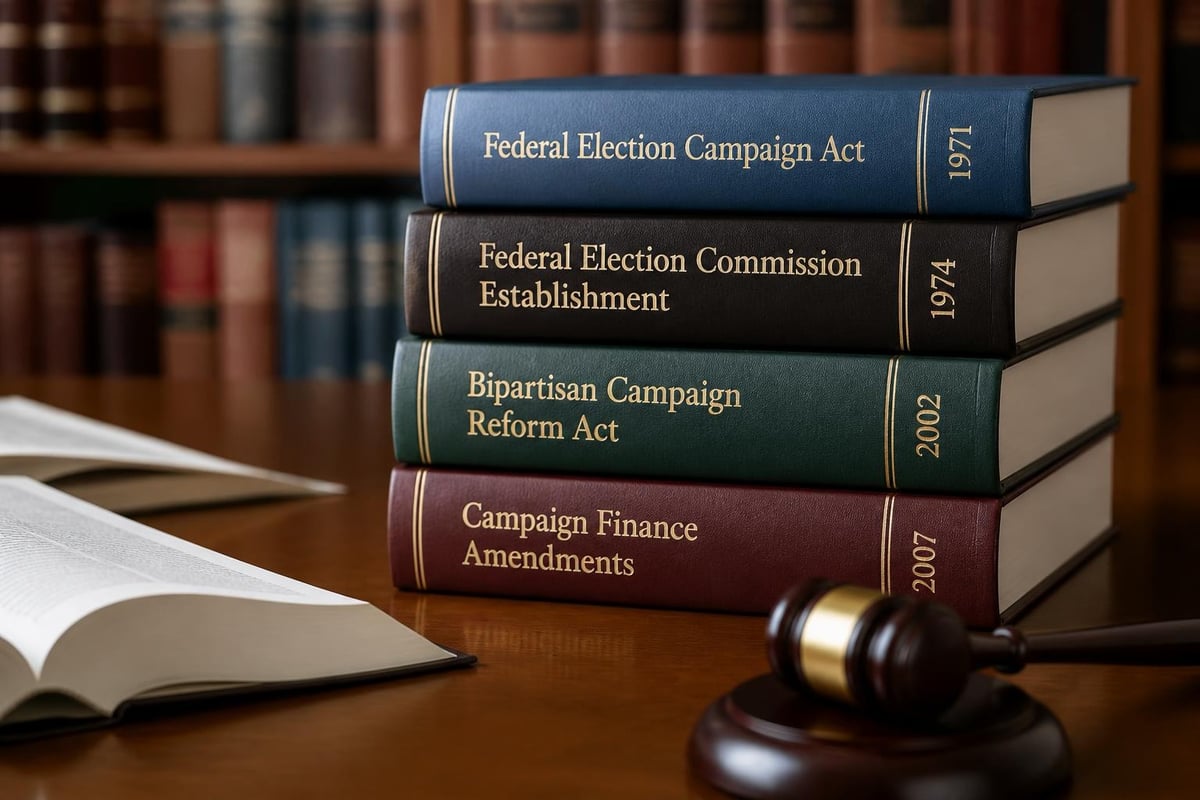
Campaign finance regulation evolved through major legislative acts over the past century:
- Federal Election Campaign Act (FECA) of 1971: Established comprehensive disclosure requirements and spending limits
- FECA Amendments of 1974: Created the FEC and imposed contribution limits after Watergate
- Bipartisan Campaign Reform Act (BCRA) of 2002: Banned soft money and regulated issue advertisements
- Honest Leadership and Open Government Act of 2007: Enhanced disclosure and restricted lobbyist contributions
Each legislative update responded to emerging loopholes or political scandals, attempting to close gaps in previous regulations.
Contribution Limits and Restrictions
Campaign finance laws explained in practical terms require understanding who can give, how much, and to whom. The FEC establishes biennial contribution limits that adjust for inflation. For the 2025-2026 election cycle, individual donors can contribute up to $3,300 per election to a presidential candidate. The primary and general elections count as separate elections, effectively doubling this limit.
Different recipient types face varying contribution caps. National party committees can receive up to $41,300 annually from individual donors. Political action committees (PACs) accepting contributions from multiple donors can give $5,000 per election to candidates. These limits prevent wealthy individuals from dominating the fundraising landscape.
| Contributor Type | Presidential Candidate (per election) | National Party Committee (annual) | PAC (annual) |
|---|---|---|---|
| Individual | $3,300 | $41,300 | $5,000 |
| Multicandidate PAC | $5,000 | $15,000 | $5,000 |
| National Party Committee | $5,000 | N/A | $5,000 |
Prohibited Contributors
Federal law categorically bans certain entities from contributing to presidential campaigns. Foreign nationals cannot contribute money, volunteer services, or make independent expenditures. Corporations and labor unions cannot contribute directly from their treasuries to candidate campaigns, though they can establish separate segregated funds (PACs) using voluntary employee or member contributions.
Government contractors face restrictions during active contract negotiations and performance periods. These prohibitions aim to prevent quid pro quo arrangements and foreign interference in American elections. The Official Federal Election Commission campaign guide for political party committees provides comprehensive details on these compliance requirements.
Super PACs and Independent Expenditures
The landscape of campaign finance laws explained must address the significant impact of the 2010 Citizens United v. FEC Supreme Court decision. This ruling fundamentally altered how independent groups can spend money in elections. The Court held that independent political expenditures constitute protected speech under the First Amendment, prohibiting limits on such spending by corporations, unions, and associations.
Following Citizens United, Super PACs emerged as dominant players in presidential elections. Unlike traditional PACs, Super PACs can raise unlimited funds from individuals, corporations, and unions. However, they cannot contribute directly to candidates or coordinate with campaigns. This creates a legal distinction between express advocacy and independent expenditures.

The Rise of Dark Money
Citizens United also enabled increased "dark money" in politics through 501(c)(4) social welfare organizations and 501(c)(6) trade associations. These groups can engage in political activity without disclosing donors, provided politics isn't their primary purpose. The Brennan Center’s research-backed analysis of Citizens United details how these organizations exploit regulatory gaps to shield contributor identities.
Presidential campaigns increasingly rely on networks of allied Super PACs and dark money groups. While legally prohibited from coordinating, campaigns and independent groups often share consultants, talking points, and strategic priorities through careful legal maneuvering. Critics argue this undermines contribution limits, while supporters defend it as protected political speech.
Disclosure and Transparency Requirements
Campaign finance laws explained wouldn't be complete without examining reporting obligations. Federal campaigns must file regular disclosure reports with the FEC detailing contributions received and expenditures made. Presidential campaigns file monthly reports during election years and quarterly reports in off-years.
Disclosure reports must identify contributors giving more than $200 in aggregate during an election cycle. This includes the donor's name, address, occupation, and employer. The itemization threshold ensures public scrutiny of significant contributions while reducing administrative burden for small donations.
The FEC maintains a searchable database of all campaign finance reports, making contribution and spending data publicly accessible. Journalists, researchers, and voters regularly use this data to track money in presidential elections. You can explore how these financial disclosures reveal patterns in presidential election campaigns and political dynamics.
Real-Time Disclosure Rules
Presidential campaigns must report contributions of $1,000 or more received within the final 20 days before an election within 48 hours. This "48-hour notice" requirement prevents last-minute contributions from escaping public scrutiny before voters head to the polls. Super PACs face similar disclosure requirements for large contributions received close to elections.
Independent expenditure communications must identify their funding sources through disclaimers. Television ads must include audio and visual "stand by your ad" statements. Print and online communications must clearly identify the paying entity. These requirements help voters evaluate the credibility and motives behind political messaging.
Public Financing of Presidential Campaigns
The Presidential Election Campaign Fund offers public financing to qualifying candidates who agree to spending limits. Taxpayers can designate $3 of their federal taxes to this fund through a checkbox on tax returns. The program aims to reduce candidate dependence on large donors and level the playing field.
Primary candidates who raise $5,000 in contributions of $250 or less in at least 20 states can receive matching funds for the first $250 of each individual contribution. General election nominees who accept public funding receive a flat grant and cannot raise additional private contributions for the general election.
However, public financing has declined dramatically in presidential races. No major party nominee has accepted public funding for the general election since 2008. The spending limits accompanying public funds have become unrealistic given modern campaign costs, making private fundraising far more attractive despite the restrictions involved.
| Election Year | Democratic Nominee | Republican Nominee | Public Funding Accepted? |
|---|---|---|---|
| 2008 | Barack Obama | John McCain | McCain only |
| 2012 | Barack Obama | Mitt Romney | Neither |
| 2016 | Hillary Clinton | Donald Trump | Neither |
| 2020 | Joe Biden | Donald Trump | Neither |
| 2024 | TBD | TBD | Expected: Neither |
State-Level Campaign Finance Regulations
While federal laws govern presidential campaigns, state regulations significantly impact presidential primaries and delegate selection. Each state establishes its own contribution limits, disclosure requirements, and enforcement mechanisms for state and local elections. Some states impose stricter limits than federal law, while others have minimal restrictions.
State laws affect presidential campaigns through primary election administration and delegate allocation. Candidates must navigate varying registration deadlines, filing requirements, and compliance obligations across all 50 states plus territories. This patchwork regulatory environment complicates campaign finance management for presidential candidates.
Several states have enacted their own public financing programs for state offices. These experiments provide laboratories for democracy, testing approaches like clean elections programs and democracy vouchers. Lessons learned from state programs inform ongoing debates about federal campaign finance reform.
Enforcement and Penalties
The FEC enforces campaign finance laws through audits, investigations, and civil penalties. The agency operates under a bipartisan structure with six commissioners, no more than three from the same party. This design aims to prevent partisan enforcement but often results in deadlock on controversial matters.
Violations can result in substantial fines. Campaigns that exceed contribution limits, fail to disclose donors, or coordinate with Super PACs face monetary penalties proportional to the violation's severity. Knowing violations or willful circumvention of regulations can lead to criminal prosecution by the Department of Justice.
The FEC's enforcement capacity has faced criticism from multiple directions. Reform advocates argue the agency lacks sufficient resources and authority to police modern campaigns effectively. Others contend aggressive enforcement infringes on political speech rights. The FEC’s updates about Citizens United show how Supreme Court decisions constrain regulatory authority.
Compliance Challenges for Presidential Campaigns
Presidential campaigns employ dedicated compliance staff and outside counsel to navigate complex regulations. The scale and speed of modern campaigns create numerous compliance risks. Processing thousands of daily contributions, vetting donors against prohibited categories, and maintaining accurate records requires sophisticated systems and procedures.
Common compliance issues include:
- Accepting contributions that exceed legal limits
- Failing to properly identify and report bundlers
- Inadequate screening of prohibited contributors
- Missing filing deadlines for disclosure reports
- Improper use of campaign funds for personal expenses
Effective compliance programs combine technology, training, and oversight. Campaigns use specialized software to track contributions, flag potential violations, and generate required reports. Regular staff training ensures everyone understands regulations affecting their responsibilities.
The Role of Bundlers and Fundraisers
Bundlers collect contributions from multiple donors and deliver them to campaigns as a package. While individual contributions remain subject to limits, bundlers help campaigns efficiently raise large sums. Presidential campaigns particularly value bundlers who can deliver six or seven-figure hauls from their networks.
Campaign finance laws explained in the context of bundling require understanding disclosure rules. Campaigns must identify individuals who bundle more than $18,300 during an election cycle, listing them as "lobbyist/registrants" or other bundlers on disclosure reports. This transparency helps voters and journalists track influence networks.
Some bundlers are registered lobbyists seeking access to future administrations. Others are wealthy individuals, corporate executives, or community leaders supporting aligned candidates. The bundling system effectively multiplies individual contribution limits by leveraging social and professional networks. Critics argue this creates a donor class with disproportionate influence despite contribution caps.
Recent Developments and Reform Proposals
Campaign finance laws explained for 2026 must address ongoing legal and legislative developments. Recent FEC advisory opinions and court decisions continue reshaping the regulatory landscape. Cryptocurrency contributions, digital advertising disclosure, and foreign influence campaigns present emerging challenges for election regulators.
Reform proposals span the political spectrum. Some advocate for stricter contribution limits, enhanced disclosure requirements, and public financing expansion. Others propose eliminating contribution limits entirely in favor of instant disclosure and market-based solutions. The Congressional Research Service analyses on campaign finance policy provide nonpartisan context for these debates.
Constitutional constraints limit reform options following Citizens United and subsequent decisions. Any reforms must respect First Amendment protections for political speech and association. This constitutional framework shapes realistic reform possibilities while ongoing litigation continues testing existing regulations.
Technology and Transparency
Modern technology enables unprecedented transparency in campaign finance. Real-time FEC data feeds, sophisticated analysis tools, and data journalism have democratized access to contribution information. Voters can easily research who funds presidential candidates and how campaigns spend money.
However, technology also facilitates new evasion methods. Digital advertising allows micro-targeted messaging with minimal disclosure. Cryptocurrency contributions complicate identity verification. Social media coordination between campaigns and outside groups occurs in gray legal zones. Regulators struggle to keep pace with innovation in political finance and communication.
Understanding these dynamics helps readers of U.S. Presidential Report contextualize campaign finance stories and evaluate candidate fundraising strategies. Following the money remains essential for comprehending presidential politics and assessing candidate viability.
Impact on Presidential Elections
Campaign finance laws profoundly shape presidential race dynamics. Fundraising ability often determines candidate viability before any votes are cast. Candidates who cannot raise sufficient funds struggle to build campaign infrastructure, hire staff, and reach voters through advertising.
The regulatory framework advantages certain candidate types. Wealthy self-funding candidates can bypass contribution limits by investing personal fortunes. Candidates with access to bundler networks and major donor communities enjoy structural advantages over grassroots-focused opponents. These financial dynamics interact with media coverage, polling, and momentum to determine electoral outcomes.
Presidential primary fundraising serves as a winnowing mechanism. Candidates unable to meet arbitrary fundraising thresholds for debate participation often withdraw early. The "invisible primary" of fundraising before Iowa and New Hampshire effectively narrows the field before most voters engage. This raises questions about whether campaign finance laws explained support or undermine democratic participation.
Recent presidential cycles have shown both traditional fundraising dominance and grassroots disruption. Small-dollar online fundraising has enabled candidates to compete without major donor support. Simultaneously, Super PAC spending has reached unprecedented levels, sometimes exceeding candidate campaign expenditures. These countervailing trends create an unstable equilibrium in presidential campaign finance.
Campaign finance laws create the financial rules and transparency requirements that govern how presidential candidates raise and spend campaign funds in federal elections. Understanding these regulations provides essential context for evaluating candidate fundraising strategies, identifying influence networks, and assessing the health of democratic processes. For comprehensive, non-partisan coverage of presidential campaigns and the financial dynamics shaping elections, U.S. Presidential Report delivers the latest news and analysis you need to stay informed about current and past U.S. Presidents.