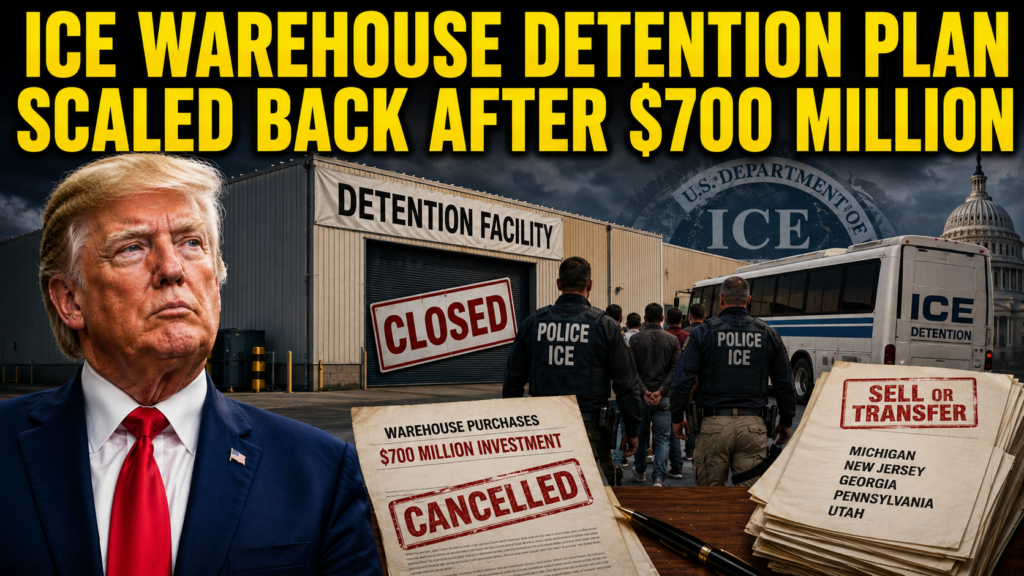
Immigration and Customs Enforcement (ICE) is reversing course on a major detention expansion initiative after spending more than $700 million on warehouse acquisitions intended to support President Donald Trump’s immigration enforcement agenda. The decision marks a significant shift in how the agency plans to increase detention capacity as it continues pursuing large-scale deportation efforts.
What Happened
According to a report by The New York Times, ICE plans to sell or transfer seven warehouses it purchased as part of a broader effort to expand immigration detention space.
The warehouses were originally acquired to help support the Trump administration’s mass deportation strategy by dramatically increasing the number of detention beds available across the country.
Over the past year, ICE purchased 11 warehouse facilities at a cost approaching $1 billion. However, agency officials are now moving to offload most of those properties, either by transferring them to other federal agencies or selling them outright.
Key Details of the ICE Warehouse Initiative
Original Goal: Expand Detention Capacity
The warehouse acquisition program was designed to address one of ICE’s biggest operational challenges: detention space.
Officials believed empty industrial facilities could be converted into processing and detention centers capable of housing thousands of migrants awaiting immigration proceedings or deportation.
The strategy was intended to accelerate removals while reducing dependence on privately operated detention facilities.
Warehouses Targeted for Sale or Transfer
Documents cited in the report indicate that ICE intends to dispose of facilities located in:
- Michigan
- New Jersey
- Georgia
- Pennsylvania
- Utah
The agency is expected to continue pursuing detention projects at a limited number of locations in Texas, Arizona, and Maryland, although some of those projects have also faced legal challenges.
Why ICE Is Changing Course
Legal Challenges and Environmental Lawsuits
One of the biggest obstacles facing the warehouse initiative has been litigation.
Several lawsuits argue that ICE failed to conduct required environmental reviews before moving forward with detention facility conversions.
Federal judges have already blocked or delayed work at certain locations while courts evaluate whether the agency complied with environmental regulations.
The legal uncertainty created significant delays and increased costs for the project.
Local Community Opposition
Community resistance also emerged across multiple states.
Residents and local officials expressed concerns about infrastructure demands, water and sewer capacity, environmental impacts, and potential economic consequences.
Opposition was not limited to Democratic areas. Some Republican elected officials reportedly urged federal authorities to reconsider warehouse detention plans within their communities.
Impact on Trump’s Immigration Agenda
Detention Capacity Remains Critical
The decision to scale back the warehouse program raises questions about how ICE will continue expanding detention space under the administration’s immigration strategy.
Detention facilities play a central role in deportation operations because migrants are typically held while awaiting removal proceedings and transportation.
Without additional detention capacity, large-scale deportation goals become more difficult to achieve.
The issue remains closely tied to broader immigration enforcement efforts, including recent developments involving Trump’s immigration funding bill and expanded ICE and CBP resources.
Leadership Change Influenced Strategy
The warehouse initiative was strongly associated with former Homeland Security Secretary Kristi Noem.
Current Homeland Security Secretary Markwayne Mullin has reportedly taken a different approach, emphasizing existing detention partnerships with state and county facilities rather than rapidly expanding federally owned detention infrastructure.
The shift signals a strategic adjustment rather than a reduction in overall immigration enforcement priorities.
Readers interested in related immigration developments can also review Trump’s green card policy adjustment efforts.
What Happens Next
ICE is expected to continue using existing detention centers while pursuing selective expansion projects in locations where legal and logistical obstacles are less severe.
The agency is also reportedly exploring the purchase of existing detention facilities from private prison companies already under contract with the federal government.
Meanwhile, investigations by the Department of Homeland Security’s inspector general into the warehouse purchases remain ongoing.
Future decisions could influence how the administration balances aggressive immigration enforcement goals with legal, environmental, and budgetary considerations.
Conclusion
The ICE warehouse detention plan was originally designed to rapidly expand detention capacity and support the Trump administration’s immigration agenda. However, legal challenges, community opposition, and operational concerns have prompted a significant reversal. While immigration enforcement remains a top priority, the decision to offload hundreds of millions of dollars in warehouse properties highlights the practical difficulties of building a large-scale federal detention network. The outcome could shape future immigration policy and detention strategies for years to come.
ICE is scaling back the initiative due to legal challenges, environmental lawsuits, and community opposition.
The agency purchased 11 warehouse facilities for nearly $1 billion, with more than $700 million tied to warehouses now slated for transfer or sale.