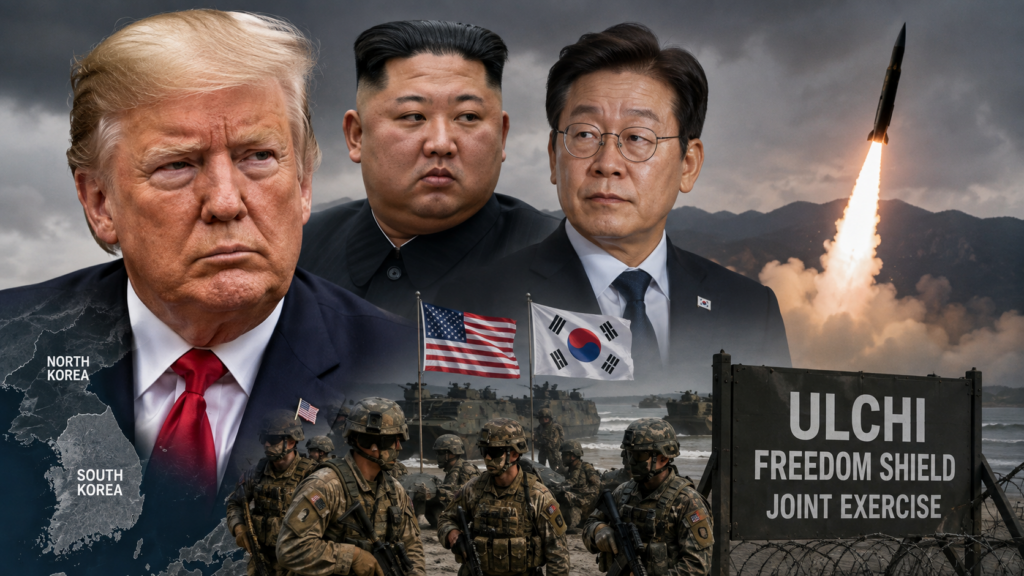
President Donald Trump has ordered the U.S. military to substantially reduce joint military exercises with South Korea, citing Seoul’s refusal to join the U.S. war in Iran and his relationship with North Korean leader Kim Jong Un. The directive came just hours before the annual Ulchi Freedom Shield drills were scheduled to begin on August 17.
What Happened
Trump announced Sunday that he had instructed Defense Secretary Pete Hegseth to reduce the scale of joint military exercises with South Korea.
In a social media post, Trump argued that the exercises send an inappropriate and hostile signal to North Korea. He also said the drills are too costly and pointed to what he described as his “very good” relationship with Kim Jong Un.
According to a report by NBC News, Trump said it was already too late to cancel the exercises completely, so he directed Hegseth to substantially reduce them instead.
The announcement came shortly before the exercises were due to begin, leaving uncertainty over which portions of the training would ultimately be scaled back.
Key Details of the Joint Exercises
The annual exercises, known as Ulchi Freedom Shield, are scheduled to run through August 27.
The South Korean Defense Ministry said Monday that the drills were proceeding as planned despite Trump’s announcement. The government did not immediately provide details about how the president’s directive would affect the exercises later in the training period.
According to U.S. Forces Korea, the exercises are designed to strengthen the combined defense posture of the United States and South Korea and improve the allies’ ability to respond to a range of security threats.
North Korea routinely condemns the exercises as preparations for an invasion. Washington and Seoul reject that characterization and describe the training as defensive.
The exercises are particularly important because South Korea and North Korea remain technically at war. The Korean War ended in 1953 with an armistice, but the two countries have never signed a permanent peace treaty.
Trump Links the Decision to Iran
Trump also connected the decision to South Korea’s position on the war in Iran.
The president said he recently asked South Korean President Lee Jae Myung whether Seoul wanted to join the United States in efforts to denuclearize Iran. Trump said South Korea declined.
Lee’s office disputed any suggestion that South Korea had simply refused to assist the United States. It said Seoul had actively participated in international discussions seeking a ceasefire in Iran and the restoration of freedom of navigation through the Strait of Hormuz.
South Korea also said it remained in close consultation with Washington about possible practical and military contributions.
The dispute adds another layer to the already complicated U.S.-South Korean alliance, as Washington continues to demand greater contributions from partners while reconsidering the scale of American military commitments overseas.
Trump and South Korea’s President Seek North Korea Talks
The announcement also reflects Trump’s interest in restarting dialogue with North Korea.
Trump has repeatedly highlighted his relationship with Kim Jong Un and has suggested that Pyongyang has been relatively restrained toward the United States during his presidency.
South Korean President Lee has similarly supported renewed dialogue with North Korea. His office said Seoul hopes Trump’s relationship with Kim can help produce meaningful U.S.-North Korea negotiations and contribute to peace and stability on the Korean Peninsula.
Lee’s government said it would continue diplomatic efforts in close coordination with Washington.
However, North Korea has shown little interest in returning to the negotiations that collapsed after Trump’s earlier diplomatic efforts with Kim failed in 2019.
Security Concerns Over Reducing the Exercises
The decision to reduce the South Korea military exercises has drawn criticism from U.S. lawmakers and security experts who argue that the training is essential to maintaining military readiness.
Sen. Mark Kelly, D-Ariz., called the move shortsighted and said the exercises help ensure that American forces can defend South Korea against a potential attack from the North.
Leif-Eric Easley, a professor of international studies at Ewha Womans University in Seoul, also warned that reducing the exercises could damage coordination between the allies.
He said scaling back the training could slow South Korea’s efforts to assume greater responsibility for its own defense while weakening deterrence against potential conflicts elsewhere in Asia.
The debate comes as the Trump administration continues to reshape U.S. defense and foreign policy. The administration’s approach to military commitments also affects U.S. service members and their families, an issue examined in our coverage of the Trump administration’s military spouse commission.
North Korea Continues Military Activity
Trump’s decision came shortly after North Korea launched a ballistic missile toward the sea.
The missile launch occurred amid preparations for the U.S.-South Korean exercises and was viewed as a possible protest against the drills.
North Korea has continued expanding its nuclear and missile capabilities since diplomatic efforts with Washington collapsed in 2019. Pyongyang has also deepened its military relationship with Russia by providing troops and weapons connected to Russia’s war in Ukraine.
That relationship complicates Trump’s hopes of using improved personal relations with Kim to restart negotiations.
Easley said North Korea is simultaneously benefiting from its relationship with Russia while modernizing its military, potentially reducing its incentive to return to talks with Washington.
The development is also relevant to the broader U.S. response to Russia’s military partnerships. Washington’s approach to Moscow continues to evolve, including congressional efforts involving new Russia sanctions legislation.
U.S. Military Presence Faces Additional Pressure
Trump’s announcement also came as the United States adjusted its military presence in the wider region.
The USS George Washington was sent to replace the USS Abraham Lincoln in the Persian Gulf. The movement followed scrutiny surrounding conditions aboard the Abraham Lincoln.
The shift illustrates the competing military priorities facing the United States as the administration manages tensions involving Iran, Russia, North Korea and other potential flashpoints.
Reducing the South Korea military exercises could therefore become part of a broader debate over how the United States distributes military resources and maintains readiness across multiple regions.
What Happens Next
The immediate question is how the Pentagon will implement Trump’s order while Ulchi Freedom Shield is already underway.
South Korea has said the exercises are proceeding as planned, while the precise scope of any reductions ordered by Washington remains unclear.
The longer-term consequences could be more significant. Joint training is a central component of U.S.-South Korean military cooperation, and any sustained reduction could affect readiness, interoperability and deterrence.
Trump’s decision also raises questions about whether reducing military exercises will help create conditions for renewed engagement with Kim Jong Un or instead weaken the alliance’s ability to respond to a crisis.
For Washington and Seoul, the challenge will be balancing diplomatic efforts with North Korea against the need to preserve a credible defense posture. The future scale of South Korea military exercises will be an important test of how the Trump administration intends to manage that balance.
Trump cited South Korea’s refusal to join the war in Iran and his relationship with North Korean leader Kim Jong Un.
No. South Korea said the Ulchi Freedom Shield exercises were proceeding as planned, although the extent of any U.S.-ordered reductions remains unclear.