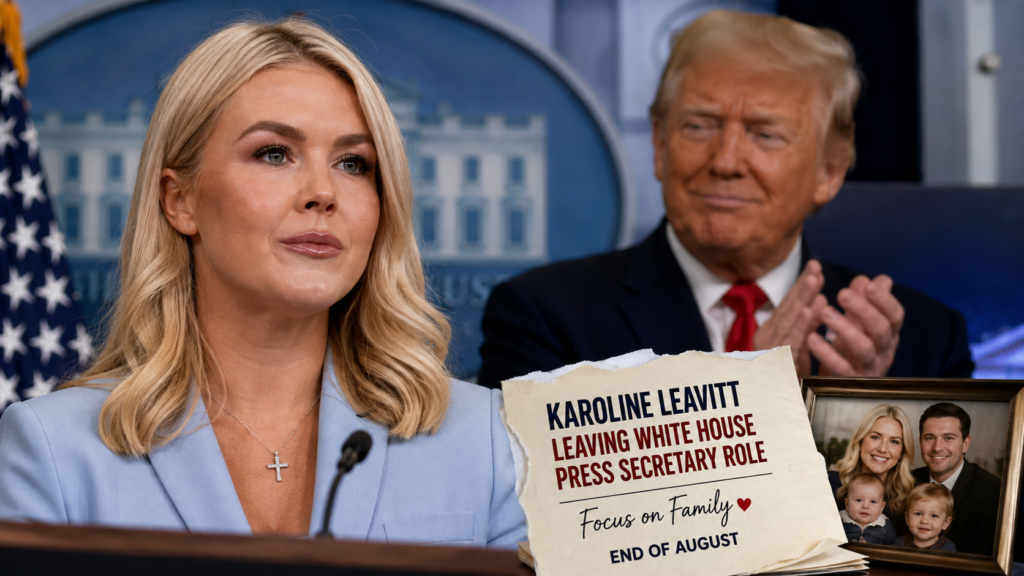
White House press secretary Karoline Leavitt will leave her position at the end of August to focus on her family, President Donald Trump announced Wednesday. The Karoline Leavitt resignation makes her the latest senior figure to leave Trump’s second administration, although Trump said she will remain a top outside adviser and influential voice within the Republican Party.
What Happened
Trump announced Leavitt’s departure on Truth Social, praising her performance as White House press secretary and describing her as a leader in his administration.
Trump said Leavitt would continue serving as one of his top outside advisers while remaining involved in Republican politics ahead of the November midterm elections.
According to a report by Al Jazeera, Leavitt will leave the White House press secretary position at the end of August after deciding to prioritize her family.
Her departure comes only weeks after she returned from maternity leave. Leavitt stepped away from her duties in late April after giving birth to her second child, Viviana, with her husband, Nicholas Riccio, in early May.
She returned to the White House briefing room in July for her first formal news briefing since taking maternity leave.
Why Karoline Leavitt Is Leaving
Leavitt’s decision is centered on her family and young children.
The demanding schedule of the White House press secretary requires frequent briefings, media appearances and rapid responses to political developments. Her departure follows her return from maternity leave and comes as she continues raising her two children.
Trump has publicly praised the decision and indicated that Leavitt’s departure is not a break with his administration.
Instead, she is expected to maintain a political relationship with Trump as an outside adviser.
Trump Praises Leavitt’s Performance
Trump described Leavitt as one of the best White House press secretaries in the history of the office.
He also praised her work defending his administration and said she would remain an influential voice within the Republican Party.
The president specifically linked her continued involvement to the Republican Party’s effort to win the November midterm elections.
That means the Karoline Leavitt resignation will remove her from one of the most visible positions in the White House while allowing her to remain connected to Trump’s political operation.
Karoline Leavitt’s Rise in Trump’s Political Operation
Leavitt has been part of Trump’s political orbit since his first presidency.
She began her White House career as an intern in the Office of Presidential Correspondence. By the end of Trump’s first term in January 2021, she had become an assistant press secretary.
After Trump left office, Leavitt continued working in conservative politics. She joined the communications operation of MAGA Inc., a super PAC associated with Trump.
In 2021, she launched a campaign for New Hampshire’s 1st Congressional District.
Leavitt won the Republican primary but lost the 2022 general election to Democratic incumbent Chris Pappas.
When Trump began his campaign for a second presidential term in 2024, Leavitt became one of his principal campaign spokespersons.
After Trump returned to the White House in January 2025, she became the youngest person to serve as White House press secretary, taking the position at age 27.
A Combative White House Media Strategy
Leavitt developed a reputation for a combative style during White House briefings.
She frequently challenged reporters and defended Trump’s policies against questions from traditional news organizations.
Her approach was closely aligned with Trump’s long-standing criticism of mainstream media organizations that he has accused of unfair or biased coverage.
One notable aspect of her tenure was the White House’s expansion of briefing-room access to bloggers, podcasters and social media influencers.
Leavitt said the administration intended to communicate with a broader range of media personalities rather than limiting access to traditional news organizations.
The approach reflected Trump’s campaign strategy during the 2024 election, when he increasingly used podcasts and alternative media platforms to reach voters.
Press Freedom Controversies
Leavitt’s tenure also unfolded amid repeated disputes between the Trump administration and news organizations.
Press freedom advocates criticized restrictions affecting journalists’ access to the executive branch and argued that some White House policies could reduce government transparency.
A major dispute involved the Associated Press after the White House objected to the organization’s continued use of the term “Gulf of Mexico” instead of Trump’s preferred “Gulf of America.”
The conflict became part of a larger debate over presidential control of media access and the constitutional protections afforded to journalists under the First Amendment.
Leavitt frequently defended the administration’s position and challenged reporters during briefings.
Broader Trump Administration Personnel Changes
Leavitt is leaving at a time when Trump’s second administration has experienced several changes among senior officials.
The source report noted departures involving former Attorney General Pam Bondi, former Homeland Security Secretary Kristi Noem and former Labor Secretary Lori Chavez-DeRemer, among other officials.
Her departure is therefore another significant personnel change within Trump’s administration, although the White House has framed it differently because Leavitt is leaving to prioritize her family rather than being removed from office.
Other senior appointments have also reshaped Trump’s administration. For example, Todd Blanche’s confirmation as a senior Trump administration official was part of the broader process of building Trump’s second-term leadership team.
What Happens Next for the White House
Trump has not announced a successor to Leavitt as White House press secretary.
The next press secretary will inherit the responsibility of managing the administration’s relationship with the news media during a politically important period.
The transition will also take place ahead of the November 2026 midterm elections, when Republicans will seek to defend and expand their congressional position.
The next press secretary could maintain Leavitt’s strategy of giving greater access to conservative influencers and digital media, or the White House could adjust its communications approach.
For broader context on Trump’s senior White House leadership, Will Scharf’s role as White House counsel provides another example of how key personnel have taken on influential positions during Trump’s second administration.
What Leavitt’s Departure Means for Trump
The Karoline Leavitt resignation removes one of Trump’s most recognizable public defenders from the White House podium.
Her tenure was notable for its close alignment with Trump’s communication style, frequent confrontations with reporters and expanded use of alternative media.
However, Trump’s decision to retain Leavitt as an outside adviser means she is not leaving his political orbit entirely.
Her continued involvement could become particularly relevant during the 2026 midterm campaign, when Trump and Republican candidates are expected to focus heavily on communicating directly with voters through conservative media, social media and other nontraditional platforms.
Leavitt’s departure therefore represents a change in the White House communications team rather than a complete departure from Trump’s political operation.
The Karoline Leavitt resignation will end her tenure behind the White House podium, but her continued relationship with Trump means she could remain an influential figure in the administration’s broader political and communications strategy.
Karoline Leavitt is stepping down at the end of August to prioritize her family after returning from maternity leave.
No. Trump said Leavitt will remain one of his top outside advisers and an influential voice within the Republican Party.