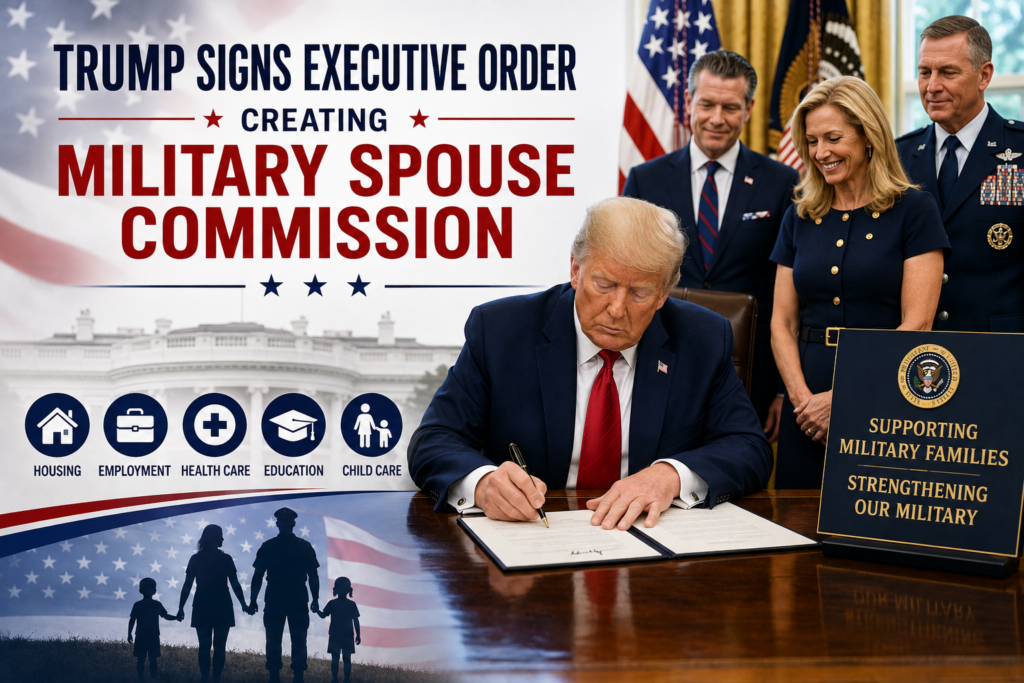
President Donald Trump has signed an executive order creating the Military Spouse Commission, a new advisory body focused on addressing employment, housing, health care, education and childcare challenges facing military families.
According to a report by PBS NewsHour, Trump signed the executive order at the White House on August 7, 2026, establishing a commission designed to recommend policies that could improve conditions for military spouses and strengthen military readiness.
What Happened
Trump signed the executive order establishing the Military Spouse Commission as part of his administration’s broader effort to support military families.
The commission will examine challenges faced by military spouses and make recommendations to the president on policies affecting their employment, housing, health care, education and childcare.
The administration has argued that supporting military families is closely connected to national security because family stability can affect service-member retention and military readiness.
Jennifer Hegseth, the wife of Defense Secretary Pete Hegseth, will chair the commission. Desiree Thompson Sayle will serve as its executive director.
The commission will bring together military spouses and other representatives to examine challenges associated with military life and develop policy recommendations.
Key Priorities of the Military Spouse Commission
Employment and Career Challenges
Employment is expected to be one of the commission’s central areas of focus.
Military families frequently relocate when service members receive new assignments. These moves can interrupt spouses’ careers, make it difficult to maintain professional licenses and require spouses to repeatedly search for new employment.
The administration says the commission will look at ways to improve employment opportunities and reduce barriers that military spouses encounter because of frequent relocations.
For spouses working in professions requiring state licenses, moving between states can create additional administrative hurdles.
Housing and Childcare
Housing is another major issue for military families.
Frequent relocations can make finding suitable housing difficult, particularly when families move to areas with high housing costs or limited availability.
Childcare can also become a significant challenge, especially for families living near military installations where demand for services can be high.
The commission is expected to examine potential policy solutions that could make these services more accessible to military families.
Health Care and Education
The commission will also consider access to health care and education.
Military children can experience repeated changes in schools because of their parents’ assignments. Moving between school districts and states can create challenges involving enrollment, academic credits and continuity of education.
Health care access can similarly become complicated when military families relocate.
The commission’s broad mandate allows these issues to be considered together rather than as isolated problems.
Why Military Families Are a National Security Issue
The Trump administration has connected military family support directly to military readiness.
When service members face persistent family challenges involving employment, housing, childcare or education, those problems can influence decisions about whether to remain in military service.
By addressing these issues, the administration argues that it can improve the quality of life for military families while also supporting recruitment and retention.
The initiative comes as Trump continues to emphasize military strength and changes to U.S. defense policy. His administration’s broader approach includes plans involving troop cuts in Europe and NATO, policies that could have implications for service members and their families stationed overseas.
Jennifer Hegseth to Lead the Commission
Jennifer Hegseth will chair the new commission.
Her position places a military spouse at the center of the administration’s effort to develop policies for military families.
The commission is expected to draw on the experiences of military spouses from different branches and backgrounds.
That approach could give the administration direct insight into practical problems that military families experience during deployments, relocations and changes in duty assignments.
The commission’s recommendations could eventually influence policies across the Defense Department and other federal agencies responsible for military family programs.
Broader Trump Administration Agenda
The creation of the commission comes as the Trump administration continues to reshape national security and defense policy.
Trump has emphasized strengthening the U.S. military, increasing defense capabilities and changing America’s approach to international military commitments.
The White House has also used high-level meetings to coordinate administration priorities involving national security, foreign policy and defense. The commission’s creation therefore fits within a broader administration agenda discussed during Trump’s Cabinet meeting at Camp David.
For military families, however, the most immediate focus will likely remain on practical issues such as jobs, housing, childcare and access to services.
Challenges Facing Military Spouses
Military spouses can face unique economic and professional challenges because of the nature of military service.
Frequent relocations can require spouses to leave established jobs, rebuild professional networks and adapt to different local labor markets.
Long deployments can also place additional responsibilities on spouses who remain at home.
These challenges can be particularly significant for families with young children or spouses working in professions where licensing requirements differ between states.
The commission’s work could therefore have implications beyond military policy if its recommendations lead to changes in federal employment, licensing or family-support programs.
What Happens Next
The Military Spouse Commission will now begin its work examining challenges affecting military families and developing recommendations for the administration.
Its effectiveness will depend on whether those recommendations result in concrete policy changes.
Potential areas of action could include improving employment opportunities, reducing professional licensing barriers, expanding childcare access, strengthening housing support and improving education resources for military children.
The commission will also need to determine which recommendations can be implemented through executive action and which would require congressional legislation or cooperation from state governments.
Why the Military Spouse Commission Matters
Trump’s creation of the Military Spouse Commission places military family concerns directly within the administration’s national security and military-readiness agenda.
Supporters say addressing employment, housing, childcare, health care and education challenges could make military service more sustainable for families and help improve retention.
The broader test will be whether the commission can translate military spouses’ experiences into meaningful policy changes. If it succeeds, its recommendations could influence how the federal government supports military families throughout Trump’s second administration.
The Presidential Military Spouse Commission is a new advisory panel created by Trump to recommend policies addressing challenges faced by military spouses and families.
Jennifer Hegseth, wife of Defense Secretary Pete Hegseth, will lead the commission.