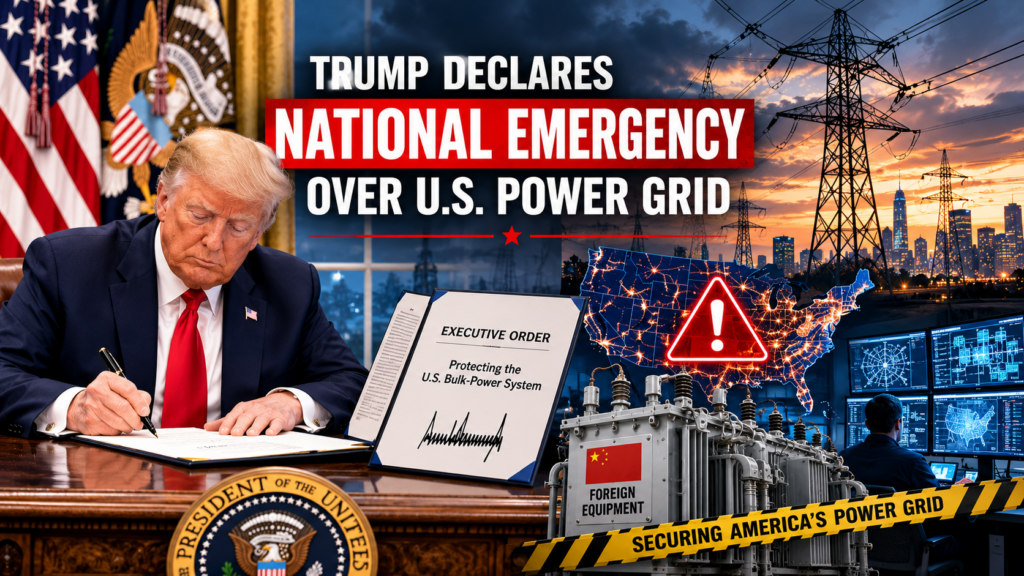
President Donald Trump has declared a national emergency over the U.S. bulk-power system, targeting foreign-produced equipment that the administration says could create cybersecurity, sabotage and supply-chain risks to the nation’s electric grid.
According to a report by Reuters, the executive order signed August 26, 2026, restricts certain foreign-made equipment used in critical electricity infrastructure and gives the Energy Department broad authority to identify, monitor, isolate, replace or remove equipment considered a national security threat.
What Happened
Trump’s Executive Order 14421 declares that foreign supply of electric equipment used in the U.S. bulk-power system constitutes an “unusual and extraordinary threat” to national security, foreign policy and the economy.
The White House says the nation’s growing dependence on reliable electricity has made the potential consequences of a successful attack or major supply disruption more serious. Advanced manufacturing, data centers, artificial intelligence and defense production are all increasing demand for secure and dependable electricity.
The order specifically raises concerns about foreign-produced equipment that could contain digital vulnerabilities, including potential remote-access capabilities or other mechanisms that could allow unauthorized interference.
Key Details of the Bulk-Power System Emergency
Foreign Equipment Can Face Restrictions
The order generally prohibits certain acquisitions, imports, transfers and installations of foreign-produced bulk-power system equipment when the Energy Secretary determines that the transaction involves a Covered Foreign Entity and presents an unacceptable risk.
The restrictions can apply not only to physical equipment but also to associated software, firmware, digital services, maintenance services and remote-access capabilities.
Potential risks include sabotage, subversion, unauthorized access, malicious remote actions, supply disruptions and catastrophic effects on critical infrastructure or the U.S. economy.
Existing Equipment Could Also Be Reviewed
The order does not apply only to future purchases.
The Energy Secretary can impose conditions on foreign-manufactured or foreign-operated equipment already acquired or installed before the order if it is determined to create a national security risk.
Possible measures include identifying, isolating, monitoring, securing, disconnecting, replacing or removing equipment. Before requiring equipment to be disconnected or replaced, officials must consider grid reliability, safety, availability of secure replacements and continuity of essential services.
What Is the Bulk-Power System?
The bulk-power system covers the high-voltage infrastructure responsible for operating the interconnected electricity transmission network and maintaining system reliability.
Under the order, the definition includes transmission lines rated at 69 kilovolts or more, along with equipment used in substations, control rooms and power-generating facilities.
The covered equipment can include substation transformers, generators, grid-connected inverters, battery energy storage systems, high-voltage circuit breakers, protective relaying, metering equipment and industrial control systems.
The order specifically distinguishes the bulk-power system from local electricity distribution facilities.
Why the Trump Administration Declared the Emergency
The White House argues that reliance on foreign equipment can create both cybersecurity and supply-chain vulnerabilities.
Officials are concerned that compromised equipment could potentially be used for unauthorized remote access or interference with electricity infrastructure. At the same time, heavy dependence on overseas suppliers could leave the United States vulnerable if international trade is disrupted.
Reuters reported that the action is part of a broader effort to reduce foreign technology risks in critical American infrastructure, with China a significant focus of longstanding U.S. concerns.
The administration’s concerns have also emerged as electricity demand rises rapidly because of data centers, artificial intelligence and advanced manufacturing.
New Rules and Federal Procurement Changes
The order gives the Energy Secretary 120 days to publish regulations needed to implement the new authorities.
Those rules can identify countries, companies, equipment and other entities that warrant additional scrutiny. The Energy Department can also establish licensing procedures and create a list of equipment and vendors that are pre-qualified for future transactions.
The order further directs the Energy Secretary to develop recommended changes to federal procurement rules within 180 days. Those recommendations are intended to strengthen national security reviews and prioritize U.S.-manufactured energy infrastructure.
The Federal Acquisition Regulatory Council will then have 90 days after receiving the recommendations to consider proposing changes through the federal rulemaking process.
Political and Economic Impact
The emergency could have significant implications for electricity infrastructure companies, utilities and equipment manufacturers that rely on overseas supply chains.
Restrictions on foreign-made transformers, inverters, control equipment and other grid components could encourage utilities and federal agencies to source more equipment domestically.
At the same time, shifting supply chains could increase procurement costs or complicate infrastructure projects if secure domestic alternatives are not immediately available.
The order attempts to address that challenge by allowing the Energy Secretary to negotiate mitigation measures and approve transactions subject to security conditions rather than applying an automatic prohibition in every case.
The administration’s broader push to strengthen strategic infrastructure also extends to policies affecting federally managed land and infrastructure, including changes to federal roadless-area policy.
National Security and Critical Infrastructure
The order treats electricity infrastructure as a core national security concern because the bulk-power system supports military operations, emergency services, communications, transportation and the broader economy.
A prolonged disruption could therefore affect far more than electricity customers. Hospitals, defense facilities, financial systems and other critical services depend on reliable power.
The White House says the growing importance of electricity-intensive industries makes resilience increasingly important.
The policy also reflects an effort to strengthen domestic capabilities in industries considered strategically important to national security. Similar infrastructure-focused initiatives have become part of the administration’s broader approach to protecting critical systems and ensuring American technological capacity, including federal policies supporting strategic U.S. infrastructure.
What Happens Next
The immediate next step is the Energy Department’s development of implementation rules and its identification of equipment and suppliers that could present unacceptable risks.
Officials are also expected to assess foreign equipment already operating within the U.S. bulk-power system and determine whether additional security measures, replacement programs or other mitigation steps are necessary.
Congress will receive recurring and final reports on the national emergency as required under federal law.
The bulk-power system emergency marks a major expansion of federal scrutiny over foreign technology used in America’s electricity infrastructure. By combining import restrictions, equipment reviews and changes to federal procurement policy, the Trump administration is seeking to reduce dependence on potentially vulnerable foreign equipment while strengthening the resilience of the U.S. power grid.
The broader impact will depend on how the Energy Department implements the order, how quickly secure alternatives can be developed and whether the new restrictions can improve grid security without creating new reliability or supply-chain problems.
The administration says foreign-produced grid equipment could create cybersecurity, sabotage and supply-chain risks to critical U.S. infrastructure.
The order can restrict certain foreign-produced grid equipment and related software, firmware, digital services and remote-access capabilities linked to Covered Foreign Entities.