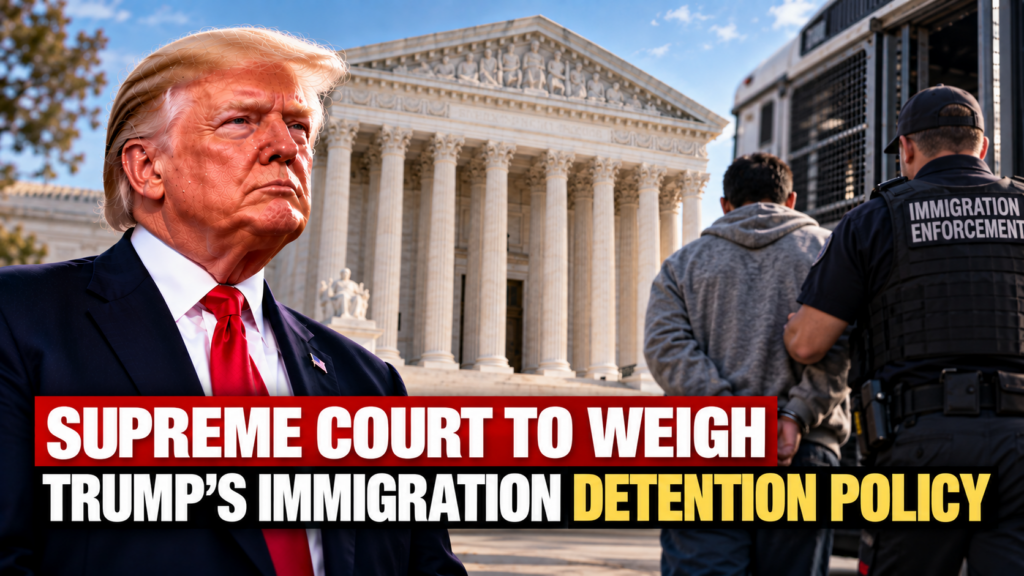
The U.S. Supreme Court will hear a major challenge to the Trump administration’s immigration detention policy, which requires many immigrants who entered the United States illegally to remain in detention without a bond hearing during deportation proceedings.
What Happened
The Supreme Court agreed on October 1 to review whether the Trump administration can require mandatory detention for millions of immigrants already living in the United States.
The case comes after several lower federal courts rejected the administration’s interpretation of federal immigration law. The Supreme Court is expected to hear arguments during its new term, which begins in October.
According to a report by Reuters, the justices agreed to hear the administration’s appeal of a ruling from the 2nd U.S. Circuit Court of Appeals involving Brazilian national Ricardo Aparecido Barbosa da Cunha.
Trump Administration’s Detention Policy
The dispute centers on guidance issued by the Department of Homeland Security in July 2025.
Under the policy, immigration officials determined that certain immigrants living in the United States illegally must be detained without a bond hearing for the duration of their deportation proceedings. Those proceedings can take months or even years.
The administration’s position represented a major departure from a nearly three-decade interpretation of federal law under which certain immigrants already living in the United States could seek release on bond while their immigration cases proceeded.
The Trump administration has made mass deportation a central immigration priority since returning to office.
Legal Challenge Reaches Supreme Court
The policy has generated thousands of legal challenges from immigrants and advocacy groups.
More than 73,000 cases involving immigrants seeking release from detention have been filed in federal court this year, according to Reuters. Those cases account for about a quarter of all civil lawsuits filed in federal courts.
A Reuters analysis in February found that federal judges had ruled more than 4,400 times that the Trump administration had unlawfully detained immigrants under the disputed policy.
Several federal appeals courts have also rejected the administration’s interpretation.
Case Involves Brazilian Immigrant
The Supreme Court case originated with Barbosa da Cunha, who entered the United States illegally around 2004 or 2005 and remained in the country.
Immigration officers arrested him in September 2025 while he was driving to work in Norwood, Massachusetts. He was initially denied a bond hearing under the administration’s policy but was later released on bond, according to court documents.
His case became part of the broader legal dispute over whether immigrants already residing in the United States can be classified as “applicants for admission” under federal immigration law.
Arguments Over Mandatory Detention
The American Civil Liberties Union is representing Barbosa da Cunha and has challenged the administration’s interpretation of the law.
Michael K.T. Tan, deputy director of the ACLU’s Immigrants’ Rights Project, argued that the government cannot use its interpretation of immigration law to detain immigrants for extended periods without bond hearings.
The administration has taken the opposite position.
Under federal immigration law, people classified as “applicants for admission” are subject to mandatory detention while their immigration cases proceed and are not eligible for bond hearings.
The Department of Homeland Security argues that its interpretation implements federal law as Congress intended.
Appeals Courts Have Split With Trump Administration
The Supreme Court’s decision to take the case follows rulings against the administration from multiple federal appellate courts.
The 2nd Circuit and the Cincinnati-based 6th U.S. Circuit Court of Appeals both rejected the administration’s approach, prompting the government to seek Supreme Court review.
In the 2nd Circuit case, U.S. Circuit Judge Joseph Bianco, a Trump appointee, described the administration’s interpretation as a basis for what he characterized as an exceptionally broad detention-without-bond policy affecting millions of noncitizens.
The disagreement among the courts has increased pressure on the Supreme Court to resolve the legal question.
What Happens Next
The Supreme Court’s ruling could determine whether the Trump administration can continue enforcing mandatory detention on a much broader group of immigrants during deportation proceedings.
The case is also one of several major immigration disputes before the court. The justices recently allowed the administration, at least temporarily, to resume quickly deporting migrants to countries other than their own without first giving them an opportunity to demonstrate the potential harm they could face. Arguments in that separate case are scheduled for December.
With immigration enforcement remaining a central part of Trump’s agenda, the Supreme Court’s decision could have significant consequences for detention practices, deportation proceedings and the administration’s broader mass-deportation strategy.
Related Reading
- Trump Administration Finalizes “Freedom Means Affordable Cars” Initiative
- White House Expands Taxpayer-Paid Ad Campaign Boosting Trump
The policy requires certain immigrants living illegally in the United States to be detained without a bond hearing during deportation proceedings.
The administration appealed lower-court rulings that rejected its interpretation of federal immigration law and its expanded use of mandatory detention.