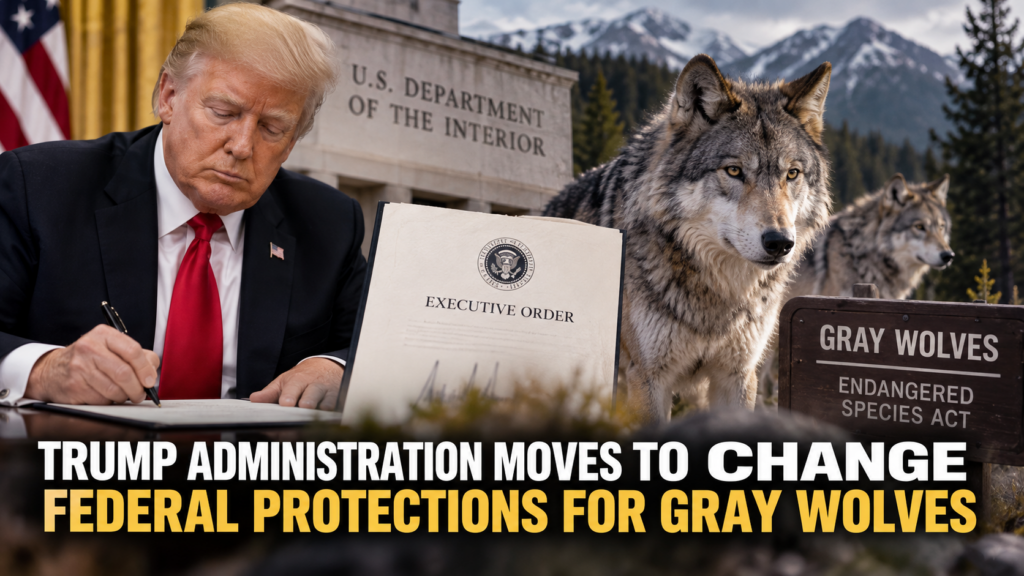
The Trump administration is moving to reconsider federal protections for gray wolves, directing the U.S. Department of the Interior to determine whether gray wolves and Mexican gray wolves have recovered enough to be removed or downgraded under the Endangered Species Act.
What Happened
President Donald Trump signed an executive order on September 4 directing Interior Secretary Doug Burgum to review the federal status of gray wolves and Mexican gray wolves. The review gives the department 90 days to determine whether the animals meet the recovery criteria for delisting or downlisting.
According to a report by BBC, the administration’s move could lead to major changes in how wolves are protected and managed across parts of the United States.
The order does not immediately remove the animals from the Endangered Species Act. Instead, it starts a process that could eventually reduce or eliminate federal protections if officials determine that recovery requirements have been met.
Key Details
Gray Wolves Remain Federally Protected in Much of the U.S.
Gray wolves remain protected under federal law across most of their range in the lower 48 states. Montana, Idaho and Wyoming are notable exceptions, where states already manage wolf populations. In Minnesota, wolves have a threatened rather than endangered classification.
The issue has been the subject of repeated federal delisting efforts. During Trump’s first administration, the federal government removed gray wolves from the endangered species list in 2020. A federal court overturned that decision in 2022, restoring protections across much of the Lower 48.
The latest Trump administration move could reopen that long-running dispute.
Mexican Gray Wolves Also Included
The executive order covers Mexican gray wolves, a rare subspecies reintroduced into Arizona and New Mexico in 1998.
The population reached 319 animals in Arizona and New Mexico at the end of 2025. Under the current recovery framework, officials can begin considering delisting after the population averages more than 320 animals for four consecutive years.
Conservation advocates argue that population numbers alone do not capture the challenges facing Mexican gray wolves, particularly their limited genetic diversity.
Political and Economic Impact
The administration has framed the changes around concerns from ranchers and the livestock industry, which has long argued that wolves can threaten cattle and other livestock.
The executive order also directs federal agencies to consider changes involving lethal wolf removal, livestock-loss compensation and coordination with states over wolf management.
Trump raised the issue during a White House event with ranchers, appearing to suggest that ranchers could immediately shoot protected wolves. Federal protections, however, remain in place unless and until the legal process changes their status.
The broader initiative is part of Trump’s effort to support ranchers and American beef production while giving states greater authority over wildlife management.
Reactions and Opposition
The administration’s proposal has drawn strong opposition from environmental and animal-protection groups.
Conservation advocates argue that removing federal protections too quickly could undermine decades of recovery efforts. They also contend that wolves still occupy only part of their historical range and remain vulnerable in several regions.
Critics have warned that weakening federal protections could allow states to introduce more aggressive hunting, trapping or lethal-control policies.
Ranching groups and other supporters of delisting, however, argue that wolf populations have recovered substantially and that states should have greater control over their management.
The dispute reflects a longstanding conflict between wildlife conservation and livestock interests, particularly across the American West.
What Happens Next
The Interior Department now has 90 days to assess whether gray wolves and Mexican gray wolves meet federal recovery criteria for delisting or downlisting.
Any formal change to their Endangered Species Act status would still have to proceed through applicable federal processes. The administration is also expected to develop legislative recommendations and work with states on potential changes to wolf-management rules.
The outcome could determine whether federal protections remain in place across much of the country or whether states gain significantly greater authority over wolf populations.
The Trump administration’s move therefore represents another major chapter in the decades-long debate over gray wolf recovery, with the next steps likely to face intense political, scientific and legal scrutiny.
Related Reading
- Trump Administration Moves to Expand Biofuel Waivers
- Trump Administration Invests $3.15 Million in Rural Ohio Pharmacies
The administration ordered a 90-day review of whether gray wolves and Mexican gray wolves qualify for federal delisting or downlisting.
Yes. Gray wolves remain federally protected across much of the Lower 48, and the executive order does not immediately remove those protections.