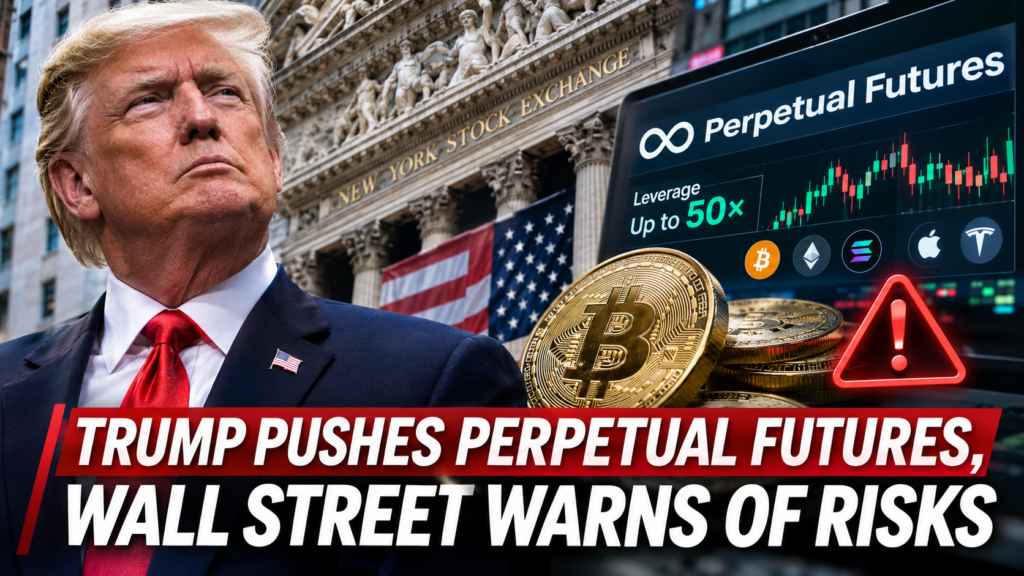
The Trump administration’s push to expand perpetual futures trading in the United States is drawing criticism from major Wall Street exchanges. Critics warn that high leverage and regulatory uncertainty could create risks for financial markets and investors.
According to a report by Reuters, the Commodity Futures Trading Commission (CFTC) has approved cryptocurrency and single-stock perpetual futures on US-regulated platforms. Traditional financial institutions are challenging the decisions, arguing that existing safeguards may be insufficient.
What Are Perpetual Futures?
Perpetual futures are derivative contracts that allow traders to speculate on asset prices without an expiration date. Positions can remain open indefinitely as long as traders meet margin requirements.
The products originated largely in offshore cryptocurrency markets. Their popularity is partly driven by continuous trading and access to leverage.
Some platforms offer leverage of up to 50 times a trader’s initial capital. While this can increase potential returns, it also magnifies losses.
According to CryptoQuant data cited by Reuters, cryptocurrency perpetual futures trading volume reached $61.7 trillion in 2025, up 29% from 2024. Major platforms include Binance and Hyperliquid.
The Trump administration wants to bring more of this activity into regulated US markets rather than leave it concentrated offshore.
CFTC Expands Access to Perpetual Futures
The CFTC has played a central role in expanding perpetual futures trading in the United States.
In May 2026, the regulator approved cryptocurrency perpetual futures on US-regulated exchanges. Platforms including Coinbase, Kalshi, and Robinhood have entered the developing market.
On November 3, CFTC Chairman Michael Selig announced that contracts tied to individual company stocks could also trade on appropriately registered exchanges.
Selig argued that domestic regulation would give American investors access to these products under US oversight.
However, traditional exchanges say the current regulatory approach may expose investors and financial institutions to risks that existing futures rules were not designed to address.
Wall Street Firms Challenge the CFTC
CME Group is suing the CFTC over its approval of cryptocurrency perpetual futures. The exchange argues that the regulator incorrectly classified the products as futures, potentially weakening investor protections and creating unfair competition.
A separate industry group representing Cboe Global Markets and Citadel Securities has also challenged the approval of single-stock perpetual futures.
At the center of both disputes is whether perpetual futures should legally be classified as futures contracts or swaps.
Why Classification Matters
Traditional futures contracts establish prices for transactions at a future date. Swaps involve exchanging cash flows or financial obligations based on an underlying asset or benchmark.
Because perpetual futures have no expiration date and involve ongoing funding payments, traditional exchanges argue that they more closely resemble swaps under the 2010 Dodd-Frank Act.
Swaps generally face stricter margin, capital, and reporting requirements. The CFTC, however, maintains that perpetual futures have futures-like characteristics.
The legal decisions could determine which protections apply and which companies can offer these products.
Wall Street Warns of Financial Risks
Executives from traditional exchanges, trading firms, and asset managers have raised concerns about the expansion of perpetual futures.
One major issue is margin requirements. Critics argue that futures-style rules may not adequately address the counterparty and liquidity risks associated with these products.
Automatic liquidations are another concern. These mechanisms close positions when traders no longer meet margin requirements.
During extreme market volatility, large-scale liquidations could accelerate price declines. Reuters reported that similar mechanisms contributed to a major Bitcoin selloff in 2025.
The CFTC has emphasized the need for clearer customer disclosures about automatic liquidations during extended trading hours.
CME Group CEO Terry Duffy has also questioned the regulatory clarity surrounding these products. Established exchanges warn that unclear rules could weaken safeguards developed after the 2007-2009 financial crisis.
The Challenges of 24-Hour Trading
Perpetual futures trade continuously, creating operational challenges for traditional financial institutions.
Exchanges, clearing houses, brokers, and investors must monitor positions and manage collateral outside normal banking hours. This can complicate margin calls and the movement of funds during weekends and overnight periods.
CME Group reportedly shelved a proposed 24-hour crude oil futures contract the previous month. Commercial clients were reluctant to maintain weekend trading operations.
Thomas Restout, CEO of institutional crypto market maker B2C2, also warned that traditional US financial infrastructure is not fully prepared for continuous markets.
These challenges could grow if perpetual futures expand beyond cryptocurrency into stocks and other traditional assets.
Competition Between Wall Street and Crypto Platforms
The dispute reflects growing competition between financial technology companies and established Wall Street institutions.
Platforms such as Kalshi and Coinbase see regulated perpetual futures as an opportunity to attract investors who might otherwise use offshore exchanges.
Kalshi executive Andy Ross argued that bringing these products into US markets is preferable to leaving the activity overseas.
Traditional exchanges disagree. They argue that financial innovation should not come at the expense of investor protection and market stability.
The dispute could also attract greater congressional scrutiny as Democrats prepare to take control of Congress following the November 2026 midterm elections.
Lawmakers may examine cryptocurrency markets, prediction platforms, and the CFTC’s regulatory decisions.
What Happens Next?
The immediate challenge is resolving the legal disputes over the CFTC’s authority and the classification of perpetual futures.
CME Group and the industry group representing Cboe and Citadel Securities are seeking to overturn regulatory decisions allowing the products to operate as futures.
The CFTC maintains that bringing these markets into the United States will improve oversight and investor protection.
The outcome could influence whether more financial platforms offer perpetual futures and whether the products expand into traditional assets.
For the Trump administration, the debate highlights the challenge of balancing financial innovation with market safeguards. Clearer rules on leverage, liquidity, and continuous trading will be critical to the future of these products.
Related Reading
- Trump Announces 3.4% GDP Growth as US Investment Rises
- Trump Says US Is Close to Canada Trade Deal as Carney Signals More Talks Needed
Perpetual futures are derivative contracts without expiration dates that allow traders to maintain positions indefinitely, often using leverage.
They argue that the products may be incorrectly classified as futures, potentially weakening margin, liquidity, and counterparty protections.