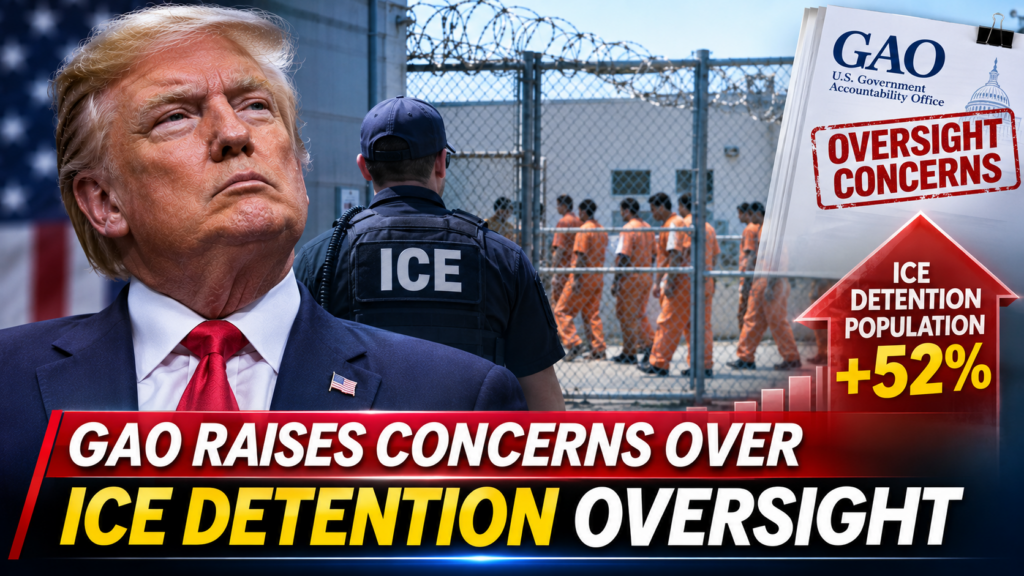
The U.S. Government Accountability Office (GAO) has warned that changes to federal inspections of Immigration and Customs Enforcement (ICE) detention facilities are raising questions about oversight as the detained population continues to grow. In a report released November 5, 2026, GAO found that inspection frequency has decreased in some areas, one oversight office has stopped conducting inspections, and ICE has not adequately assessed whether the remaining inspection system can identify problems across its expanding detention network.
The findings come as the number of people held in ICE facilities increased by more than 50% in one year. GAO said the changes could affect the government’s ability to identify deficiencies involving medical care, food services, suicide prevention and other conditions that directly affect the health and safety of detained individuals.
ICE Detention Population Increased by 52%
According to a report by the U.S. Government Accountability Office, ICE’s average daily population in facilities holding noncitizens for more than 72 hours increased from 40,587 in April 2025 to 61,817 in April 2026. That represents a 52% increase in just 12 months.
The number of authorized detention facilities also expanded during the same period. ICE increased its network from 128 facilities in April 2025 to 172 in April 2026, adding more than 40 facilities and expanding capacity by over 30%.
The expansion followed a January 2025 executive order directing the Department of Homeland Security (DHS) to increase immigration detention capacity. The report also noted that ICE received more than $45 billion for detention capacity through fiscal year 2029 under legislation enacted in 2025, alongside additional funding for immigration enforcement activities.
The 172 facilities include different types of detention arrangements. Some are operated by private companies under direct ICE contracts, while others are managed through agreements with state and local governments, the U.S. Marshals Service and the Federal Bureau of Prisons. ICE also uses two facilities at Guantanamo Bay.
One significant addition was Camp East Montana in El Paso, Texas, which became ICE’s largest detention facility after its construction and operation were initially handled through a U.S. Army contract.
Federal Inspection Programs Have Been Reduced or Changed
GAO examined four DHS entities responsible for inspecting immigration detention facilities. The report found that three changed their inspection activities between fiscal year 2024 and July 2026, while one generally maintained its existing medical inspection procedures.
The changes affected how frequently facilities are inspected, whether inspections are announced and which detention standards are assessed.
ICE Office of Detention Oversight
The ICE Office of Detention Oversight (ODO) is the only DHS entity that consistently assesses facilities against all core detention standards designed to protect the health, life and safety of detained individuals.
ODO reduced its inspections from 194 in fiscal year 2024 to 102 in fiscal year 2025. Previously, facilities with an average daily population of at least 10 detained individuals generally received two inspections annually, including a follow-up inspection. Under the revised approach, dedicated facilities are inspected annually, while non-dedicated facilities holding both ICE detainees and other confined populations are generally inspected every two years.
ODO also introduced self-inspections for certain smaller facilities. Facilities with an average daily population of 49 or fewer detained individuals generally complete their own inspections, while facilities with 50 or more continue to receive on-site inspections.
Under the self-inspection process, facilities have 30 calendar days to complete their assessments. ODO staff then visit toward the end of that period to observe conditions, interview detained individuals and check the facility’s reported findings.
ODO also generally stopped conducting unannounced inspections as a regular practice, although officials said the office retains the authority to conduct them when necessary.
Office of the Immigration Detention Ombudsman
The DHS Office of the Immigration Detention Ombudsman (OIDO) stopped conducting inspections in January 2026 after its last inspection.
The office had faced a significant reduction in staff, with DHS approving reduction-in-force notices affecting 46 positions in 2025. It subsequently did not receive an appropriation for fiscal year 2026.
Although the statutory position of Immigration Detention Ombudsman was not repealed, the official holding the position told GAO that the office could no longer operate or conduct oversight activities because it lacked appropriated funding.
OIDO had conducted inspections focused on specific concerns, including complaints from detained individuals, findings from previous inspections and issues identified by other DHS oversight offices. Its suspension therefore removed one of the inspection channels previously available to monitor detention facilities.
ICE Health Service Corps and DHS Inspector General
The ICE Health Service Corps (IHSC) generally maintained its medical inspection procedures. It continued inspecting facilities at least once every two years, focusing on compliance with medical care standards.
IHSC conducted 80 inspections in fiscal year 2024 and 117 in fiscal year 2025. Its inspections include reviewing clinical records, observing facility operations and assessing compliance with applicable medical requirements. Facilities using private medical contractors generally receive annual inspections from IHSC field medical coordinators.
Meanwhile, the DHS Office of Inspector General (OIG) continued conducting unannounced inspections, although some inspections in fiscal year 2025 were shortened to one day to help cover the growing number of facilities.
The OIG received $20 million in additional funding in April 2026, available through September 2027, to expand detention facility oversight. It hired a contractor expected to conduct approximately 96 additional inspections. Those inspections began in August 2026 and are planned to be unannounced, last three days and examine selected detention standards.
GAO Found Gaps in ICE’s Assessment of Inspection Changes
The central issue identified by GAO is not simply that some inspections have decreased. It is that ICE has not demonstrated, through a comprehensive evidence-based assessment, whether the changes collectively provide sufficient oversight.
ICE relies on inspections to identify deficiencies and determine whether detention facilities comply with applicable standards. These standards cover areas such as medical care, legal services, grievance procedures, food services and suicide prevention.
The scale of previously identified problems illustrates why inspection findings matter. In fiscal year 2024, ODO identified 933 deficiencies across 70 facilities that followed one particular set of detention standards. The deficiencies included issues involving medical care, food services and environmental health.
GAO said ICE had not formally analyzed how reducing ODO inspections, introducing facility self-inspections, discontinuing OIDO inspections and temporarily increasing OIG inspections affected its ability to identify deficiencies in a timely manner.
ICE officials told GAO that they did not believe the changes to ODO inspections and the discontinuation of OIDO inspections had weakened the agency’s oversight. They also said the revised ODO approach allowed resources to be directed toward facilities based on their size and operational complexity.
However, GAO found that ICE had not provided documentation showing a comprehensive assessment of the combined inspection system. The agency had also not demonstrated whether changes across the four DHS entities created new oversight gaps or adequately addressed existing ones.
The report emphasized that ICE can use inspection findings, facility performance information and contract compliance data to evaluate whether its monitoring system is working. Without that analysis, the agency cannot be certain that its inspection activities collectively provide adequate oversight.
DHS Agreed With GAO Recommendations but Disputed the Need for Further Action
GAO issued two recommendations directing ICE to strengthen its assessment and inspection procedures.
First, the agency should use inspection data and performance information to determine how changes across DHS inspection programs have affected oversight. This assessment should establish whether the combined inspection system is sufficient to monitor compliance with detention standards and identify deficiencies.
Second, ICE should modify its own inspections based on the results of that assessment, where necessary.
DHS agreed with both recommendations but argued that ICE already uses inspection data and other oversight information to monitor facilities. The department also said that a lower number of inspections does not automatically mean fewer facilities receive formal performance assessments.
DHS described existing efforts to identify recurring deficiencies and adjust monitoring activities when inspection results indicate a need for additional review.
GAO maintained that the recommendations were still necessary. The agency said ICE had not provided evidence of a comprehensive assessment covering the changes made by ODO, OIDO, IHSC and OIG.
GAO also clarified that simply having the ability to adjust inspection schedules is not enough. ICE needs to document its assessment, explain what the evidence shows about the effectiveness of its oversight system and demonstrate what changes it makes in response.
Both recommendations remained open when the report was published on November 5, 2026.
What Happens Next?
ICE is expected to address GAO’s recommendations by evaluating whether its current inspection arrangements are sufficient and making adjustments where the findings identify gaps. The additional OIG inspections are also expected to provide further information about conditions across the expanding detention network.
The report does not conclude that all ICE facilities are failing to meet detention standards. Instead, it identifies a broader accountability concern: the number of facilities and detained individuals has grown substantially while important parts of the inspection system have been reduced or changed.
The findings place greater attention on how the federal government monitors immigration detention as enforcement capacity expands. Whether ICE can demonstrate that its oversight system remains effective will be an important measure of its ability to ensure safe, secure and humane detention conditions.
Related Reading
- Supreme Court Rejects Trump Administration’s Bid to Block California Ballots
- Trump Says US Will End $4 Billion in Annual Aid to Israel
GAO found that inspection programs have been reduced or changed as detention facilities and the detained population have expanded. ICE has not comprehensively assessed whether the current system can identify deficiencies effectively.
GAO recommended that ICE evaluate the effects of inspection changes using evidence and performance data, then modify its inspection procedures based on the results.