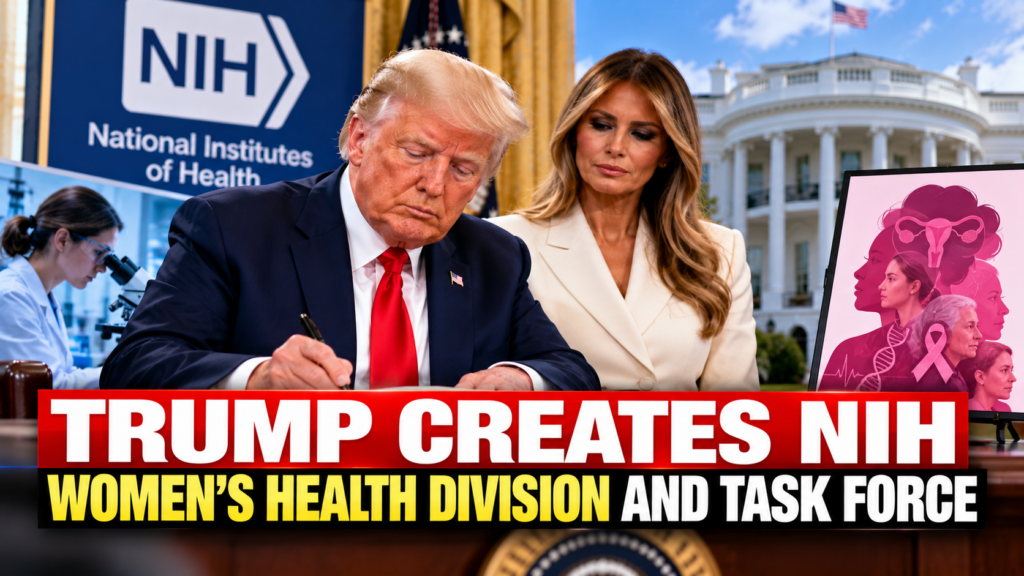
President Donald Trump signed an executive order on October 19, 2026. It establishes a new Women’s Health Division at the National Institutes of Health (NIH). The order also creates a White House task force to strengthen research, improve medical care, and address health conditions that disproportionately affect women.
What Happened
Trump signed the executive order at the White House alongside First Lady Melania Trump. Under the order, the Department of Health and Human Services (HHS) must establish the new division within 90 days. The order also creates a separate White House Women’s Health Task Force.
According to a report by Reuters, the initiative aims to strengthen women’s health research. It also seeks to turn scientific findings into better prevention, diagnosis, and treatment.
Meanwhile, Melania Trump has played a central role in promoting the initiative. She has emphasized the need to address longstanding gaps in women’s health research. She also wants to make medical breakthroughs more accessible and affordable.
Key Details of the NIH Women’s Health Initiative
A New Division Within the NIH
The executive order gives HHS 90 days to establish a dedicated Women’s Health Division within the NIH.
The new division will work alongside the existing NIH Office of Research on Women’s Health. It will not replace that office. Instead, the division will coordinate research and help bring scientific discoveries into clinical care more quickly.
The initiative focuses on conditions that uniquely or disproportionately affect women. These include cardiovascular disease, cancer, autoimmune disorders, chronic pain, and reproductive health conditions.
White House Task Force Leadership
The new White House Women’s Health Task Force will have two co-chairs: White House Chief of Staff Susie Wiles and Health and Human Services Secretary Robert F. Kennedy Jr.
The task force will coordinate federal efforts to improve women’s health. It will also encourage collaboration across government agencies. In addition, it will support progress in research, prevention, diagnosis, and treatment.
Its work will cover women’s health at every stage of life. This includes infancy, adolescence, the reproductive years, menopause, and healthy aging.
Focus on Research, Technology, and Access
The administration has identified several priorities for the initiative:
- Advance research into diseases that disproportionately affect women.
- Accelerate medical discoveries and treatment development.
- Bring research findings into clinical practice more quickly.
- Explore the use of artificial intelligence in health research.
- Improve access to affordable medical breakthroughs.
Together, these priorities aim to address gaps in scientific knowledge. More importantly, they seek to turn research into practical improvements in healthcare.
Political and Healthcare Implications
The executive order makes women’s health research a stated priority for the Trump administration. However, its success will depend on implementation, research resources, and coordination across federal agencies.
The initiative must also translate scientific advances into better patient outcomes. Without effective implementation, the new structure may not deliver the improvements the administration expects.
The order also changes the federal policy framework established under former President Joe Biden. According to Reuters, Trump’s order repeals Biden’s 2024 executive order on women’s health research and a related initiative.
As a result, the new NIH division and White House task force represent more than organizational changes. They also reflect a shift in how the administration plans to coordinate women’s health policy.
Reactions and Policy Context
First Lady Melania Trump has presented the initiative as an effort to give women’s health greater national attention. The administration believes the changes will help address unanswered medical questions. It also expects them to accelerate the development of treatments.
However, the initiative’s impact will depend on how the new division works with existing NIH programs. Funding and support for research priorities will also play important roles.
Meanwhile, the announcement comes amid broader debates over federal healthcare policy. These debates include the administration’s other actions involving reproductive healthcare and medical research.
What Happens Next
HHS must establish the new NIH Women’s Health Division within 90 days. Meanwhile, the White House task force will coordinate federal efforts to improve women’s health. Its first meeting is scheduled for October 19, 2026.
Next, attention will turn to implementation. Officials will need to determine how the new division works with existing research offices. They must also identify research priorities and measure progress in diagnosis, treatment, and access to care.
Ultimately, Trump’s executive order creates a new framework for federal women’s health research. Its long-term impact will depend on whether the administration can turn its priorities into sustained scientific progress. The key test will be whether these efforts lead to meaningful improvements in healthcare for women and girls across the United States.
Related Reading
- Trump Awards National Science and Technology Medals to Six Innovators
- Trump Administration Plans to Move AI Testing Officials to White House
It is a new division directed by Trump’s executive order to strengthen research into conditions that uniquely or disproportionately affect women. It is expected to be established within 90 days.
White House Chief of Staff Susie Wiles and Health and Human Services Secretary Robert F. Kennedy Jr. will co-chair the task force.