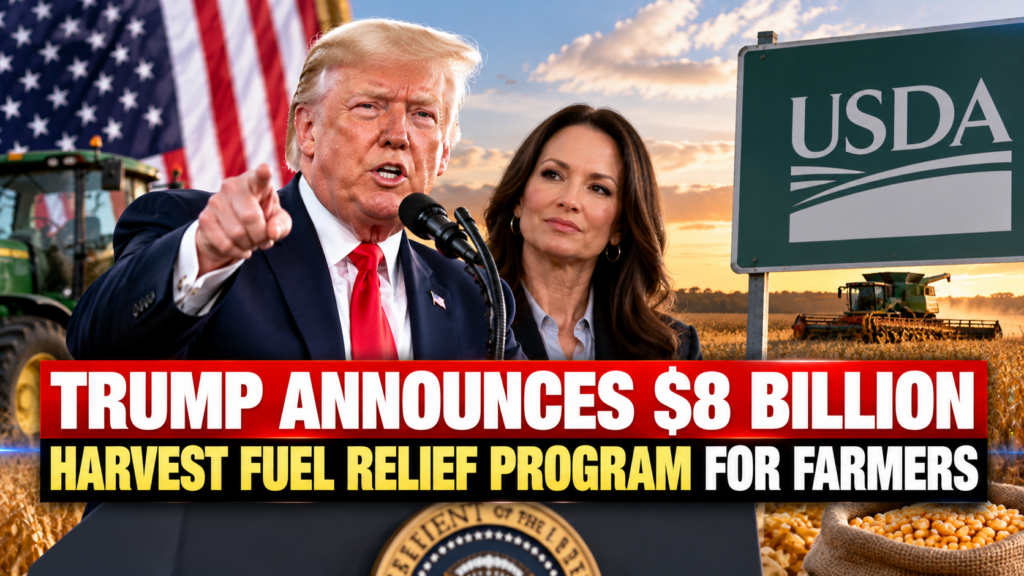
President Donald Trump announced an $8 billion Harvest Fuel Relief Program on October 19, 2026, to provide one-time payments to American farmers facing higher fuel and production costs during the 2026 harvest season. The U.S. Department of Agriculture (USDA) will administer the program to help agricultural producers manage temporary market disruptions and offset a portion of their modeled crop-year losses.
What Happened
Trump announced the Harvest Fuel Relief Program alongside Agriculture Secretary Brooke Rollins. The initiative will make $8 billion available for one-time payments to eligible American agricultural producers.
According to a report by the U.S. Department of Agriculture, the program is designed to provide targeted financial support during the harvest season, when farmers face higher operating expenses and market uncertainty.
The funding will be authorized under the Commodity Credit Corporation (CCC) Charter Act and administered by the USDA’s Farm Service Agency (FSA).
Rollins said the investment was intended to provide greater certainty for farmers as they work to complete the harvest and continue supplying food to the country.
Key Details of the Harvest Fuel Relief Program
How the $8 Billion in Payments Will Work
The Harvest Fuel Relief Program will provide one-time payments based on a uniform formula designed to cover a portion of modeled losses during the 2026 crop year.
According to the USDA, the calculation will use three main sources of agricultural data:
- Farm Service Agency (FSA) reported planted acres.
- Economic Research Service estimates of production costs.
- World Agricultural Supply and Demand Estimates for crop yields and prices.
The formula is intended to distribute support proportionally based on estimated losses rather than reimburse every farmer’s actual expenses in full.
The USDA said commodity-specific payment rates for crops covered under Title I would be released in November. Payment methods for other eligible commodities will be announced later.
Which Farmers May Qualify?
The program is designed to support eligible agricultural producers affected by higher input costs and market disruptions during the 2026 crop year.
Producers of Title I commodities will receive payment rates based on the program’s formula. The USDA is also considering how to determine payments for non-Title I commodities, including specialty crops and fisheries.
Farmers producing these other commodities are encouraged to submit information about increased fuel costs to HarvestFuel@usda.gov for consideration when the USDA determines payment rates.
Crop insurance will not be a requirement for participation in the Harvest Fuel Relief Program. However, the USDA has encouraged producers to use available risk-management tools to protect against future price volatility.
How Farmers Can Prepare to Apply
The USDA has encouraged potentially eligible producers to create a Login.gov account before the application period is announced.
Farmers who link their Login.gov accounts to USDA systems will be able to access pre-filled applications online when the application process opens.
The department has not yet announced all payment rates or the complete application timetable. Producers should therefore monitor official USDA announcements for further instructions.
Political and Economic Impact
Relief Amid Rising Farm Production Costs
The Harvest Fuel Relief Program comes as American farmers face increased costs for diesel and other agricultural inputs. Fuel is essential for operating tractors, harvesting machinery, irrigation systems, and transporting crops to market.
Higher production expenses can reduce farm profitability, particularly when crop prices do not rise enough to offset additional costs. The administration’s $8 billion initiative is intended to help producers manage these pressures during the current harvest.
However, the program will cover only a portion of modeled losses. The amount each eligible producer receives will depend on the USDA’s payment formula and the applicable commodity rates.
Part of a Broader Federal Farm Support Strategy
The new program builds on earlier financial assistance provided by the Trump administration.
According to the USDA, the Farmer Bridge Assistance program delivered $12 billion in one-time payments to more than 560,000 farmers earlier in 2026. The department also reported nearly $14 billion in gross payments through the Agriculture Risk Coverage and Price Loss Coverage programs.
The Harvest Fuel Relief Program adds another round of federal support as agricultural producers contend with rising input costs and market uncertainty.
The initiative also has a political dimension. Reuters reported that Trump announced the program during a campaign speech in Kansas ahead of the November 2026 midterm elections, when Republicans are seeking to maintain control of Congress.
What Happens Next
The USDA will release commodity-specific payment rates for Title I crops in November 2026. Further details on payment methods for other eligible commodities and the application process are expected to follow.
In the meantime, eligible producers can prepare by establishing a Login.gov account and linking it to their USDA accounts to facilitate access to pre-filled applications.
The program’s effectiveness will ultimately depend on how the funds are distributed, how much assistance farmers receive, and whether the payments meaningfully offset higher production costs.
The $8 billion Harvest Fuel Relief Program represents a significant federal commitment to supporting American agriculture during a challenging harvest season. Its broader impact will become clearer once payment rates are published and farmers begin receiving assistance.
Related Reading
- Trump Diesel Relief Could Save Drivers Up to $100 Per Fill
- Trump’s Russian Diesel Deal Draws Bipartisan Backlash Over Ukraine
The Harvest Fuel Relief Program is an $8 billion federal initiative providing one-time payments to eligible American farmers to offset a portion of modeled losses during the 2026 crop year.
The USDA plans to release commodity-specific payment rates for Title I crops in November 2026. The complete payment timetable and application details have not yet been announced.