The national debt under US presidents has become one of the most scrutinized aspects of American governance, reflecting the fiscal consequences of policy decisions, economic crises, and global events. From the nation's founding to the present day in 2026, the trajectory of federal debt has varied dramatically across administrations, shaped by wars, recessions, tax policies, and spending priorities. Understanding how different presidents have managed-or contributed to-the national debt provides essential context for evaluating executive leadership and the long-term fiscal health of the United States.
The Evolution of Presidential Debt Management
Presidential approaches to the national debt under US presidents have shifted substantially throughout American history. Early presidents faced relatively modest debt levels, primarily stemming from the Revolutionary War and infrastructure investments. The Office of Management and Budget historical tables reveal that the federal government's debt as a percentage of GDP remained manageable through much of the 19th century.
Founding Era Through the Civil War
George Washington inherited approximately $75 million in Revolutionary War debt when he took office in 1789. His Treasury Secretary, Alexander Hamilton, argued for federal assumption of state debts to establish creditworthiness. By the end of Washington's tenure, the debt had grown modestly but remained within sustainable bounds.
The Civil War marked a dramatic turning point. Abraham Lincoln presided over an explosion in federal borrowing to finance the Union war effort. The debt skyrocketed from $65 million in 1860 to over $2.7 billion by 1865, fundamentally transforming the relationship between presidential policy and national borrowing.
The World Wars and Depression
The 20th century brought unprecedented debt accumulation under several presidents:
- Woodrow Wilson saw debt rise from $2.9 billion to $25.5 billion due to World War I financing
- Franklin D. Roosevelt expanded federal debt through New Deal programs and World War II mobilization
- Harry Truman inherited the highest debt-to-GDP ratio in American history at war's end (approximately 106% in 1946)

Post-war presidents generally reduced debt as a percentage of GDP through economic growth, though absolute debt levels continued rising. The Congressional Research Service analysis of debt limits documents how these structural changes influenced later debates about fiscal responsibility.
Modern Era Debt Trajectories
The national debt under US presidents from Reagan forward reflects a new fiscal dynamic characterized by tax policy debates, entitlement expansion, and periodic crises.
Reagan Through Clinton
Ronald Reagan entered office promising fiscal conservatism but presided over substantial debt growth. Military spending increases combined with tax cuts drove the debt from $997 billion in 1981 to $2.85 trillion by 1989. Reagan-era policies fundamentally reshaped debates about the relationship between tax revenue and borrowing.
| President | Starting Debt | Ending Debt | Percentage Increase |
|---|---|---|---|
| Reagan | $997B (1981) | $2.85T (1989) | 186% |
| Bush (41st) | $2.85T (1989) | $4.41T (1993) | 55% |
| Clinton | $4.41T (1993) | $5.77T (2001) | 31% |
George H.W. Bush faced economic headwinds and a savings-and-loan crisis, adding $1.56 trillion to the debt despite breaking his "no new taxes" pledge. Bill Clinton benefited from the dot-com boom and worked with a Republican Congress to balance budgets in his second term, though the absolute debt level still rose.
The Twenty-First Century Surge
The national debt under US presidents in the 21st century accelerated dramatically due to terrorism, financial crisis, healthcare reform, pandemic response, and structural fiscal imbalances.
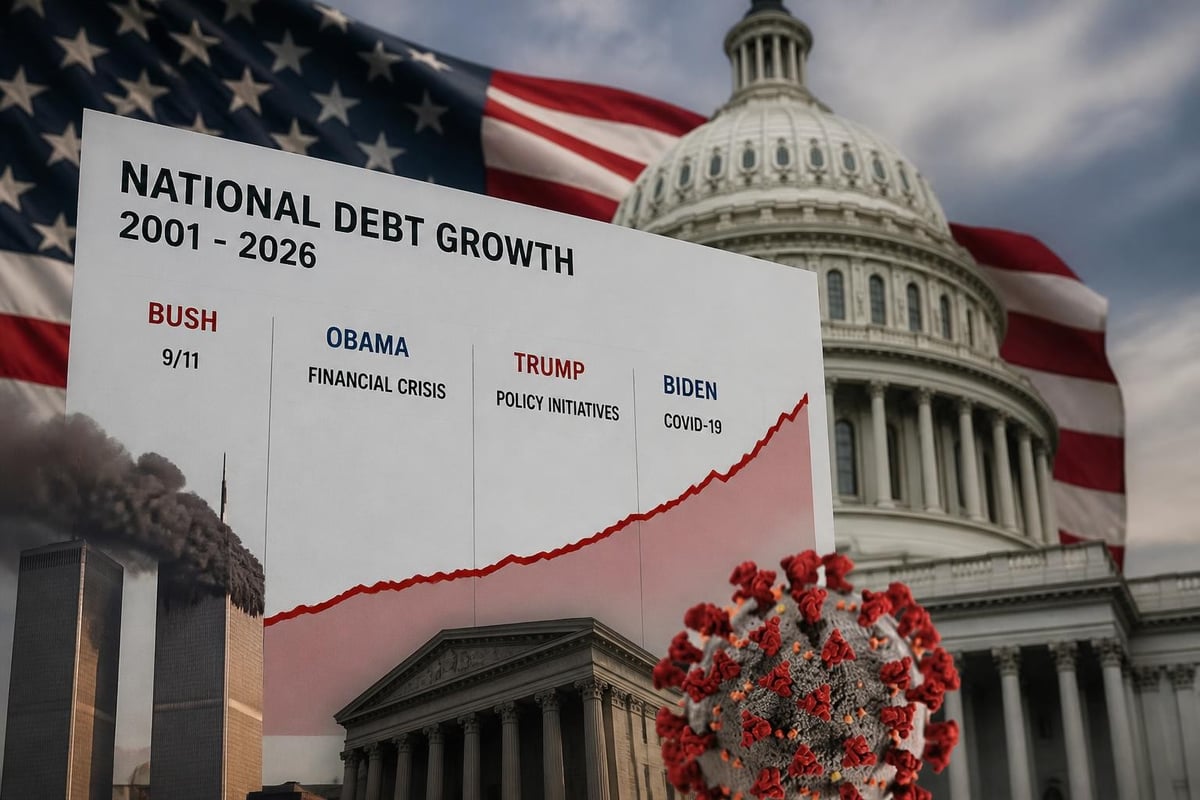
George W. Bush inherited a $5.77 trillion debt in 2001. The September 11 attacks, subsequent wars in Afghanistan and Iraq, Medicare Part D expansion, and the 2008 financial crisis pushed the debt to $11.91 trillion by January 2009. The Brookings Institution’s analysis of tax cuts and budget outlook provides detailed examination of how the Bush-era tax cuts influenced long-term fiscal trajectories.
Barack Obama took office during the Great Recession, implementing stimulus measures and financial sector rescues. The debt nearly doubled during his tenure, rising from $11.91 trillion to $19.95 trillion by 2017. Crisis response, automatic stabilizers, and the Affordable Care Act all contributed to this increase.
Trump and Biden Administrations
Donald Trump campaigned on reducing the national debt but presided over significant increases even before the COVID-19 pandemic. Tax cuts, spending increases, and eventually pandemic relief pushed the debt from $19.95 trillion to $27.75 trillion by January 2021.
Joe Biden has continued high spending levels through infrastructure investment, climate initiatives, and student loan forgiveness attempts. As of October 2026, the national debt exceeds $35 trillion. Those interested in current presidential policy analysis can find ongoing coverage of fiscal decisions and their implications.
Factors Driving Debt Accumulation
Wars and National Emergencies
Every major American military conflict has substantially increased the national debt under US presidents. Wars require immediate, massive resource mobilization that cannot be fully funded through taxation alone:
- Revolutionary War – Established initial federal debt
- Civil War – First major debt explosion (over 4,000% increase)
- World War I – Debt rose approximately 800%
- World War II – Debt increased over 500% from 1940 to 1945
- Afghanistan and Iraq Wars – Added trillions across Bush, Obama, and Trump administrations
The COVID-19 pandemic represented a modern equivalent, requiring multi-trillion-dollar emergency responses under both Trump and Biden.
Economic Crises and Recessions
Recessions automatically increase deficits through reduced tax revenue and increased safety-net spending. Presidential responses to economic downturns significantly shape debt trajectories:
- Great Depression – New Deal spending under Roosevelt
- 1970s Stagflation – Challenged Ford and Carter with low growth and high inflation
- 2008 Financial Crisis – Stimulus and bailouts under Bush and Obama
- COVID-19 Recession – Historic economic disruption requiring unprecedented fiscal response
The Peter G. Peterson Foundation’s comprehensive fiscal plans examine how presidents and Congress might address structural deficits created by economic shocks.
Tax Policy Changes
Presidential tax policies directly affect revenue collection and debt accumulation. Major tax legislation has significantly influenced the national debt under US presidents:
Revenue-reducing measures:
- Reagan tax cuts (1981, 1986)
- Bush tax cuts (2001, 2003)
- Trump Tax Cuts and Jobs Act (2017)
Revenue-increasing measures:
- Bush (41st) tax increase (1990)
- Clinton tax increase (1993)
- Affordable Care Act taxes (2010)
| Tax Policy Era | Primary Approach | Debt Impact |
|---|---|---|
| 1940s-1970s | High marginal rates, war financing | Post-war debt reduction as % of GDP |
| 1980s-2000s | Supply-side cuts, deregulation | Absolute debt growth acceleration |
| 2010s-2020s | Mixed approaches, crisis response | Unprecedented debt levels |
Mandatory Spending Growth
Entitlement programs now dominate federal spending, constraining presidential fiscal flexibility. Social Security, Medicare, and Medicaid spending increases largely automatically based on demographics and healthcare costs, not annual appropriations decisions.
Presidents have limited ability to control these expenditures without legislative reform. The aging Baby Boomer generation has accelerated this trend, with mandatory spending now consuming approximately 70% of the federal budget in 2026.
Measuring Presidential Fiscal Responsibility
Absolute Versus Relative Metrics
Evaluating the national debt under US presidents requires careful consideration of measurement approaches. Absolute debt increases can mislead because they ignore economic growth, inflation, and starting conditions.
Key metrics include:
- Debt-to-GDP ratio – Most meaningful comparison across eras
- Percentage increase – Shows relative growth during term
- Per capita debt – Accounts for population changes
- Real (inflation-adjusted) debt – Removes price-level distortions
Franklin Roosevelt added more debt in percentage terms than any modern president, yet reduced the debt-to-GDP ratio through economic growth. Conversely, some recent presidents have presided over debt growth that outpaced GDP expansion.
Presidential Versus Congressional Responsibility
The Constitution grants Congress the "power of the purse," complicating efforts to assign debt responsibility solely to presidents. Tax legislation, appropriations, and debt ceiling increases all require legislative action.
Divided government often produces fiscal outcomes neither party prefers. Clinton-era budget surpluses emerged from Republican congressional pressure and Democratic presidential priorities finding common ground. The TreasuryDirect public debt reports provide authoritative data on how debt accumulated month-by-month across these political dynamics.
Historical Context and Political Narratives
Partisan Perspectives on Debt
Political parties have alternated positions on debt depending on who controls the White House. Republicans traditionally emphasized fiscal conservatism but presided over major debt increases under Reagan, both Bushes, and Trump. Democrats criticized these increases while defending their own crisis-driven borrowing under Obama and Biden.
This partisan inconsistency reflects competing priorities:
- Republican emphasis – Tax reduction, military spending, deregulation
- Democratic emphasis – Social programs, healthcare expansion, infrastructure
- Bipartisan reality – Neither party has sustained deficit reduction when governing
Crisis Justifications
Presidents consistently cite extraordinary circumstances to justify debt increases. Few administrations have prioritized debt reduction when facing immediate challenges:
- Economic recession requiring stimulus
- National security threats demanding military spending
- Infrastructure deficiencies needing investment
- Healthcare crises requiring intervention
- Natural disasters necessitating relief
These justifications may be legitimate, but they collectively explain why the national debt under US presidents has grown almost continuously since the nation's founding. Readers following current presidential policy debates recognize these patterns repeating across administrations.
Long-Term Fiscal Challenges
Demographic Pressures
The most significant driver of future debt growth is demographic change rather than presidential discretion. An aging population means:
- Higher Social Security outlays
- Increased Medicare spending
- Rising healthcare costs overall
- Slower labor force growth
- Reduced tax revenue per capita
No president can reverse these demographic realities without fundamental entitlement reform, which remains politically challenging regardless of party control.
Interest on the Debt
As debt accumulates, interest payments consume increasing portions of the federal budget. In 2026, net interest costs exceed $800 billion annually, surpassing defense spending. Rising interest rates have accelerated this trend.
Future presidents will face increasingly constrained budgets as debt service crowds out discretionary spending. This dynamic creates a self-reinforcing cycle where debt generates more debt through compounding interest obligations.
Structural Deficit Solutions
Addressing long-term debt trajectories requires presidential leadership on difficult trade-offs:
Revenue options:
- Tax increases on high earners
- Broadening the tax base
- Carbon or consumption taxes
- Closing corporate loopholes
Spending options:
- Entitlement benefit adjustments
- Eligibility age increases
- Means testing for benefits
- Healthcare cost containment
- Defense spending reductions
Most comprehensive fiscal plans involve combinations of revenue increases and spending restraint. The political challenge is that voters prefer neither tax increases nor benefit cuts, creating gridlock that perpetuates deficit spending.
Comparing Presidential Records
Best and Worst Performers
Ranking presidents by fiscal responsibility depends heavily on chosen metrics and context. By debt-to-GDP reduction, Harry Truman and Dwight Eisenhower excel, benefiting from post-war economic growth. By absolute restraint, Calvin Coolidge reduced nominal debt in the 1920s.
By debt increase, recent presidents dominate due to larger baseline debt and economic scale. Obama, Trump, and Biden have each added more debt in absolute terms than all presidents through Reagan combined, though this partly reflects the economy's size.
Exceptional Circumstances Defense
Nearly every president can claim exceptional circumstances:
- Lincoln faced existential civil war
- Both Roosevelts confronted depression and world war
- Reagan claimed Soviet containment necessity
- Bush (43rd) responded to terrorism and financial crisis
- Obama inherited the Great Recession
- Trump and Biden dealt with pandemic fallout
This pattern suggests that exceptional circumstances are the norm rather than the exception, making "normal" fiscal conditions rare. Those tracking presidential decision-making observe how successive administrations navigate these recurring challenges.
Institutional Constraints
Modern presidents face structural deficits built into the budget regardless of policy choices. With mandatory spending locked in, annual deficits occur even before discretionary appropriations. Reversing this trajectory requires either:
- Economic growth substantially exceeding spending growth (rare)
- Major legislative reforms to entitlements (politically difficult)
- Significant tax increases (electorally risky)
- Dramatic spending cuts (affecting popular programs)
These constraints mean the national debt under US presidents will likely continue rising absent major institutional changes or sustained economic booms.
Future Outlook and Presidential Options
Sustainable Debt Levels
Economists debate whether current debt levels threaten economic stability. Some argue that as long as economic growth exceeds interest rates, debt sustainability remains achievable. Others warn that confidence crises could trigger rapid interest rate spikes, making debt service unmanageable.
The Congressional Budget Office projects debt exceeding 200% of GDP by 2050 under current law, a level unprecedented in peacetime American history. Future presidents must confront whether this trajectory is sustainable or requires correction.
Political Will and Public Opinion
Public concern about the national debt under US presidents fluctuates with economic conditions and partisan control. Voters consistently tell pollsters they oppose both tax increases and spending cuts, creating impossible political mathematics.
Presidential leadership theoretically could overcome this gridlock through persuasion and coalition-building. In practice, recent presidents have found debt reduction politically unrewarding and fiscally challenging given competing priorities.
Global Comparisons
The United States maintains unique advantages in managing high debt:
- Dollar's reserve currency status
- Deep, liquid Treasury markets
- Strong rule of law and institutions
- Diverse, innovative economy
- Military and geopolitical strength
These factors allow the US to sustain higher debt levels than most nations. However, they don't eliminate fiscal constraints indefinitely. As debt rises, these advantages could erode if creditors lose confidence in American fiscal governance.
The national debt under US presidents reflects the accumulated policy choices, crisis responses, and structural fiscal dynamics across American history. While individual presidents bear responsibility for decisions during their tenure, the debt trajectory results from deeper institutional factors including entitlement structure, tax policy frameworks, and recurring emergencies that demand fiscal responses. Understanding this complex history helps citizens evaluate current leadership and future policy options. For comprehensive, non-partisan coverage of presidential fiscal policy and other governance issues, explore the analysis and reporting available at U.S. Presidential Report, where you'll find ongoing coverage of how current and past presidents shape America's fiscal future.