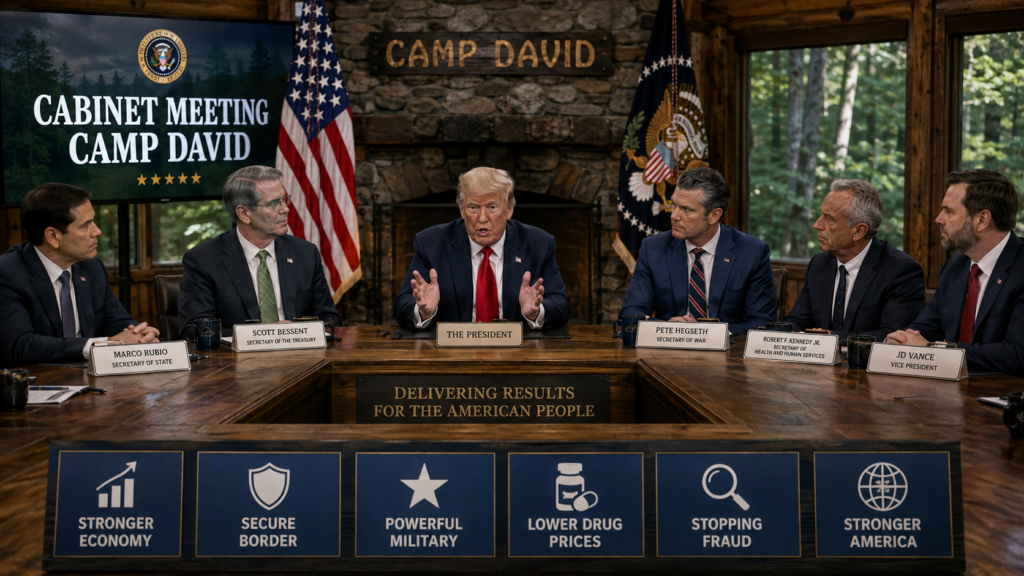
President Donald Trump convened the first live televised Cabinet meeting ever held at Camp David, using the historic gathering to highlight his administration’s accomplishments on the economy, border security, national defense, healthcare, and foreign policy. Senior Cabinet officials also outlined progress on anti-fraud efforts, military modernization, prescription drug costs, and economic initiatives during the meeting.
According to a report by The White House, the meeting marked the first televised Cabinet session from the presidential retreat and served as an update on the administration’s policy agenda after nearly 18 months in office.
What Happened?
President Trump opened the Cabinet meeting by highlighting what he described as major improvements in border security, crime reduction, inflation, and economic performance since returning to office.
The president said his administration inherited significant economic and security challenges but argued that policies implemented over the past 18 months have strengthened the U.S. economy, reduced illegal border crossings, and increased public safety.
The meeting featured updates from several Cabinet members covering domestic policy, national security, healthcare, and foreign affairs.
Key Highlights From the Cabinet Meeting
Economy and Tax Policies
Treasury Secretary Scott Bessent highlighted several economic indicators that he said demonstrate continued growth.
Among the administration’s priorities, Bessent cited:
- Working Families Tax Cuts.
- No Tax on Tips.
- No Tax on Overtime.
- No Tax on Social Security benefits.
- Tax deductions for auto loans on qualifying American-made vehicles.
He also said manufacturing activity has expanded for six consecutive months while reporting higher consumer confidence and wage growth among lower-income workers.
The administration linked these initiatives to its broader domestic economic agenda, including policies surrounding Trump’s clean energy grants reforms designed to encourage domestic investment.
Trump Accounts Program
President Trump and Secretary Bessent highlighted the launch of the new “Trump Accounts,” tax-free investment savings accounts created under recently enacted legislation.
Administration officials said more than seven million children have already been enrolled, describing the program as one of the largest government savings initiatives introduced during Trump’s second term.
National Security and Defense
Military Investment
Secretary of War Pete Hegseth outlined plans to continue expanding defense investment while emphasizing recruitment, military readiness, and domestic defense manufacturing.
According to Hegseth, private defense companies have committed approximately $75 billion in investments to expand production facilities, manufacturing capacity, and weapons production inside the United States.
Administration officials also reaffirmed support for increased defense spending while emphasizing that future military equipment would continue to be manufactured domestically.
The broader defense strategy complements initiatives such as Trump’s nuclear innovation agenda intended to strengthen America’s long-term national security capabilities.
Foreign Policy Updates
Secretary of State Marco Rubio provided updates on several international issues, including:
- U.S. efforts regarding the International Criminal Court.
- Diplomatic engagement involving Israel and Lebanon.
- Developments related to Hamas disarmament discussions.
- Cooperation with governments across the Western Hemisphere.
Rubio said the administration continues pursuing policies focused on strengthening American leadership abroad while expanding relationships with allied governments.
Healthcare and Prescription Drug Costs
Health and Human Services Secretary Robert F. Kennedy Jr. discussed the administration’s prescription drug pricing initiative.
Kennedy said the TrumpRx program has already generated approximately $700 million in savings and now includes more than 800 medications through partnerships with companies including Amazon and GoodRx.
The administration said it expects additional medications to become available through the program while continuing efforts to reduce prescription drug prices.
Anti-Fraud Initiative
Vice President JD Vance reported progress from the administration’s federal Fraud Task Force.
According to Vance, investigators have identified approximately $230 billion in alleged fraud affecting government programs and have already prevented roughly $56 billion in fraudulent activity.
He also announced 17 additional anti-fraud actions valued at approximately $330 million.
What Happens Next?
The Camp David meeting provided an opportunity for Cabinet officials to outline the administration’s policy priorities across multiple areas, including economic growth, healthcare, defense, fraud prevention, and foreign affairs.
As Congress considers additional legislation and agencies continue implementing executive initiatives, the administration is expected to focus on expanding domestic manufacturing, strengthening national security, reducing prescription drug costs, and advancing its broader economic agenda through the remainder of President Trump’s second term.
It marked the first live televised Cabinet meeting ever held at Camp David, bringing together senior administration officials to discuss key policy priorities.
Officials addressed the economy, tax policy, border security, military investment, healthcare, prescription drug pricing, anti-fraud efforts, and foreign policy.