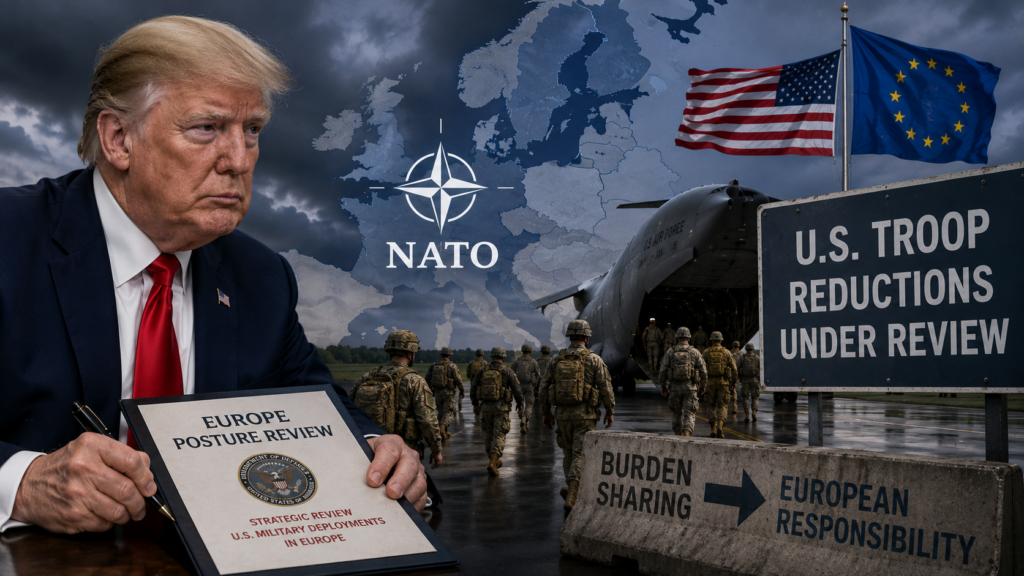
The Trump administration has launched a strategic review of U.S. military deployments across Europe, signaling potential troop reductions that could reshape NATO’s defense structure. The six-month review is intended to encourage European allies to assume greater responsibility for the continent’s security, but defense experts warn the transition could create short-term security risks for the alliance.
According to a report by EUobserver, the Pentagon’s Europe Posture Review aims to accelerate what some officials describe as a more balanced and sustainable version of NATO while shifting more conventional defense responsibilities to European members.
What Happened?
The U.S. formally launched its Europe Posture Review on July 27 as part of a broader reassessment of American military commitments overseas.
Elbridge Colby, the U.S. Under Secretary of War, said the review is designed to accelerate NATO’s transition toward a stronger alliance in which European allies assume greater responsibility for conventional defense while the United States provides more targeted support.
The review follows remarks by Defense Secretary Pete Hegseth during NATO defense ministers’ meetings in Brussels, where he confirmed that allied nations would be evaluated on their readiness to shoulder greater defense responsibilities.
Key Details
Pentagon Reviewing U.S. Military Presence
The review is expected to take approximately six months and will examine the size, location, and strategic role of American forces stationed across Europe.
Administration officials argue the assessment aligns with the 2026 U.S. National Defense Strategy, which prioritizes preparing for growing strategic competition in the Indo-Pacific while encouraging European allies to strengthen their own military capabilities.
The review is intended to determine how NATO can evolve into a more balanced alliance with greater burden-sharing among member states.
The Vision for “NATO 3.0”
Elbridge Colby has previously described his vision as “NATO 3.0,” a model in which European countries become the primary providers of conventional defense on the continent.
Supporters argue that recent commitments by NATO members to increase defense spending—from the long-standing target of 2% of GDP to a higher long-term goal—make this transition more achievable.
Under this approach, the United States would continue providing critical capabilities while reducing its overall military footprint in Europe.
Why the Review Is Taking Place
The troop review follows several developments that have influenced the administration’s defense strategy.
Among them were disagreements between Washington and some European allies over the use of military bases during operations involving Iran. The administration has also emphasized that future U.S. defense planning must allocate more military resources toward the Indo-Pacific in response to evolving security challenges.
The review reflects the administration’s broader effort to realign military resources while encouraging allies to increase defense readiness.
Concerns Over a Transition Gap
While many policymakers agree Europe should expand its defense capabilities, several security experts caution that reducing U.S. troop levels too quickly could create a temporary “transition gap.”
Critics argue European militaries still rely heavily on American logistics, intelligence, command-and-control systems, air defense, and strategic transportation.
A rapid withdrawal of U.S. forces before those capabilities are fully developed could weaken NATO’s deterrence posture during the transition period.
Supporters of the review counter that clearly signaling future reductions could accelerate defense investments already pledged by European governments.
Political and Strategic Impact
The Europe Posture Review represents one of the most significant reassessments of U.S. military commitments to NATO in recent years.
If implemented, the review could redefine burden-sharing within the alliance while allowing the United States to devote additional resources to strategic competition elsewhere.
The administration’s emphasis on shifting priorities also complements broader national security initiatives, including Trump’s strategy during the Iran conflict and Strait of Hormuz tensions, which have highlighted competing global military demands.
Likewise, the review aligns with wider efforts to strengthen U.S. technological and defense competitiveness, including Trump’s 6G alliance strategy to counter China.
What Happens Next?
The Pentagon’s Europe Posture Review is expected to conclude within six months, after which the administration could announce adjustments to U.S. troop deployments across Europe.
Any recommendations would likely be coordinated with NATO allies and could influence alliance planning for years to come. While the administration views the review as an opportunity to build a more sustainable NATO, European governments and defense analysts will be closely watching whether the transition preserves deterrence while avoiding potential security gaps.
The review aims to encourage NATO allies to take greater responsibility for Europe’s defense while allowing the U.S. to rebalance military resources toward other strategic priorities.
“NATO 3.0” refers to a proposed model in which European allies lead conventional defense efforts with continued but more limited U.S. military support.