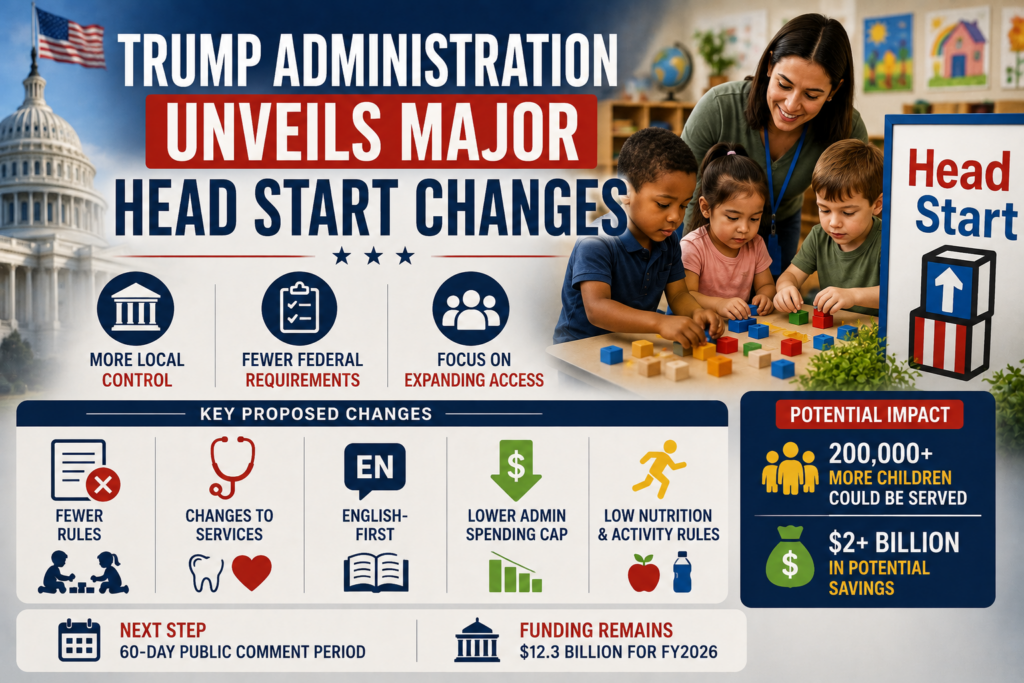
The Trump administration has proposed sweeping Head Start changes that would eliminate nearly 1,400 federal regulatory requirements, reduce administrative costs and give states and local providers greater control over the early childhood program.
According to a report by Upper Michigan’s Source, the Department of Health and Human Services unveiled the proposal on August 6, with the changes now subject to a 60-day public comment period.
What Happened
The Trump administration is seeking to substantially rewrite the federal rules governing Head Start, which provides early education and other services to hundreds of thousands of children from low-income families.
The proposed rule would remove nearly 1,400 existing federal requirements and give states and local Head Start providers more flexibility over how programs operate.
The administration says the current regulations create unnecessary costs and administrative burdens that limit the number of children providers can serve.
The Associated Press reported that HHS officials estimate the changes could save more than $2 billion and potentially create more than 200,000 additional enrollment slots.
Key Head Start Changes
Nearly 1,400 Regulations Could Be Eliminated
Head Start currently operates under extensive federal standards covering staffing, classroom sizes, curriculum, health services and family engagement.
The Trump administration wants to remove most of these detailed federal requirements.
Under the proposal, providers would rely more heavily on state and local childcare licensing standards for issues such as staffing and classroom operations.
HHS officials argue that local providers are better positioned to determine how services should be delivered based on the needs of their communities.
Staffing and Class Sizes
The proposed changes would eliminate several federal requirements governing staff-to-child ratios and classroom sizes.
Supporters say this could allow providers to enroll more children without having to meet the comparatively strict staffing requirements currently imposed by Head Start.
Critics argue that larger classes and fewer staff members could reduce the amount of individualized attention children receive.
The concern comes as many Head Start providers are already dealing with staffing shortages and rising operating costs.
Health and Family Services Could Change
Medical and Dental Services
The proposed Head Start changes would remove many detailed federal requirements related to health services.
Head Start currently provides children with access to services such as medical and dental screenings and developmental assessments.
The proposal would also eliminate certain federal requirements involving lead exposure prevention and other health-related services.
The administration says greater local flexibility could allow providers to determine which services are most appropriate for their communities.
Critics counter that federal health requirements help ensure that children receive a consistent level of support regardless of where they live.
Family Engagement
The proposal would also remove several federal requirements governing family engagement.
Current Head Start rules require programs to work with parents and help families establish goals related to children’s development and household stability.
Under the proposed system, many of those requirements would no longer be federally mandated.
Head Start advocates have warned that reducing these requirements could weaken the program’s broader family-support mission.
New Requirements Would Also Be Introduced
The proposal is not solely focused on eliminating regulations. It would also introduce several new requirements.
English-Language Instruction
The administration would require Head Start instruction to be conducted in English, with an exception for certain tribal programs that use Native-language immersion.
The proposal follows Trump’s broader push to promote English as the country’s official language.
Lower Administrative Spending Cap
The administration would reduce the maximum share of Head Start funding that providers can spend on administrative costs from 15% to 5%.
Officials argue that the change would direct more federal funding toward services for children and families.
Physical Activity and Nutrition
The proposed rules would establish new physical activity and nutrition requirements.
Programs would have to provide 30 minutes of physical activity for every three and a half hours of program time, with outdoor activity encouraged when weather permits.
The proposal would also require nutrition education addressing the health effects of sugar-sweetened beverages and grain-based desserts.
The nutrition provisions align with Health Secretary Robert F. Kennedy Jr.’s broader Make America Healthy Again agenda.
Trump Administration Says Changes Could Expand Access
The administration argues that the Head Start changes could make the program more efficient and allow providers to serve additional children.
HHS estimates that reducing federal regulatory requirements could save more than $2 billion.
Officials also estimate that the changes could potentially create more than 200,000 additional enrollment opportunities.
The proposal reflects a broader Trump administration approach of reducing federal regulations and giving states greater authority over federally funded programs.
A similar state-focused approach is visible in Trump’s Medicaid work requirement changes, which give states a greater role in implementing new federal eligibility requirements.
Critics Warn of Weaker Standards
Head Start advocates and former program officials have criticized the proposal, arguing that it could weaken the quality of services available to children.
State childcare licensing standards generally focus on basic health and safety requirements. Head Start’s federal standards, by contrast, cover a much broader range of educational, health and family-support services.
Critics say replacing those federal standards with state-level requirements could create significant differences between Head Start programs in different parts of the country.
Former Head Start leader Khari Garvin has described the proposal as a significantly weakened version of the program. (apnews.com)
Opponents also question whether larger classes and reduced staffing requirements would actually improve access or simply reduce the quality of care.
Impact on Low-Income Families
Head Start serves approximately 700,000 children, including children from low-income families and children experiencing homelessness, living in foster care or with disabilities.
Unlike conventional preschool programs, Head Start combines early education with health, nutrition and family-support services.
That means the proposed Head Start changes could affect families beyond the classroom.
For parents who depend on Head Start for developmental screenings, nutrition assistance or other family services, changes to federal standards could alter the type and level of support available through local programs.
The debate is therefore also about whether Head Start should remain a nationally standardized program or become a more locally controlled early childhood system.
Broader Trump Administration Policy Agenda
The Head Start proposal is part of a wider administration effort to reduce federal regulation and shift greater responsibility to states and local institutions.
Trump has pursued similar changes across several areas of domestic policy, arguing that federal agencies have accumulated excessive regulations and bureaucracy.
The administration’s broader policy direction has also been discussed at high-level meetings, including Trump’s Cabinet meeting at Camp David, where officials have addressed major priorities across the federal government.
For Head Start, the administration argues that reducing federal requirements can make the program more flexible and efficient.
Critics counter that federal standards exist to ensure children receive comparable services regardless of where they live.
What Happens Next
The proposed rule is not yet final.
HHS has opened a 60-day public comment period during which parents, educators, childcare providers, state officials and advocacy organizations can submit feedback.
The department can revise the proposal after reviewing public comments before issuing a final rule.
The changes could also face legal challenges, potentially delaying implementation.
Until a final rule takes effect, Head Start providers remain subject to the existing federal requirements.
Why the Head Start Changes Matter
The Trump administration’s Head Start changes could fundamentally reshape one of the nation’s largest federally funded early childhood programs.
Supporters say eliminating unnecessary regulations could reduce costs, increase enrollment and give local providers more flexibility. Critics warn that removing federal standards could weaken staffing levels, health services, educational quality and family support.
The final outcome will depend on the public comment process, any revisions made by HHS and potential legal challenges. The central question will be whether greater state and local flexibility can expand access to Head Start without reducing the comprehensive services that have defined the program for decades.
The proposal would eliminate nearly 1,400 federal regulations, increase state and local control, change staffing and health requirements, and add new nutrition and physical activity rules.
No. The proposal would restructure Head Start regulations rather than eliminate the program or its existing fiscal-year 2026 funding. Congress appropriated more than $12.3 billion for Head Start programs.