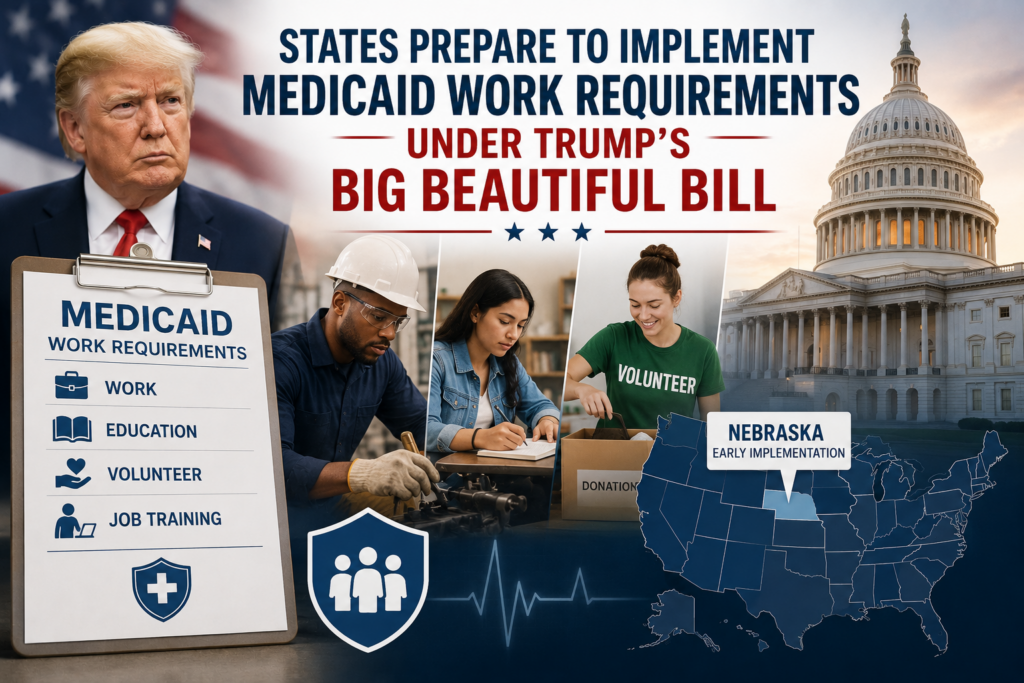
States across the country are preparing to implement new Medicaid work requirements established under President Donald Trump’s Big Beautiful Bill, with Nebraska becoming one of the first states to enforce the policy. The new federal rules will require millions of Medicaid recipients to meet work, education, or volunteer requirements to maintain health coverage, while supporters argue the changes promote employment and fiscal responsibility and critics warn they could increase coverage losses.
According to a report by NPR, Nebraska launched the program months ahead of the federal deadline, making it an early test case for one of the largest Medicaid policy changes since the Affordable Care Act.
What Happened?
The Medicaid work requirements included in President Trump’s Big Beautiful Bill require many adult Medicaid recipients to work, volunteer, attend school, or participate in job training for at least 80 hours per month to remain eligible for benefits.
Under the law, states must implement the new requirements by Jan. 1, but Nebraska elected to begin enforcement on Aug. 1, becoming one of the first states to do so.
Nebraska Medicaid Director Drew Gonshorowski said approximately 200 beneficiaries are expected to lose coverage during the initial implementation while the state carefully reviews eligibility decisions to minimize errors.
Key Details
Who Must Meet the Requirements?
Federal officials estimate that approximately 20 million Medicaid recipients across 44 states could eventually be subject to the new work requirements.
Individuals generally must:
- Work at least 80 hours per month.
- Volunteer.
- Attend school.
- Participate in approved job training programs.
Several groups are exempt, including:
- People with disabilities.
- Individuals with serious illnesses.
- Parents of young children.
- Caregivers.
- Other qualifying populations defined under federal rules.
Nebraska officials estimate roughly 70,000 residents in the state are subject to the new requirements.
Nebraska Launches Early
Nebraska officials said they decided to implement the policy ahead of schedule because the state operates its own Medicaid eligibility system.
According to Medicaid Director Drew Gonshorowski, Nebraska can automatically verify compliance for approximately three-quarters of recipients without requesting additional paperwork from beneficiaries.
State officials also launched a public outreach campaign that included:
- Mailed notices.
- Text messages.
- Emails.
- Television advertisements.
- Radio advertisements.
Despite those efforts, healthcare advocates argue many low-income residents remain uncertain about whether the new rules apply to them.
Supporters Say the Policy Encourages Employment
Supporters of Medicaid work requirements argue the policy is designed to encourage greater workforce participation while helping recipients achieve long-term financial independence.
Nebraska officials also believe the policy will improve coordination between Medicaid and state workforce agencies by connecting beneficiaries with employment opportunities.
Supporters further point to federal projections estimating the policy could reduce government spending by approximately $325 billion over ten years.
The administration has promoted the broader legislation as part of its domestic policy agenda, alongside initiatives such as Trump’s clean energy grants reforms intended to reshape federal spending priorities.
Critics Warn of Coverage Losses
Opponents argue previous state experiments with Medicaid work requirements produced little evidence that beneficiaries secured more employment.
Instead, researchers found that many recipients lost coverage because they:
- Were unaware of reporting requirements.
- Experienced administrative errors.
- Struggled with paperwork.
- Had difficulty accessing state assistance.
Recent estimates cited in the report project between 3 million and 8.6 million people nationwide could lose Medicaid coverage by 2028, including approximately 30,000 Nebraskans.
Healthcare organizations have also raised concerns that call center delays and confusing notices may make compliance more difficult for eligible recipients.
What Happens Next?
As additional states prepare to implement the new Medicaid work requirements before the federal deadline, policymakers will closely monitor enrollment trends, appeals, and administrative challenges.
Nebraska officials said one of the key measures of success will be the number of Medicaid recipients who file appeals after losing coverage, which they believe will help determine whether eligibility decisions are being implemented fairly and accurately.
The rollout is expected to shape future debates over Medicaid reform and federal healthcare policy as other states adopt similar requirements under President Trump’s Big Beautiful Bill. The implementation also reflects the administration’s broader domestic agenda, which includes reforms affecting healthcare, workforce participation, and public spending priorities alongside initiatives such as Trump’s hospital records policy discussions.
Most affected adult Medicaid recipients must work, volunteer, attend school, or complete job training for at least 80 hours each month to maintain coverage, unless they qualify for an exemption.
States must implement the federal requirements by Jan. 1, with Nebraska among the first to begin enforcement ahead of the deadline