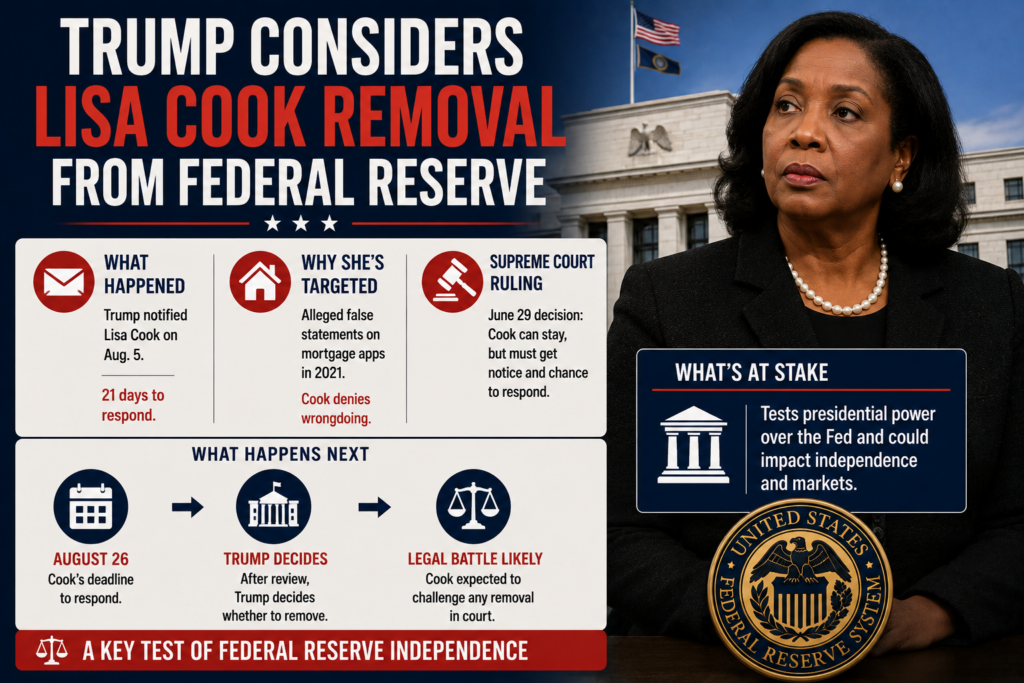
President Donald Trump has renewed his effort to remove Federal Reserve Governor Lisa Cook, notifying her that he is considering her removal over allegations involving mortgage applications filed before she joined the central bank. The move follows a June Supreme Court ruling that blocked Trump’s earlier attempt to remove Cook without giving her an opportunity to respond.
According to a report by SCOTUSblog, the White House formally notified Cook that Trump is considering removing her from the Federal Reserve Board of Governors.
What Happened
The Trump administration has restarted its effort to remove Lisa Cook from the Federal Reserve after the Supreme Court ruled in June that she could remain in office while challenging the president’s earlier attempt to fire her.
A letter dated August 5 and signed by White House Deputy Chief of Staff Dan Scavino informed Cook that Trump was considering her removal. The administration gave her 21 days to respond to allegations that she made false statements on mortgage agreements.
Cook’s deadline to respond is August 26.
The allegations concern mortgage documents from 2021, before Cook became a Federal Reserve governor. Federal Housing Finance Agency Director Bill Pulte previously accused Cook of listing properties in Michigan and Georgia as primary residences on separate mortgage applications.
Cook has denied wrongdoing and has maintained that Trump’s effort to remove her is unlawful.
Why Trump Is Targeting Lisa Cook
Mortgage Fraud Allegations
The dispute began in August 2025 when Pulte publicly accused Cook of mortgage fraud.
The allegations center on claims that Cook identified two properties as primary residences on mortgage documents, potentially allowing her to receive more favorable loan terms.
Trump subsequently attempted to remove Cook, saying he had sufficient reason to believe she had made false statements on mortgage agreements.
Cook challenged the removal in federal court, arguing that the president lacked legal authority to dismiss her without meeting the Federal Reserve Act’s requirements.
No criminal conviction has established that Cook committed mortgage fraud, and the renewed White House action remains an allegation rather than a judicial finding of wrongdoing.
Supreme Court Ruling Changed the Process
The latest removal effort follows a closely watched Supreme Court decision in Trump v. Cook issued on June 29, 2026.
The Supreme Court ruled 5-4 against the administration’s request to immediately remove Cook while the litigation continued. The Court emphasized that Federal Reserve governors serve staggered 14-year terms and can be removed only “for cause.”
The Court’s opinion also held that Cook was entitled to notice and an opportunity to respond before being terminated.
The decision did not permanently prevent Trump from pursuing Cook’s removal. Instead, it required the administration to follow the appropriate process.
Chief Justice John Roberts’ opinion indicated that the president could make another removal attempt if Cook was given an opportunity to contest the allegations.
The White House’s new notice appears designed to address that procedural requirement.
Cook’s Response and Legal Fight
Cook’s legal team has strongly rejected the administration’s allegations.
Her attorney, Abbe Lowell, said the allegations were baseless and argued that there is no valid cause for removing the Federal Reserve governor.
The renewed effort is expected to trigger another legal battle if Trump ultimately decides to dismiss Cook after reviewing her response.
Cook remains a member of the Federal Reserve Board while the process continues.
The dispute has therefore moved beyond the question of mortgage documents and into a larger constitutional and institutional fight over the independence of the nation’s central bank.
Federal Reserve Independence at Stake
The Lisa Cook removal effort has significant implications for the Federal Reserve’s independence.
The Federal Reserve is designed to operate with substantial independence from direct presidential control. Governors are appointed by the president and confirmed by the Senate, but they serve lengthy terms and are protected by statutory removal provisions.
The Supreme Court’s June ruling specifically emphasized the historical importance of an independent central bank and warned that allowing governors to be removed at will could undermine the protections established by Congress.
That makes Trump’s renewed effort to remove Cook an important test of how far presidential authority extends over the Federal Reserve.
The controversy also comes as Trump has repeatedly pushed for lower interest rates and criticized Federal Reserve officials when monetary policy has not matched his preferences.
Readers following Trump’s economic agenda can also review the administration’s broader push for interest rate cuts and economic changes.
Political and Economic Impact
The dispute could have consequences beyond Cook’s position on the Federal Reserve Board.
Financial markets closely monitor the independence of the Federal Reserve because investors rely on the central bank to make monetary policy decisions based primarily on economic conditions rather than short-term political considerations.
A successful presidential removal of a Fed governor could therefore raise questions about the institution’s independence and the credibility of future monetary policy decisions.
The issue is particularly significant because the Federal Reserve’s decisions on interest rates influence borrowing costs, inflation, employment and financial markets throughout the United States.
Trump’s broader economic policies have also involved efforts to reshape federal institutions and regulations. The administration’s cryptocurrency legislation and financial policy agenda is another example of how economic policy has become a major focus of Trump’s second administration.
What Happens Next
Cook now has until August 26 to respond to the allegations presented by the White House.
After reviewing her response, Trump could decide whether to proceed with her removal. If he does, Cook is expected to challenge the decision in court again.
The Supreme Court’s June ruling provides an important legal framework for the next stage of the dispute, but it did not definitively resolve every question surrounding the president’s authority to remove a Federal Reserve governor.
The case could therefore return to the federal courts and potentially to the Supreme Court.
Why the Lisa Cook Removal Effort Matters
The renewed Lisa Cook removal effort places the Trump administration and the Federal Reserve at the center of another major legal and economic confrontation.
For Trump, the new process provides an opportunity to pursue the removal while addressing the procedural concerns identified by the Supreme Court. For Cook, the dispute represents a fight over both her position and the legal protections governing Federal Reserve governors.
The outcome could ultimately establish an important precedent for presidential power over the central bank. More broadly, the case will test whether the Federal Reserve can maintain its institutional independence while facing increased pressure from the White House over monetary policy.
Trump is considering removing Cook over allegations that she made false statements on 2021 mortgage applications. Cook denies wrongdoing.
The White House gave Cook 21 days to respond, setting an August 26, 2026, deadline.