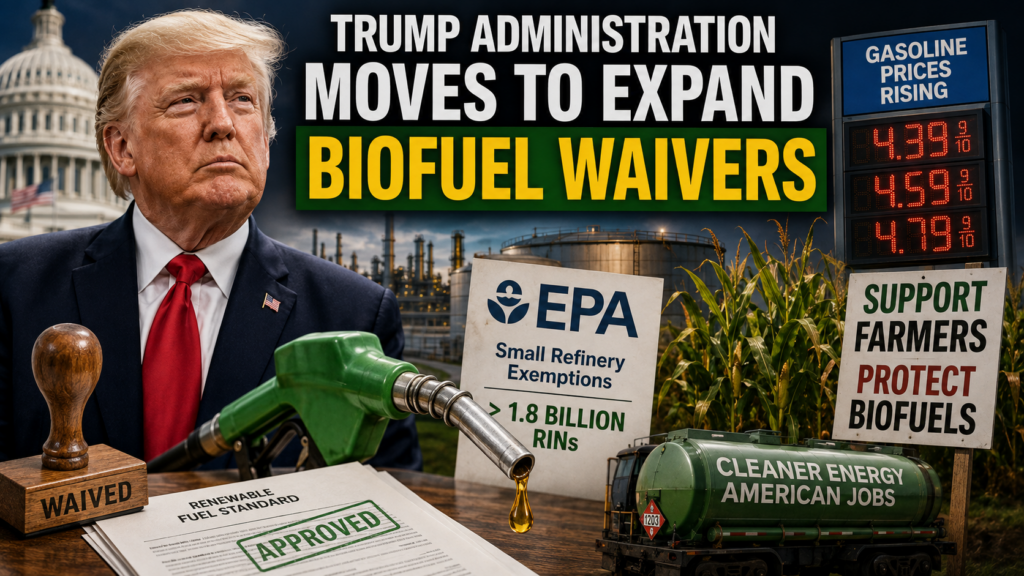
The Trump administration is moving to expand biofuel waivers for U.S. oil refiners as it seeks to ease rising gasoline prices, setting up a new clash with farm-state lawmakers and the biofuel industry.
According to a report by Reuters, the Environmental Protection Agency is expected to grant exemptions covering more than 1.8 billion renewable fuel credits to small refineries, roughly double the volume previously under consideration. The move comes as gasoline prices remain elevated amid the U.S. conflict with Iran.
What Happened
The Environmental Protection Agency is preparing to expand small refinery exemptions from federal biofuel blending requirements.
Under the Renewable Fuel Standard, oil refiners and fuel importers must blend specified amounts of renewable fuels such as ethanol into transportation fuel or purchase renewable identification numbers, commonly known as RINs, to demonstrate compliance.
Small refineries can seek exemptions when they can show that complying with the requirements would create disproportionate economic hardship.
The Trump administration is now considering a significantly larger group of exemptions as it looks for ways to reduce pressure on gasoline prices.
Key Details of the Biofuel Waivers
More Than 1.8 Billion RINs Could Be Covered
Reuters reported that the EPA is expected to issue waivers covering more than 1.8 billion RINs for the latest compliance period.
That would be approximately twice the number of credits the agency had initially indicated it planned to cover. Applicants include refineries operated by major oil companies such as Marathon Petroleum and Chevron.
The size of the proposed exemptions has become a major point of contention because RINs represent compliance obligations under the federal renewable fuel program.
EPA Decision Could Shift Into September
The EPA had previously indicated that it would decide on pending exemption requests by the end of August.
However, people familiar with the matter told Reuters that the final decision could slip to Tuesday, September 1.
The uncertainty has already affected the renewable fuels market. Ethanol blending credit prices dropped sharply after the EPA announced an extension of the compliance deadline for refiners and signaled that it would act on long-pending small refinery exemptions.
Why the Trump Administration Wants the Waivers
The expanded biofuel waivers are part of a broader effort to manage gasoline prices.
Fuel costs have risen amid disruptions associated with the conflict involving Iran. Reuters reported that the White House is seeking measures that could reduce pressure at the pump while avoiding additional political damage ahead of the November congressional elections.
Refiners argue that compliance with renewable fuel mandates can become expensive when RIN prices are high. Reducing their obligations could lower production costs and potentially provide more flexibility in the fuel market.
The administration has pursued other measures aimed at increasing gasoline supply, including temporary fuel-standard waivers designed to increase the availability of gasoline. The EPA said those measures could add hundreds of thousands of barrels per day to domestic supply.
Farm-State Lawmakers Push Back
The proposal has triggered strong resistance from agricultural interests.
Farm-state lawmakers and biofuel producers fear that broader exemptions will reduce demand for corn and other crops used to produce renewable fuels.
Because the Renewable Fuel Standard creates a market for ethanol and other renewable fuels, reducing refinery obligations can lower demand for the credits and potentially weaken demand for agricultural feedstocks.
The dispute places President Donald Trump between two important parts of the domestic energy economy: oil refiners seeking lower compliance costs and farmers who depend on biofuel demand.
Possible Relief for Farmers
The administration is reportedly considering a way to offset some of the potential harm to agriculture.
According to Reuters, the EPA is considering reopening the 2027 renewable fuel quotas and adding roughly 500 million renewable fuel credits, or potentially more, to compensate for some of the impact of the expanded exemptions.
That approach would allow the administration to provide additional relief to refiners while attempting to preserve demand for renewable fuels in future years.
The balance is especially important for rural economies, where agricultural production and biofuel plants are closely connected. The administration has also pursued other policies affecting American agriculture, including trade policies affecting U.S. farmers and agricultural markets.
Political and Economic Impact
The proposed exemptions could have consequences well beyond the refining industry.
For refiners, fewer RIN obligations could reduce operating costs and make fuel production more economical.
For farmers, however, lower biofuel demand could put pressure on crop prices and reduce revenues for corn and soybean producers.
The American Petroleum Institute has criticized the expansion, warning that the policy could create uncertainty for fuel markets and undermine regulatory stability.
The issue also revives a familiar political fight from Trump’s first administration, when broad refinery exemptions angered Midwestern agricultural groups that argued the policy weakened the Renewable Fuel Standard.
The stakes are higher now because the administration is attempting to address gasoline affordability while maintaining support in agricultural states.
Renewable Fuel Standard Explained
The Renewable Fuel Standard was created by Congress to increase the use of renewable fuels in the nation’s transportation system.
Refiners and fuel importers generally satisfy the program by blending required renewable fuel volumes into gasoline and diesel. When they cannot meet the requirements directly, they can purchase RINs.
Small refinery exemptions allow qualifying facilities to receive relief when compliance would cause disproportionate economic hardship.
The EPA is responsible for evaluating exemption petitions and determining whether they meet statutory requirements.
Earlier in August, the agency announced decisions involving several individual small refinery petitions for prior compliance years, including full and partial exemptions.
Broader Energy Strategy
The biofuel dispute comes as the Trump administration pursues a wider strategy focused on increasing domestic energy supply and reducing fuel costs.
The administration has used temporary fuel-standard waivers, encouraged greater domestic refining capacity and explored additional energy supply options as global oil markets remain volatile.
The administration’s energy and transportation agenda also includes policies affecting infrastructure and land use, including changes involving federal roadless-area policy that could influence future access to certain public lands.
Taken together, these initiatives show the administration attempting to use regulatory changes to increase energy flexibility while supporting domestic production.
What Happens Next
The key immediate question is whether the EPA will formally approve the expanded exemptions and how many renewable fuel credits will ultimately be covered.
If the agency grants waivers approaching or exceeding 1.8 billion RINs, farm groups are likely to intensify pressure for stronger protections for agricultural producers.
The proposed increase in 2027 renewable fuel obligations could become an important part of negotiations between the administration, refiners and the agricultural sector.
The biofuel waivers also remain tied to the administration’s efforts to lower gasoline prices. Whether the exemptions actually provide meaningful relief at the pump is uncertain, particularly because gasoline prices are influenced by crude oil costs, refining capacity, transportation and global geopolitical conditions.
The decision ultimately puts Trump at the center of a long-running energy-policy dispute. Expanding refinery exemptions could provide refiners with immediate regulatory relief, but it risks angering farmers and biofuel producers who depend on strong renewable fuel demand. As the administration seeks lower gasoline prices ahead of the midterm elections, the outcome could shape both energy markets and its political relationship with rural America.
They are proposed exemptions from federal renewable fuel blending requirements for certain small oil refineries.
The administration is seeking to reduce refinery compliance costs and ease pressure on gasoline prices amid elevated energy costs.