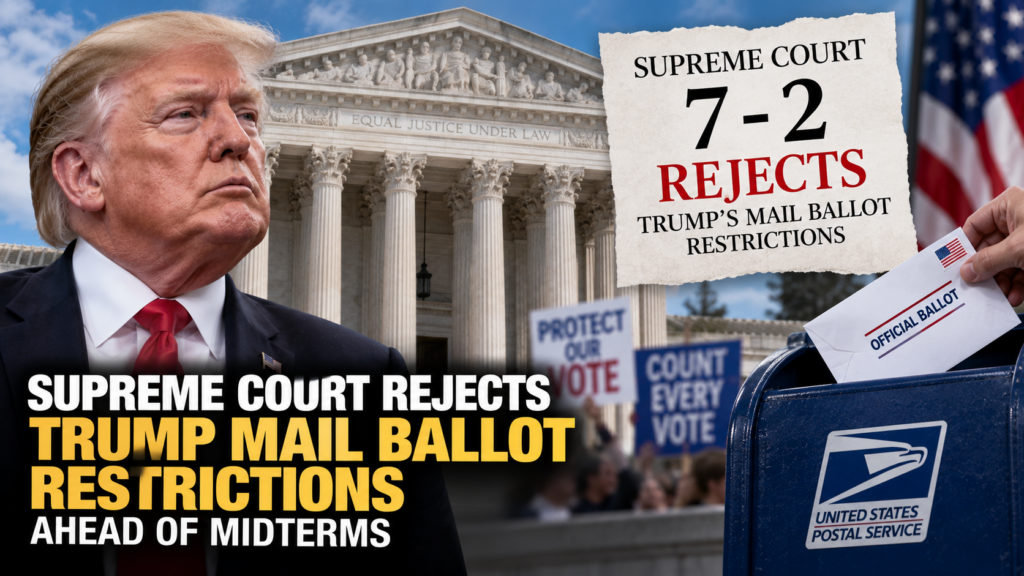
The U.S. Supreme Court has refused to allow the Trump administration to implement new mail ballot restrictions before the 2026 midterm elections, leaving in place a lower-court order blocking the U.S. Postal Service policy. The 7-2 decision represents a major setback for President Donald Trump’s effort to change federal oversight of mail voting.
What Happened
On September 14, the Supreme Court denied the Trump administration’s request to stay a preliminary injunction issued by U.S. District Judge Indira Talwani in Massachusetts. That injunction prevents the Postal Service from enforcing a new rule connected to Trump’s executive order on mail-in voting.
In its brief order, the Supreme Court said the government was unlikely to succeed on the merits of its challenge to the lower-court injunction. The justices did not provide an extensive explanation, making the decision another significant emergency or “shadow docket” ruling.
According to a report byReason.com, the 7-2 ruling leaves the lower-court decision blocking the USPS policy in place and raises questions about whether federal law gives the Postal Service sufficient authority to alter state election procedures.
Key Details
What Trump’s Mail Ballot Policy Would Have Changed
The contested USPS rule would have introduced new federal requirements for mail ballots.
States would have been required to provide lists of mail-ballot recipients to the Postal Service and use agency-approved envelopes with unique barcodes. The USPS would then have been able to reject ballots that failed to meet the new requirements or were connected to voters who did not appear on the submitted lists.
The administration argued that the policy was designed to protect the mail system from voter fraud and establish greater consistency in how election-related mail is handled.
Critics, however, warned that the changes could disrupt thousands of legitimate ballots because states were already preparing for the November 3 election.
Election Officials Faced a Tight Deadline
Timing became a central issue in the Supreme Court dispute.
Mail ballots were already being sent in states including Alabama, North Carolina and Wisconsin, while the proposed federal system was not yet operational. Election officials argued that implementing a major new system only weeks before the election would be extremely difficult.
Justice Brett Kavanaugh agreed that the restrictions should remain blocked for the 2026 elections. In a concurring statement, however, he said there was at least a “fair prospect” that the final rule could fall within the Postal Service’s statutory authority. He concluded that implementing it this close to the election would violate the Administrative Procedure Act because state and local officials lacked sufficient time to reasonably comply.
Alito and Thomas Dissent
Justices Samuel Alito and Clarence Thomas dissented from the Supreme Court’s decision.
Alito argued that the Postal Service has broad authority to regulate mail and that the administration had met the requirements necessary for emergency relief. He also argued that the challengers’ legal claims were unlikely to succeed.
The dissent highlights an important unresolved legal question: how far federal authority over postal operations extends when the rules directly affect state-administered elections.
Federalism and Separation of Powers
The mail ballot ruling also raises broader constitutional questions about the division of authority between the federal government and the states.
Federal and state officials traditionally share responsibilities in federal elections, but states play a central role in administering elections and determining how ballots are distributed and processed.
The lower courts questioned whether Congress had clearly authorized the Postal Service to impose requirements that could effectively change state mail voting systems. The First Circuit also warned that the rule could potentially disenfranchise millions of voters while providing limited benefits in preventing fraud.
Reason’s analysis focused on the major questions doctrine, which generally requires Congress to speak clearly when delegating highly consequential powers to federal agencies. The argument is particularly significant here because changing the rules governing how states administer elections would have substantial national consequences.
Political Impact
The Supreme Court’s mail ballot ruling is a significant political setback for Trump ahead of the November midterm elections.
Nearly one-third of votes are cast by mail, according to AP reporting, meaning major changes to mail voting procedures could affect millions of voters.
The ruling also comes as Republicans and Democrats compete for control of Congress. The Trump administration has repeatedly argued that stronger mail-ballot safeguards are necessary to protect election integrity, while opponents say the restrictions could interfere with access to voting.
Voting-rights organizations welcomed the decision. Sophia Lin Lakin of the American Civil Liberties Union said the ruling protected the authority of states and Congress to establish election rules. California Gov. Gavin Newsom also described the decision as a victory for democracy and the rule of law.
What Happens Next
For the 2026 election, the immediate consequence is that states can continue using their existing mail-ballot procedures rather than adopting the new USPS requirements.
The Supreme Court’s decision does not necessarily resolve every underlying legal question permanently. Kavanaugh’s concurrence leaves open the possibility that the Postal Service could have statutory authority to regulate certain aspects of ballot mail under different circumstances.
The broader legal dispute could therefore continue, particularly over the extent of presidential and agency authority to influence election administration without explicit congressional authorization.
The ruling nevertheless makes it significantly harder for the Trump administration to impose the contested mail ballot system before the 2026 midterms. With voting already underway in several states, maintaining the existing system provides election officials with greater operational certainty heading into November.
Conclusion
The Supreme Court’s 7-2 mail ballot ruling blocks the Trump administration from enforcing its new Postal Service requirements for the 2026 midterm elections. While the justices left some questions about USPS statutory authority unresolved, the decision reinforces the importance of timing, federalism and congressional authorization when federal agencies seek to reshape state election procedures.
Related Reading
- Trump Moves to Reshape Mail-In Voting Rules Ahead of 2026 Elections
- Trump Administration Targets Tax Exemptions for Colleges With DEI Policies
The court said the government was unlikely to succeed on the merits and agreed that implementing the rules before the 2026 elections could disrupt state and local election systems.
States can continue using their existing mail-ballot procedures because the new USPS requirements remain blocked.