The 2026 midterms decide whether Trump's legislative agenda can advance through 2028 or stalls under divided government. If Republicans keep both chambers, the White House can keep passing party-line packages and confirming nominees. If Democrats win the House, the Senate or both, most new legislation stops and the next two years shift toward oversight, spending standoffs and executive action.
Voters appear to understand what is at stake. In an October 13–19 survey of 2,028 respondents, a clear majority said electing a Congress to check Trump mattered more than electing one to help pass his agenda, while a much smaller share preferred the latter. That poll carried a margin of sampling error of 2.2 percentage points, so the gap is far wider than statistical noise. This article explains how each outcome would affect the second half of Trump's term, which priorities are most exposed, and how local organizers can plan around the results.
How Congressional Control Shapes the Second Half of a Term
Control of Congress determines which bills reach the president's desk, which nominees get confirmed and which administration actions face scrutiny. A president's party has often lost House seats in postwar midterms, so the baseline expectation is frequently a harder second half, not an easier one.
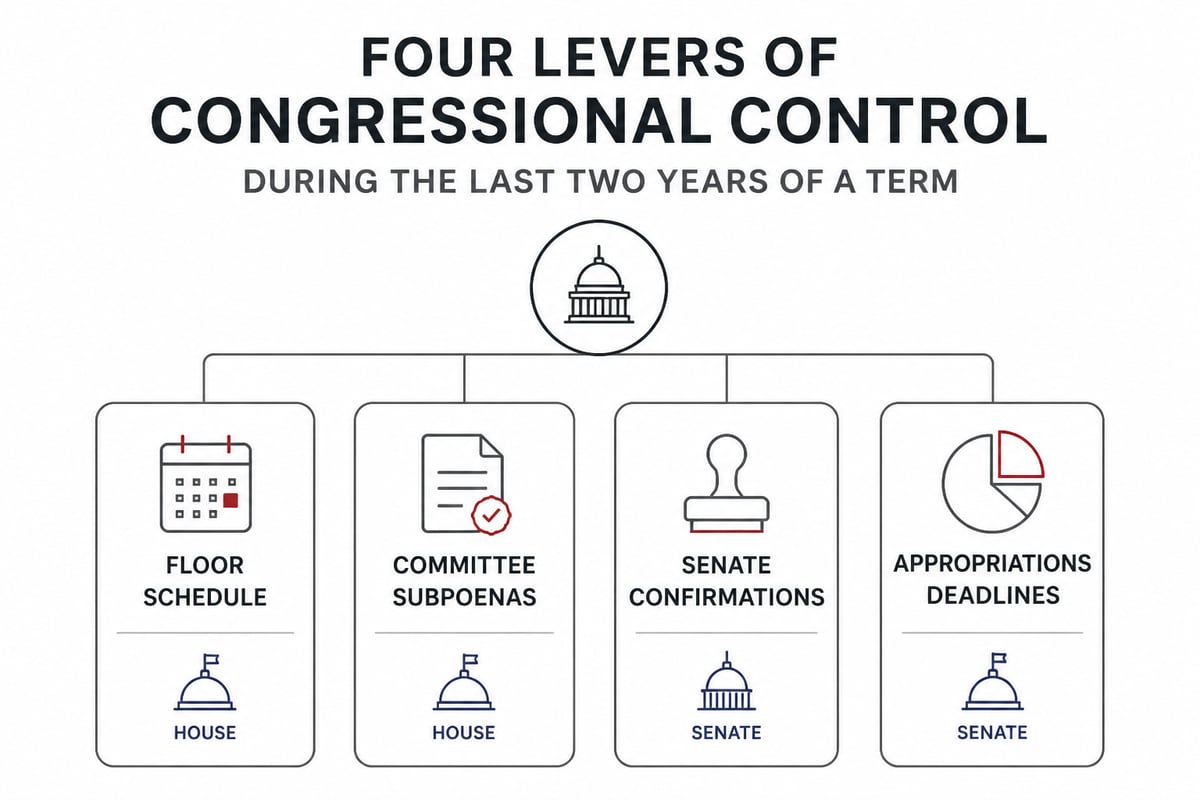
Four mechanisms matter most:
- Floor schedule. The majority party in each chamber decides what gets a vote. A Democratic House could refuse to move any Trump priority.
- Committee power. Chairs set hearings and issue subpoenas, which turns oversight into a standing feature of the calendar.
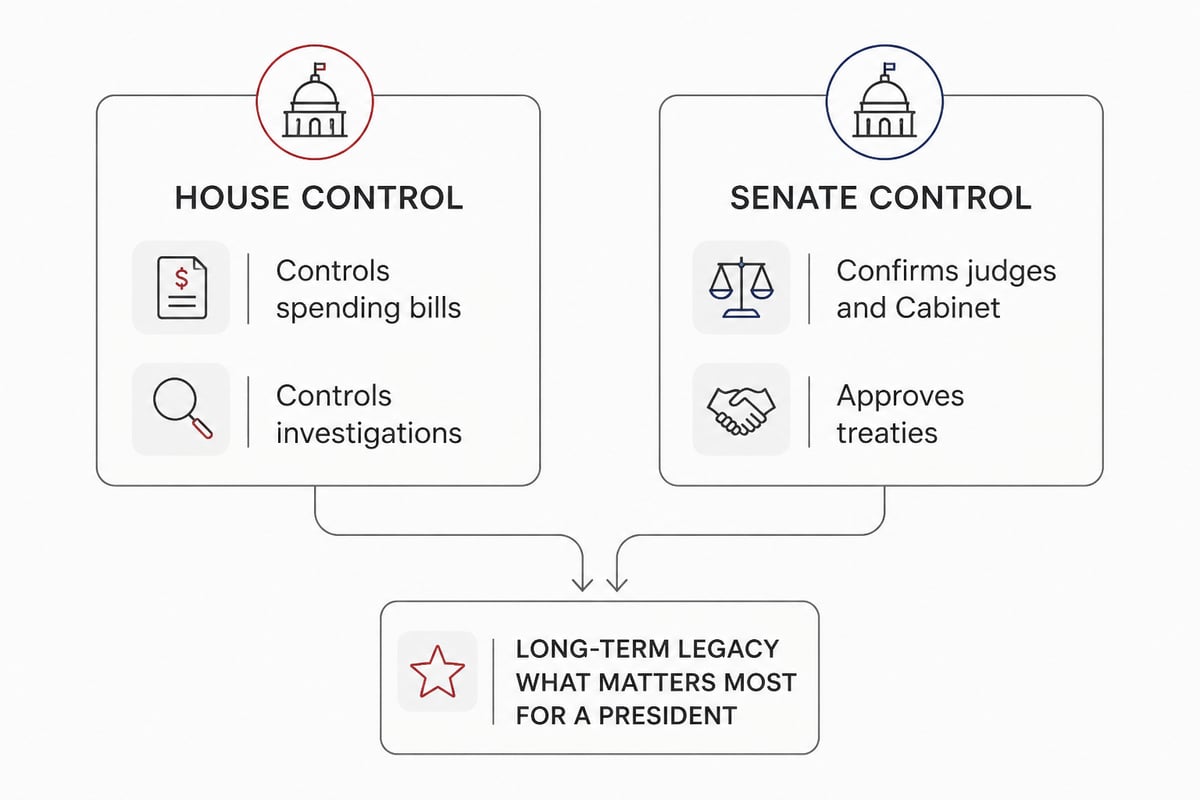
- Confirmations. The Senate confirms judges, Cabinet officers and ambassadors. Senate control is often more consequential than House control for the long-term legacy of a presidency.
- Appropriations. Both chambers must agree on spending, which gives the House a lever over every funding deadline.
For a detailed look at where the current majorities stand, the 2026 midterm election results and Trump’s Congress coverage tracks the numbers race by race.
Three Midterm Outcomes and What Each Means for the Agenda
The 2026 midterms, Trump's legislative agenda and 2028 planning all hinge on which of three outcomes occurs: unified Republican control, a Democratic House with a Republican Senate, or Democratic control of both chambers. The table below compares them.
| Outcome | New legislation | Oversight | Nominations | Likely White House response |
|---|---|---|---|---|
| Republicans hold both chambers | Reconciliation and narrow party-line bills remain possible | Limited | Smooth confirmations | Push remaining tax, spending and regulatory priorities |
| Democratic House, Republican Senate | Most House-origin bills die; Senate can still confirm judges | Substantial, with subpoenas | Confirmations continue | Shift toward executive orders and vetoes |
| Democrats win both chambers | Near-total legislative gridlock | Extensive | Confirmations at risk | Rely on executive authority, litigation and vetoes |
The middle scenario is the one most analysts treat as the central case, because House seats are more sensitive to presidential approval than Senate seats. The 2026 versus 2024 Senate projections comparison shows why the Senate map is structurally tougher for Democrats than the House map.
What Happens If Republicans Keep Both Chambers
If Republicans hold Congress, the White House keeps its fastest route to enacting policy: budget reconciliation, which needs only a simple majority in the Senate. That tool has already been used to pass major tax and spending legislation this term, and a second package remains plausible in 2027.
Likely candidates for a second round include:
- Further tax adjustments, building on the framework described in the Trump tax plan breakdown.
- Additional border and immigration funding tied to the border security plan for 2026.
- Energy and permitting measures, including nuclear expansion.
- Spending reductions, which are constrained by the reconciliation rules and the Senate parliamentarian.
Even with unified control, margins are thin. A handful of defections can sink a bill in either chamber, and intraparty friction has been a recurring story. The coverage of tensions between Trump and congressional Republicans shows where those defections tend to come from. Filibuster rules also still block most non-budget legislation, so a Republican sweep does not mean everything on the wish list becomes law.
What Happens If Democrats Take the House
A Democratic House would end most of the Trump legislative agenda for 2027 and 2028, because no bill can pass without a majority-controlled floor schedule. What replaces it is a different kind of political work.
A change in congressional control could reshape investigations, confirmations and the president's use of executive authority, as Christian Science Monitor’s reporting on a post-midterm lame-duck dynamic discusses. Expect these developments:
- Committee investigations into agency decisions, spending and personnel, backed by subpoena power.
- Appropriations leverage, with the House using each funding deadline to seek policy concessions or limit specific programs.
- Veto dynamics. Democrats would lack the two-thirds majorities needed to override, so vetoes would mostly serve to frame political contrasts.
- Impeachment speculation. A House majority could pursue it, though removal requires 67 Senate votes, which makes conviction highly unlikely.
For the White House, the practical response is to shift weight onto executive orders, agency rulemaking and trade and foreign policy tools that do not require Congress. The overview of Trump’s executive orders affecting the country in 2026 shows how much ground that toolkit already covers.
Why the Senate Matters More Than the House for the Long Term
Senate control decides who sits on federal courts and in the Cabinet, which makes it the more durable prize. A president who loses the House can still reshape the judiciary if the Senate stays friendly, and that legacy outlasts any single term.
The reverse also holds. If Democrats flip the Senate, judicial and executive nominees would need bipartisan support or would stall. Vacancies could remain open, acting officials could multiply, and the administration could find itself in recurring disputes over temporary appointments. Cabinet turnover is already a topic of speculation, as covered in the report on Cabinet rumors looking ahead to 2028.
The Senate also controls treaty ratification and, in practice, how much of the legislative calendar is consumed by nominations rather than bills. A closely divided Senate rewards leaders who can manage absences, illness and attendance, a detail that often decides narrow votes.
How the Midterms Feed Into the 2028 Race
The midterm result sets the terms of the 2028 presidential contest, even though Trump cannot run again. Seats won in 2026 help determine the governors, senators and party officials who will shape the next nomination fights, and the results will be read as a verdict on the administration.
On the Republican side, the key questions are who inherits the movement and how much weight Trump's endorsement carries in contested primaries. The analysis of the impact of MAGA endorsements on the 2026 midterms and the record of Trump-backed primary victories give a baseline for measuring that influence.
On the Democratic side, a strong midterm would elevate governors and House leaders who may build national profiles. The rundown of top Democratic candidates for 2028 is a useful reference as that field takes shape.
A weak Republican showing would likely intensify debate over whether to continue the current agenda or pivot toward a new message. A strong one would reinforce the argument that the governing coalition is durable.

Issues Most Exposed Under Divided Government
Not every priority is equally vulnerable. Policies already enacted into law, or implemented through rules that survive court review, are harder to reverse than agenda items still awaiting action.
The most exposed items tend to share three traits: they require new statutory authority, they need appropriations, or they rely on a single vote in a narrow Senate. Based on the current agenda, the areas to watch are:
- Tax and spending changes that need another reconciliation bill.
- Immigration enforcement funding, which depends on annual appropriations.
- Health policy, including the MAHA agenda, where much depends on agency action and funding.
- Tariffs and trade, where Congress has been reluctant to act but could assert itself through legislation or hearings.
By contrast, executive actions on foreign policy, regulatory rollbacks and personnel decisions are less dependent on Congress, though courts can still block them. Economic conditions also shape how much political capital the White House retains. Voter concern about prices, tracked in the coverage of inflation and the midterms, is likely to remain the strongest driver of turnout.
What Business Lobbyists and Local Organizers Should Track
Watching a few specific indicators will tell you more than national topline polling. For anyone planning local activity around the midterms, the practical question is how congressional control changes the issues voters will care about in 2027.
A short monitoring list:
- Presidential approval. Midterm results have often been tied to the president's standing, which the Trump approval rating explainer tracks.
- Generic ballot and district-level polling, which are better predictors than national mood alone.
- Appropriations deadlines. Shutdown risk rises sharply under divided government.
- Retirement announcements. A wave of departures signals members who expect to lose power.
- Court rulings on executive actions, which determine how much policy survives without Congress.
Analysis of how congressional control could constrain or enable Trump’s remaining priorities offers a useful framework for weighing these signals against the possible outcomes.
For political clubs and campaign volunteers, the lesson is concrete. In a Democratic-House scenario, oversight fights and spending standoffs dominate local news, and organizers who frame their message around specific federal programs gain traction. In a unified Republican scenario, the agenda moves into implementation, and attention shifts to how new laws affect households and local budgets.
Key Dates and Milestones to Watch Through 2028
The calendar after election night is shorter than it appears. Several fixed events will reveal how the new balance of power actually works.
- Lame-duck session (November to December 2026). Outgoing members can still pass bills, and the current Congress may try to finish work before majorities change.
- January 2027. The new Congress is sworn in, leaders are elected and committee chairs are assigned.
- Early 2027 funding deadlines. The first test of divided or unified government usually arrives in the form of a spending fight.
- 2027 filing deadlines and primaries for 2028. Early moves by presidential hopefuls typically begin within months of the midterms.
- 2028 general election. The agenda that survives to this point becomes the baseline for the next administration's priorities.
A common pattern is that the early months of a new Congress set the tone for the next two years. A president facing a hostile House may respond quickly with executive actions, and the speed of that response is itself a useful signal.
Your next step is to build a simple tracker for your own district, listing the incumbent, the challenger, the margin in the last cycle and the three federal issues your neighbors raise most often. If you want help turning that research into local action, U.S. Presidential Report publishes non-partisan coverage of presidents, Congress and federal policy, and it is a practical foundation if you plan to Start Your Own Political Club and keep your members informed with reliable, current reporting.