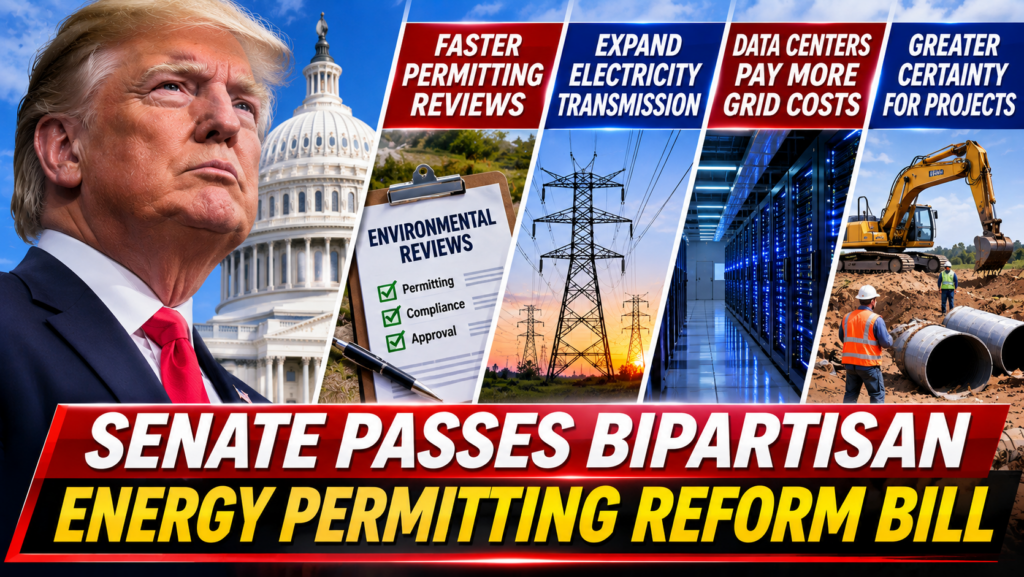
The U.S. Senate has passed the Bipartisan American Affordability and Jobs Act of 2026 (BAAJA), a major permitting reform bill designed to accelerate energy and infrastructure projects across the country. Approved by a 62-33 vote on November 19, the legislation aims to shorten environmental reviews, expand electricity transmission, and reduce delays affecting renewable energy, fossil fuel, and infrastructure development.
According to a report by The New York Times, the bipartisan legislation represents a significant step toward changing how the federal government reviews and approves major construction projects. The bill now moves to the House of Representatives, where its future remains uncertain.
What Happened?
The Senate approved BAAJA on November 19, following years of negotiations over federal permitting reform.
The legislation passed with 62 votes in favor and 33 against. Support came from most Republicans and 15 members of the Democratic caucus, while 31 Democrats opposed the measure alongside two Republican senators.
The bill was developed by four leading senators:
- Mike Lee, Republican from Utah.
- Shelley Moore Capito, Republican from West Virginia.
- Martin Heinrich, Democrat from New Mexico.
- Sheldon Whitehouse, Democrat from Rhode Island.
The legislation aims to address long-standing concerns that federal environmental reviews and permitting procedures can delay major infrastructure projects for years.
With Senate approval secured, the bill now heads to the House for further consideration.
What Does the BAAJA Permitting Reform Bill Include?
The Bipartisan American Affordability and Jobs Act proposes changes to several federal laws governing infrastructure development, environmental reviews, and energy projects.
Its provisions cover electricity transmission, renewable energy, fossil fuels, mining, hydropower, and other major infrastructure investments.
1. Shorter Environmental Review Timelines
One of the central provisions would establish deadlines for federal environmental reviews.
The bill sets a two-year target for major federal environmental reviews, compared with an average of more than four years under current processes, according to the White House Council of Economic Advisers.
It would also require federal agencies to coordinate permitting decisions and establish a permitting tracker to improve transparency.
Supporters argue that shorter review periods would reduce administrative delays and give developers greater certainty when planning large projects.
2. Expanded Electricity Transmission Infrastructure
The legislation includes provisions intended to accelerate the planning, approval, and construction of interstate electricity transmission lines.
It would expand the role of the Federal Energy Regulatory Commission (FERC) in permitting certain interstate transmission projects.
The changes are particularly relevant as electricity demand increases across the United States, partly because of the expansion of artificial intelligence and large data centers.
Additional transmission capacity could help address grid bottlenecks and connect electricity generation with areas experiencing growing demand.
3. Data Centers Must Pay More of Their Grid Costs
Another important provision addresses the growing electricity consumption of large data centers.
Under the bill, large computing facilities would be required to bear more of the transmission and infrastructure costs associated with their electricity demand.
The provision is intended to prevent households and other electricity customers from carrying an unfair share of the costs associated with expanding data center operations.
The issue has become increasingly important as technology companies invest in AI infrastructure and electricity demand rises across several regions.
4. Greater Certainty for Energy Project Permits
The legislation would also limit the circumstances in which federal permits can be revoked or challenged in court.
It establishes a 150-day window for many legal challenges following permits or environmental reviews.
Supporters say this would provide greater certainty for investors and developers, reducing the risk of projects being delayed by lengthy litigation.
Critics, however, argue that shorter legal deadlines could limit opportunities for communities and environmental organizations to challenge government decisions.
Why Supporters Say the Bill Could Lower Energy Costs
Supporters of BAAJA argue that lengthy permitting procedures increase construction costs and delay the development of infrastructure needed to meet rising electricity demand.
By accelerating approvals for power plants, transmission lines, and other energy projects, the legislation could help expand electricity supply and improve grid efficiency.
The White House Council of Economic Advisers estimated that the bill could:
- Increase annual U.S. economic output by approximately $82 billion to $164 billion.
- Reduce average household electricity bills by an estimated $178 to $251 annually.
- Accelerate the development of major energy and infrastructure projects.
These figures are projections rather than guaranteed savings. The actual economic impact will depend on implementation, investment decisions, and the projects that ultimately receive approval.
Environmental Groups and Tribal Organizations Raise Concerns
Despite bipartisan support, the legislation has faced opposition from environmental organizations, tribal groups, and several Democratic lawmakers.
Critics argue that accelerating permitting procedures could weaken environmental protections and reduce public oversight of major infrastructure projects.
Their concerns include:
- Environmental protections: Changes to federal review requirements could make it easier to approve fossil fuel projects and developments affecting public lands, waterways, and wildlife.
- Judicial oversight: Shorter deadlines for legal challenges could restrict the ability of communities and environmental organizations to contest project approvals.
- Tribal consultation: Tribal organizations have raised concerns about protections for sacred sites and the time available for consultation with Native American communities.
- Fossil fuel development: Critics argue that the legislation could accelerate oil and gas infrastructure alongside renewable energy projects.
The Natural Resources Defense Council (NRDC) has acknowledged that the bill includes potentially valuable transmission and grid reforms while arguing that other provisions go too far in weakening environmental safeguards and public participation.
The disagreement reflects a broader debate over how the United States should balance infrastructure development, energy affordability, and environmental protection.
What Happens Next?
Following Senate approval, BAAJA must now advance through the House of Representatives before it can reach President Donald Trump for consideration.
As of November 24, the House has not yet voted on the Senate-approved version, and a vote date has not been confirmed.
The legislation faces a potentially difficult path because lawmakers remain divided over its environmental provisions, data center regulations, and implications for tribal authority.
President Trump has expressed support for the bipartisan agreement, while its supporters are urging the House to act before the end of the current congressional session.
If enacted, BAAJA could significantly reshape federal permitting procedures and influence how quickly energy and infrastructure projects move from planning to construction.
Its ultimate impact will depend on whether Congress can maintain bipartisan support while addressing concerns about environmental safeguards, public participation, and the distribution of electricity costs.
Related Reading
- DOJ Warns Elizabeth Warren Over Records Linked to Trump Investigations
- Trump Administration Moves to Cut Food Stamps for 6.3 Million People
The Bipartisan American Affordability and Jobs Act of 2026 proposes changes to federal permitting and environmental reviews to accelerate energy and infrastructure projects.
No. The Senate passed it on November 19, 2026, but it must still receive House approval before going to President Trump.