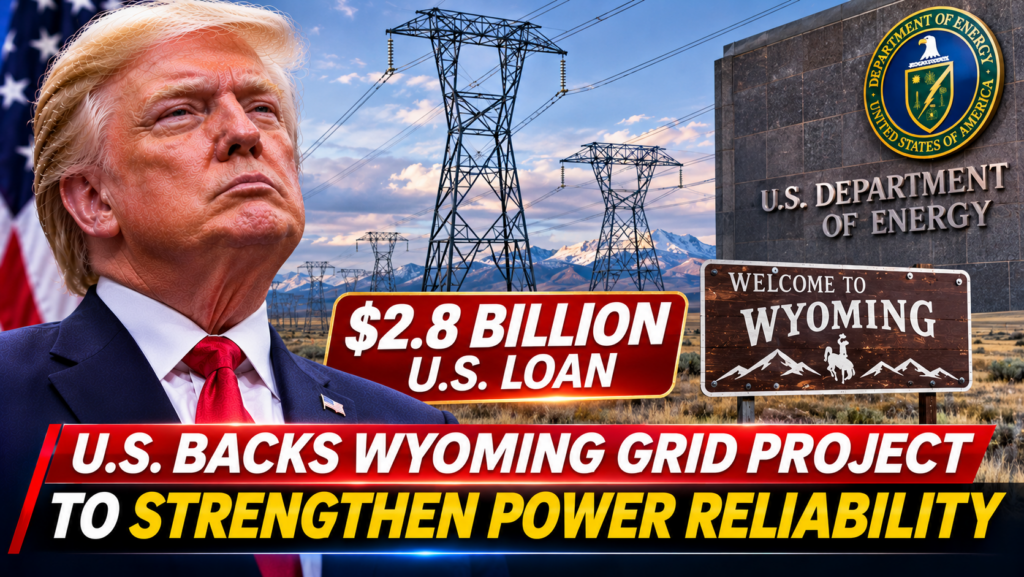
The U.S. Department of Energy has offered a conditional loan commitment of up to $2.8 billion for the Wyoming Intertie, a major electricity transmission project developed by Grid United. The project aims to connect the eastern and western U.S. power grids, increase electricity transfer capacity, and improve grid reliability across 17 states.
According to a report by Reuters, the proposed financing is intended to help reduce electricity costs and strengthen the country’s power infrastructure. However, the loan remains conditional and will not be disbursed until the project meets federal requirements.
What Is the Wyoming Intertie Project?
The Wyoming Intertie is a proposed 106-mile high-voltage transmission project being developed by Houston-based Grid United.
It will connect the eastern and western electricity systems through infrastructure in Wyoming, allowing power to move between two major regional networks:
- Southwest Power Pool (SPP): An electricity market and regional transmission organization serving parts of the central United States.
- Western Electricity Coordinating Council (WECC): The regional organization responsible for coordinating electricity reliability across much of the western United States.
The project is expected to add approximately 1.8 gigawatts of electricity transfer capacity.
According to the Department of Energy, the new connection will double existing transfer capacity between the SPP and WECC regions.
Key Details of the $2.8 Billion Federal Loan
The Department of Energy’s Office of Energy Dominance Financing announced the conditional commitment on November 17, 2026.
The financing is expected to cover a significant portion of the project’s construction costs.
According to Grid United’s project financing fact sheet:
- Loan amount: Up to $2.8 billion, excluding interest during construction.
- Loan term: 30 years, including the construction period.
- Construction costs: The financing is expected to cover approximately 80% of construction costs.
- Developer: Grid United, an independent transmission infrastructure company.
- Project capacity: Approximately 1.8 gigawatts of electricity transfer capacity.
- Estimated cost savings: Up to $39 billion across 17 states, according to the Department of Energy.
The federal financing is expected to offer a lower borrowing rate than typical private-market financing, potentially reducing the overall cost of the project.
However, the $2.8 billion commitment is not yet a completed loan. Grid United must satisfy the required conditions before the federal government finalizes the financing documents and releases funds.
How the Project Could Improve U.S. Electricity Reliability
The Wyoming Intertie is designed to address limitations in the country’s existing electricity transmission infrastructure.
The eastern and western U.S. power grids operate asynchronously, meaning they cannot exchange electricity through a conventional alternating-current connection without specialized conversion infrastructure.
The project plans to use high-voltage direct current (HVDC) technology and voltage source converter (VSC) systems to enable controlled electricity transfers between the two networks.
This technology could provide several benefits:
- Greater grid flexibility: Electricity could move in either direction depending on regional supply and demand.
- Improved reliability: Regional operators could access additional electricity during periods of high demand or generation outages.
- Extreme weather resilience: The connection could help regions respond to disruptions affecting electricity supply.
- More efficient energy distribution: Additional transmission capacity could reduce congestion and help electricity reach areas where it is needed.
The Department of Energy estimates that the project could generate up to $39 billion in electricity cost savings for households and businesses across 17 states.
That figure is a federal projection rather than a guaranteed reduction in electricity bills.
Project Still Faces Regulatory and Financial Requirements
Despite the federal commitment, the Wyoming Intertie must complete several development and approval stages before construction can begin.
The Department of Energy requires the project to satisfy technical, legal, environmental, and financial conditions before entering definitive financing agreements.
Grid United’s development requirements include:
- Securing the full project right-of-way.
- Obtaining federal, state, and local permits.
- Meeting environmental review requirements.
- Securing commercial capacity agreements with utilities or other customers.
- Satisfying federal financing program requirements.
The proposed route also involves federally owned land, requiring environmental reviews under the National Environmental Policy Act.
At the state level, the project requires an Industrial Siting Certificate from the Wyoming Department of Environmental Quality, alongside relevant county approvals.
Grid United’s development schedule anticipates further permitting activity in 2027 and 2028, followed by key federal environmental and permitting milestones in 2029.
Construction could begin as early as 2030, with commercial operations projected for 2032 or 2033, subject to regulatory approvals and equipment procurement.
Economic Impact and Energy Policy Implications
The Wyoming Intertie could have implications beyond Wyoming by improving electricity transfers between regional markets.
The Department of Energy expects the project to create hundreds of construction-related jobs and additional long-term operations positions.
The project could also help electricity producers access wider markets while giving utilities more flexibility to manage regional demand.
For the Trump administration, the financing commitment supports its broader objective of expanding domestic energy infrastructure and strengthening electricity reliability.
It also reflects a growing federal focus on transmission infrastructure as electricity demand increases across the United States.
The project’s estimated $39 billion in potential savings and its ability to connect two major regional power systems make it a significant proposed investment in the country’s electricity network.
What Happens Next?
The immediate priority is for Grid United to complete the technical, environmental, legal, and commercial requirements attached to the federal commitment.
The financing will only proceed to final documentation and funding once those conditions have been satisfied.
If the development schedule remains on track, construction could begin around 2030, with commercial operations targeted for 2032 or 2033.
The Wyoming Intertie demonstrates how federal financing could support large-scale electricity infrastructure. However, its eventual economic benefits will depend on securing approvals, completing construction, and delivering the projected improvements in electricity transmission and reliability.
Related Reading
- Federal Appeals Court Rules Trump Cannot Withhold Highway Funding From New York
- Federal Judge Blocks Trump’s Plan to Renovate Historic Washington DC Golf Course
FAQs
It is a proposed 106-mile transmission project designed to connect the eastern and western U.S. electricity grids and add approximately 1.8 GW of transfer capacity.
No. The Department of Energy has issued a conditional commitment, subject to technical, legal, environmental, and financial requirements.