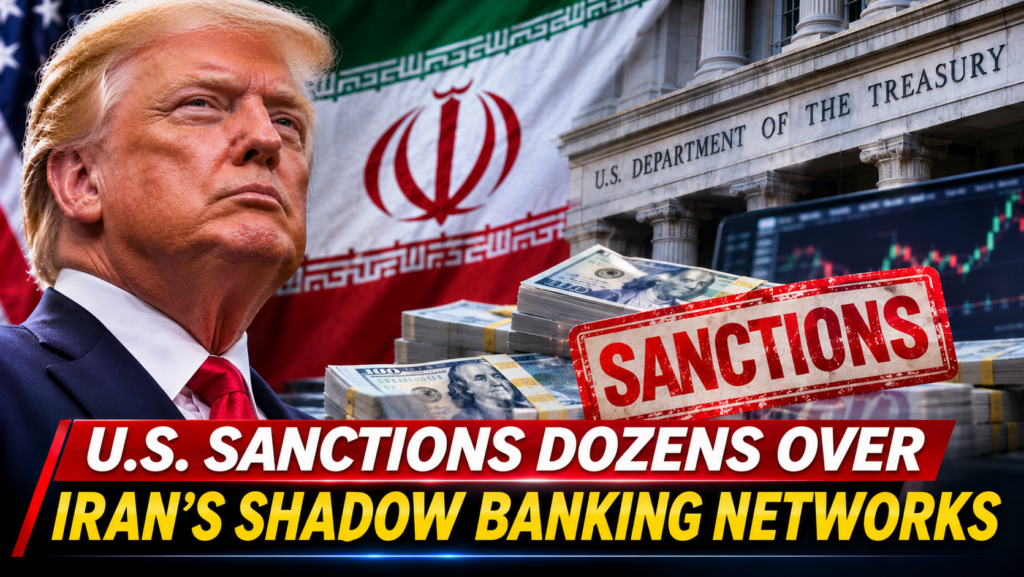
The United States has imposed new sanctions on more than two dozen Iranian exchange houses, front companies, and key individuals accused of supporting Iran’s shadow banking networks. Announced by the Treasury Department on November 23, the measures aim to restrict Tehran’s access to foreign currency and disrupt financial channels supporting its international trade.
The announcement came alongside a new financial analysis identifying approximately $14.7 billion in activity potentially linked to Iranian shadow banking between January 2025 and August 2026.
What Happened?
The sanctions were announced under the Trump administration’s Operation Economic Outcast, a campaign designed to disrupt Iran’s financial networks and limit its ability to evade U.S. sanctions.
According to a report by Reuters, the latest measures target two dozen Iranian exchange houses and front companies, including businesses operating in the United Arab Emirates, Turkey, and Hong Kong, as well as individuals connected to the networks.
Treasury Secretary Scott Bessent said the administration intended to dismantle what it described as a financial lifeline for the Iranian government.
How Iran’s Shadow Banking Network Operates
Iran’s shadow banking system relies on exchange houses and affiliated companies known as “rahbar companies.” According to the Treasury Department, these entities help manage financial transactions for Iranian clients and facilitate international trade despite existing sanctions.
The system is overseen by the Central Bank of Iran and operates through networks of front companies across multiple jurisdictions, particularly Dubai and Hong Kong.
These companies help move money between exporters, importers, and other businesses, allowing Iranian entities to access foreign currency through international financial channels.
Companies and Individuals Targeted
The Treasury Department identified several entities allegedly involved in facilitating these transactions.
Among the targets was Rahbar Bazargani Nesim Baharan Qeshm Company, also known as Nesim Baharan. Treasury said the company operated as a rahbar company for Bank Sarmayeh and worked with Iranian exchange houses to facilitate transactions for the bank’s clients.
The sanctions also targeted individuals identified by Treasury as senior officials of the company.
Other designated entities included Mina Fashki and Partners Exchange Company, known as Fashki Exchange, and Mellat Exchange Company, along with several owners and officials.
Treasury also identified foreign-based companies allegedly involved in facilitating payments connected to Iranian businesses and industries, including oil, petrochemicals, and copper.
Treasury Identifies Nearly $15 Billion in Potential Financial Activity
Alongside the sanctions announcement, the Financial Crimes Enforcement Network (FinCEN) released an analysis identifying approximately $14.7 billion in financial activity potentially linked to Iranian shadow banking.
The analysis covered transactions reported between January 2025 and August 2026 by U.S. financial institutions under their reporting obligations.
According to FinCEN, the activity involved businesses and financial connections across several jurisdictions, particularly the United Arab Emirates, Hong Kong, and Singapore.
The networks reportedly involved companies operating in sectors such as oil, shipping, investment, and technology procurement.
However, the $14.7 billion figure represents potentially linked financial activity identified through suspicious activity reporting. It does not mean that the entire amount has been independently confirmed as illegal transactions.
FinCEN also found that the volume of potential Iranian shadow banking activity declined during the review period. The agency said this could indicate that sanctions and enforcement measures had partially disrupted the networks.
Economic and Foreign Policy Implications
The latest sanctions increase pressure on companies and financial institutions that facilitate transactions connected to Iran.
Treasury warned that businesses involved in money laundering or sanctions evasion on behalf of Iran could face restrictions, including the risk of losing access to the U.S. financial system.
The measures also highlight the importance of international financial cooperation. Because the networks operate across multiple jurisdictions, enforcement efforts may affect businesses and intermediaries outside Iran.
For financial institutions, the announcement reinforces the need to monitor transactions involving companies with potential links to Iranian trade and financial networks.
What Happens Next?
The sanctions form part of the broader Operation Economic Outcast, announced by Bessent in August 2026. The initiative targets financial channels, oil-related activities, and intermediaries that the U.S. government says help sustain Iran’s economy despite international restrictions.
The Treasury Department has indicated that it will continue pursuing entities involved in sanctions evasion and financial activities linked to the Iranian government.
The effectiveness of the campaign will depend partly on whether the United States and its international partners can restrict the networks’ access to financial institutions and commercial intermediaries across different countries.
As Washington expands its enforcement efforts, Iran’s ability to maintain international trade and access foreign currency is likely to remain a central point of pressure in U.S. policy toward Tehran.
Related Reading
- Trump Says U.S. Does Not Need Iran Deal, Redirects JD Vance to Domestic Corruption
- Federal Judge Blocks Trump’s Plan to Renovate Historic Washington DC Golf Course
The sanctions aim to disrupt financial channels that the U.S. says help Iran evade restrictions and maintain international trade
FinCEN identified approximately $14.7 billion in potentially related financial activity between January 2025 and August 2026.