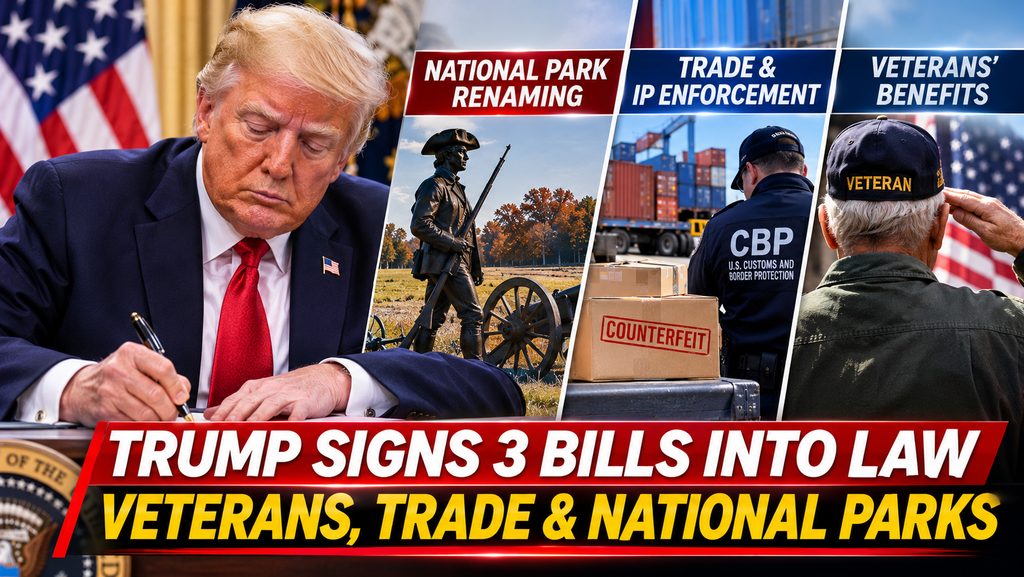
President Donald Trump signed three congressional bills into law on November 23, 2026, covering veterans’ compensation, intellectual property enforcement, and the redesignation of a historic national park. The legislation includes expanded information-sharing authority for U.S. Customs and Border Protection (CBP), a cost-of-living adjustment for veterans’ benefits, and a new name for Saratoga National Historical Park in New York.
According to the White House announcement, the three measures are H.R. 1550, H.R. 4930, and H.R. 8552.
What Happened?
The White House confirmed that Trump signed all three bills on Monday, November 23.
The legislation addresses three separate areas of federal policy:
- H.R. 1550: Redesignates Saratoga National Historical Park as Saratoga National Battlefield Park.
- H.R. 4930: Expands CBP’s authority to share information about imports suspected of violating U.S. intellectual property rights.
- H.R. 8552: Establishes a cost-of-living adjustment for veterans’ disability compensation and dependency and indemnity compensation beneficiaries.
The measures have different policy objectives, ranging from protecting intellectual property rights in international trade to adjusting benefits for veterans and recognizing an important historical site.
H.R. 1550 Renames Saratoga National Historical Park
The first bill, known as the Strengthening America’s Turning Point Act, officially redesignates Saratoga National Historical Park as Saratoga National Battlefield Park.
Located in New York, the site commemorates the Battles of Saratoga during the American Revolutionary War.
Under the legislation, the new designation will replace the previous name in federal laws, maps, regulations, documents, and other official records.
The bill changes the park’s official designation without outlining broader changes to its management or operations.
H.R. 4930 Expands CBP Information-Sharing Authority
The second measure focuses on intellectual property protection and the enforcement of trade regulations.
H.R. 4930 expands the authority of U.S. Customs and Border Protection to share information about merchandise suspected of violating American intellectual property rights.
The legislation allows relevant information to be shared with:
- Intellectual property rights holders.
- Online marketplaces and other digital platforms.
- Shipping companies and freight forwarders.
- Express consignment operators.
- Other stakeholders involved in the importation or sale of merchandise.
The bill also addresses the use of nonpublic information generated by online marketplaces, shipping operators, and other businesses involved in the movement of goods into the United States.
This information-sharing framework is intended to help rights holders and relevant stakeholders identify potentially counterfeit or pirated products entering the U.S. market.
The measure expands the information CBP can disclose while establishing notification requirements when certain nonpublic information is shared.
H.R. 8552 Provides Cost-of-Living Adjustments for Veterans
The third bill, the Veterans’ Compensation Cost-of-Living Adjustment Act of 2026, concerns federal benefits for veterans and eligible survivors.
The legislation requires the Department of Veterans Affairs to increase qualifying compensation rates effective December 1, 2026.
The adjustment will match the percentage increase applied to Social Security benefits under the relevant cost-of-living calculation.
The benefits covered include:
- Disability compensation for veterans with service-connected disabilities.
- Additional compensation for eligible dependents.
- Clothing allowances.
- Dependency and indemnity compensation for surviving spouses.
- Dependency and indemnity compensation for eligible children.
The adjustment is intended to help maintain the purchasing power of veterans’ benefits as living costs change.
The Department of Veterans Affairs must publish the updated compensation rates in the Federal Register following the applicable Social Security adjustment determination.
Implications for U.S. Domestic Policy
The three laws address different priorities within the federal government’s responsibilities.
H.R. 1550 recognizes the historical significance of the Saratoga battlefield through an official designation change.
H.R. 4930 strengthens the government’s ability to coordinate with private-sector stakeholders when addressing suspected intellectual property violations in imported merchandise.
Meanwhile, H.R. 8552 directly affects veterans and eligible survivors by linking compensation adjustments to the Social Security cost-of-living formula.
Together, the measures demonstrate how congressional legislation can address historical recognition, trade enforcement, and federal benefit policy through separate legislative actions.
What Happens Next?
With the three bills signed into law, implementation will move to the relevant federal agencies and authorities.
The next steps include:
- National Park Service: Updating official references and records to reflect the Saratoga National Battlefield Park designation.
- U.S. Customs and Border Protection: Applying the expanded information-sharing provisions under H.R. 4930.
- Department of Veterans Affairs: Calculating and publishing the adjusted compensation rates under H.R. 8552 ahead of their December 1, 2026 effective date.
The legislation covers distinct areas of American public policy, but its implementation will determine how the changes affect federal agencies, businesses involved in international trade, and veterans receiving government compensation.
Related Reading
- Trump Administration Moves to Cut Food Stamps for 6.3 Million People
- Supreme Court to Review Trump’s Asylum Restrictions at U.S.-Mexico Border
FAQs
H.R. 1550, H.R. 4930, and H.R. 8552, covering a national park redesignation, trade enforcement, and veterans’ compensation.
H.R. 8552 links qualifying veterans’ disability and survivor compensation adjustments to the Social Security cost-of-living increase, effective December 1, 2026.