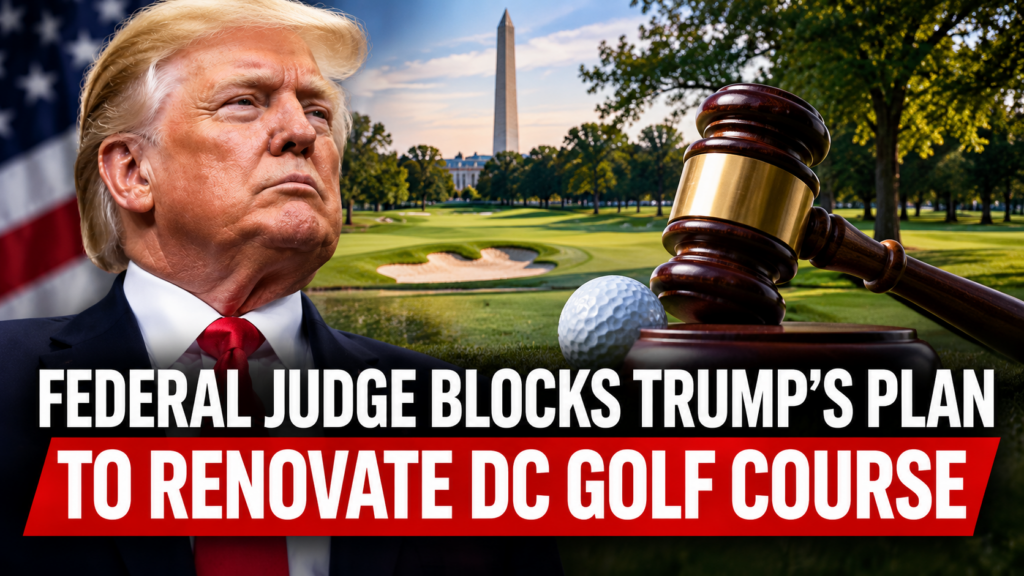
A federal judge has temporarily blocked President Donald Trump’s plan to close and renovate the historic East Potomac Golf Course in Washington, D.C. The ruling prevents the Trump administration from shutting down the surrounding public park while a legal challenge over the proposed redevelopment continues.
U.S. District Judge Ana Reyes issued the temporary restraining order on November 14, one day before the National Park Service was scheduled to close the property for a 15-month renovation. The decision marks another legal setback for Trump’s efforts to reshape major public spaces in the nation’s capital.
What Happened?
According to a report by The Guardian, the federal court blocked the administration from closing East Potomac Park and its golf course as planned.
The ruling followed an emergency request from the DC Preservation League and two local residents who challenged the government’s redevelopment plans. They argued that closing the historic public space would cause lasting harm and violate federal environmental and administrative requirements.
Judge Ana Reyes ordered the government to maintain public access to the park during the hours it was previously open. The temporary order remains in effect through November 28, 2026, unless the court issues another decision.
According to Reuters, the judge found that the administration’s stated reasons for closing the park were “pretextual” and that the government had violated at least two federal laws while attempting to meet what she described as an arbitrary deadline.
Trump’s Plan to Transform East Potomac Golf Course
Trump’s redevelopment proposal aims to transform East Potomac Park into a championship-level golf destination.
The historic site currently contains three golf courses with a combined 36 holes, a miniature golf course, and public recreational facilities. The proposed redesign would replace the existing courses with a single 18-hole championship course.
The administration has promoted the project as an opportunity to modernize the facility and create a venue capable of hosting major international golf competitions.
Trump has also suggested that the redesigned course could eventually host prestigious tournaments, including the U.S. Open and the Ryder Cup, while remaining accessible to the public.
The renovation was expected to take approximately 15 months, with the closure originally scheduled to begin on November 15.
Why Did the Judge Block the Renovation?
The legal dispute centers on whether the Trump administration followed the required procedures before attempting to close the park.
Government officials argued that the closure was necessary because of safety concerns, infrastructure conditions, and the departure of National Links Trust, the organization’s previous golf course operator.
However, Judge Reyes questioned whether these explanations justified closing the entire park.
Concerns Over Public Safety Justification
The administration cited concerns about the deteriorating seawall surrounding East Potomac Park as one reason for restricting public access.
However, the judge noted that the seawall’s condition had been documented for years. The government also failed to explain why it needed to close the entire property rather than restrict access to specific areas requiring repairs.
During court proceedings, the administration acknowledged that it had no immediate plans to begin the golf course renovation or repair the seawall.
The estimated cost of the seawall project was approximately $305 million, and the government had not identified funding for the work, according to reporting by The Washington Post.
Dispute Over the Golf Course Operator
The judge also challenged the administration’s argument that the departure of National Links Trust justified closing the property.
Reyes questioned whether the government had effectively created the operational problem it was using to support the closure.
In her ruling, she argued that the administration had used the absence of a golf course operator as an additional justification after Trump had already directed officials to close the site.
The distinction was important because the government could discontinue golf operations without necessarily preventing the public from accessing the wider park.
Federal Environmental and Administrative Requirements
The case also involves federal regulations governing public land, environmental protections, and historic preservation.
The preservation group argued that the redevelopment could permanently change the character of East Potomac Park.
The dispute intensified after the National Park Service removed more than 500 trees from the golf course over a weekend. Judge Reyes subsequently restricted further tree removal and other irreversible changes without advance notice or court approval.
The latest ruling adds another restriction on the administration’s ability to move forward with the redevelopment.
Trump’s Response to the Court Ruling
Trump criticized Judge Reyes’ decision in a post on his Truth Social platform, describing the golf course as being in poor and unsafe condition.
He argued that the renovation was necessary to improve the facility and questioned why the court would delay the project.
Trump also announced that his administration would immediately appeal the decision on an expedited basis.
The president maintained that the redevelopment would create a significantly improved public golf facility while supporting tourism, jobs, and economic activity in Washington.
However, the court’s order means the administration cannot proceed with the planned park-wide closure while the temporary restriction remains in effect.
Legal Opposition and the Administration’s Position
The DC Preservation League welcomed the ruling, describing it as an important step toward protecting East Potomac Park.
The organization, represented by Democracy Forward, argued that the administration’s redevelopment plans threatened a historic public space that could not easily be replaced.
Catherine Carroll, a senior legal adviser at Democracy Forward, said the closure would have taken away a treasured public park from Washington residents.
The Justice Department defended the administration’s position, emphasizing that the National Park Service retains authority to restrict access when public safety is at risk.
It also clarified that the court’s decision does not prevent the government from continuing to plan for the proposed championship golf course.
The ruling therefore does not permanently cancel Trump’s redevelopment proposal. Instead, it temporarily limits the administration’s ability to close the property while the legal dispute continues.
Broader Legal Challenges to Trump’s Washington Projects
The East Potomac Golf Course dispute is part of a wider series of legal challenges involving Trump’s plans to reshape Washington, D.C.
His administration has also faced opposition over other major projects, including the proposed monumental arch near the National Mall and renovations involving prominent federal properties.
In a separate case, a federal judge recently blocked construction of Trump’s proposed monumental arch for 14 days, raising further questions about the legal requirements surrounding major government-backed construction projects.
These cases highlight the role of federal courts in reviewing executive actions, particularly when government projects involve public land, historic preservation, and established regulatory procedures.
The disputes also demonstrate that presidential support for a development project does not eliminate the administration’s obligation to comply with federal laws.
What Happens Next?
The temporary restraining order is scheduled to remain in effect through November 28, 2026, unless the court issues a further order.
The Trump administration has indicated that it intends to challenge the ruling. Meanwhile, the broader lawsuit over the redevelopment remains unresolved.
The proposed golf course design must also undergo additional environmental and historic-preservation reviews before the project can move forward.
A key development is expected on December 3, when the National Capital Planning Commission is scheduled to consider the proposed golf course project.
For now, the ruling preserves public access to East Potomac Park while limiting the administration’s immediate plans for redevelopment.
The case could have broader implications for how presidential administrations approach major construction projects involving historic public spaces. It reinforces the importance of federal oversight, environmental compliance, and public access when government decisions affect nationally significant properties.
Related Reading
- Federal Judge Blocks Construction of Trump’s Monumental Arch for 14 Days
- GAO Raises Concerns Over ICE Immigration Detention Oversight as Facilities Expand
Judge Ana Reyes found that the administration’s reasons for closing East Potomac Park were pretextual and that the government had likely violated federal laws and procedures.
Trump wants to replace the existing three golf courses with a single 18-hole championship facility designed to host major golf tournaments while remaining open to the public.