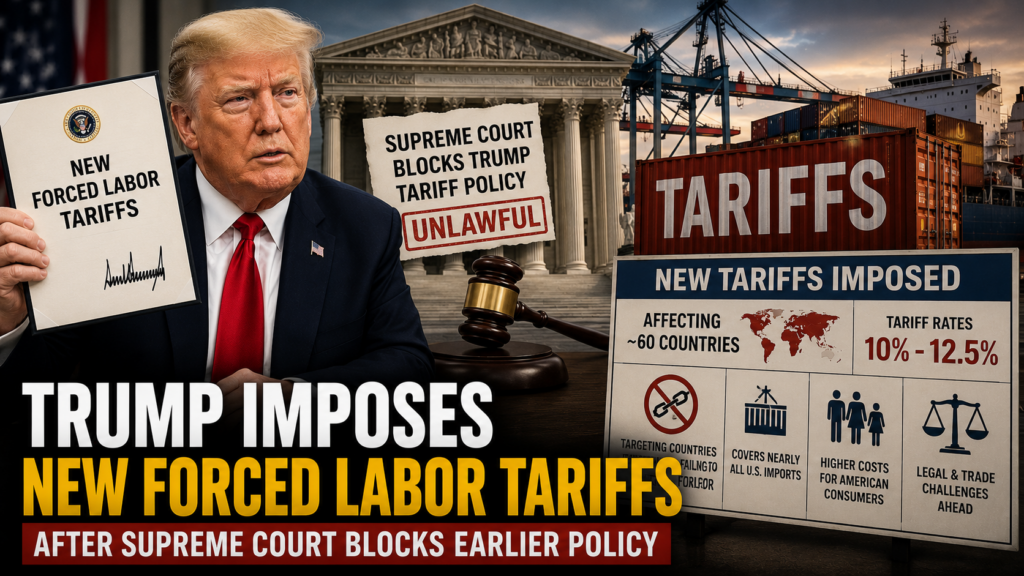
The Trump administration has imposed new double-digit tariffs on imports from dozens of U.S. trading partners, citing inadequate enforcement of forced labor bans after the Supreme Court struck down President Donald Trump’s earlier global tariff policy. The new measures, announced just before temporary tariffs expired, target countries representing nearly all U.S. imports and mark the administration’s latest effort to reshape U.S. trade policy.
According to a report by Associated Press, the administration will impose tariffs ranging from 10% to 12.5% on imports from approximately 60 trading partners, arguing that these nations have failed to adequately prevent goods produced through forced labor from entering global supply chains.
What Happened
The new Trump forced labor tariffs take effect immediately after the expiration of temporary 10% worldwide tariffs that were introduced earlier this year under Section 122 of the Trade Act of 1974.
Those temporary tariffs followed a major legal setback for the administration when the U.S. Supreme Court ruled that the International Emergency Economic Powers Act (IEEPA) did not authorize the sweeping global tariffs Trump had previously imposed. The ruling required the federal government to refund importers who had already paid those duties.
In response, the administration shifted its legal strategy by relying on Section 301 of the Trade Act of 1974, a provision that allows the president to impose trade sanctions against countries engaging in unfair or unreasonable trade practices.
Why the Administration Says the Tariffs Are Necessary
U.S. Trade Representative Jamieson Greer said the tariffs are intended to encourage stronger global enforcement against forced labor.
“The United States has had a forced labor import ban for nearly a century, and rigorously enforces it; it’s well past time for our trading partners to do the same,” Greer said.
The administration argues that countries failing to prohibit imports produced with forced labor gain an unfair trade advantage while undermining international labor standards.
Some nations were able to reduce their tariff rates after strengthening enforcement measures during the U.S. investigation. India, for example, reportedly saw its proposed tariff lowered from 12.5% to 10%.
Products including oil, natural gas, fertilizer, and goods qualifying under the U.S.-Mexico-Canada Agreement (USMCA) are exempt from the new tariffs.
The latest trade action follows several recent administration initiatives affecting international commerce, including Trump’s tariffs on Brazil, which have added to broader tensions over global trade policy.
International Reaction
Several countries immediately criticized the decision.
Brazil called the tariffs “arbitrary and unjustified,” announcing plans to invoke its reciprocity law and challenge the measures through the World Trade Organization (WTO).
Chile also rejected the findings, arguing that it maintains strong labor protections and effective safeguards against forced labor.
Canadian Trade Minister Dominic LeBlanc said the decision was not unexpected and reaffirmed Canada’s commitment to preventing forced labor within international supply chains while continuing discussions with Washington.
Critics Question the Legal and Political Strategy
Democratic lawmakers argued the administration is using forced labor concerns as a legal justification to continue pursuing a broader tariff agenda.
Representative Richard Neal, the ranking Democrat on the House Ways and Means Committee, said forced labor is a serious human rights issue that should not become a pretext for trade policies based on disputed legal theories.
Business groups also warn that tariffs are paid by U.S. importers, who often pass higher costs on to consumers through increased prices. With inflation and living costs remaining key concerns for voters, critics argue the new tariffs could place additional financial pressure on American households ahead of the November midterm elections.
The administration has defended the broader use of tariffs as part of President Trump’s strategy to strengthen domestic manufacturing and reduce dependence on foreign imports. The policy also comes as the White House continues pursuing other major economic and technology initiatives, including new restrictions on advanced AI model access for government use.
Human Rights Experts Offer Mixed Views
Human rights organizations acknowledged that import restrictions can help discourage forced labor but cautioned that successful enforcement requires transparency and international cooperation.
According to the International Labour Organization (ILO), approximately 27.6 million people worldwide were living in conditions of forced labor in 2021.
Martina Vandenberg, president of The Human Trafficking Legal Center, said import bans can be an effective tool but should be implemented gradually to give countries time to establish meaningful enforcement systems.
Other experts noted that recent U.S. investigations may already be encouraging governments to strengthen labor regulations, even if the long-term effectiveness of tariffs remains uncertain.
What Happens Next
The Office of the U.S. Trade Representative is already investigating whether 16 additional countries have engaged in excessive production practices that harm American manufacturers.
If those investigations conclude that unfair trade practices exist, the administration could announce another round of Section 301 tariffs in the coming months.
The latest Trump forced labor tariffs are also expected to face continued legal scrutiny and diplomatic challenges, potentially shaping U.S. trade relations well beyond the upcoming midterm elections.
As the administration continues to rely on existing trade authorities following the Supreme Court’s ruling, the outcome of these measures could influence future presidential use of tariff powers while redefining how the United States balances economic policy, international trade, and human rights enforcement.
The administration says the tariffs encourage countries to strengthen enforcement against goods produced with forced labor after earlier tariffs were invalidated by the Supreme Court.
Around 60 U.S. trading partners representing roughly 99% of U.S. imports face tariffs ranging from 10% to 12.5%, although some products and countries receive exemptions or reduced rates.