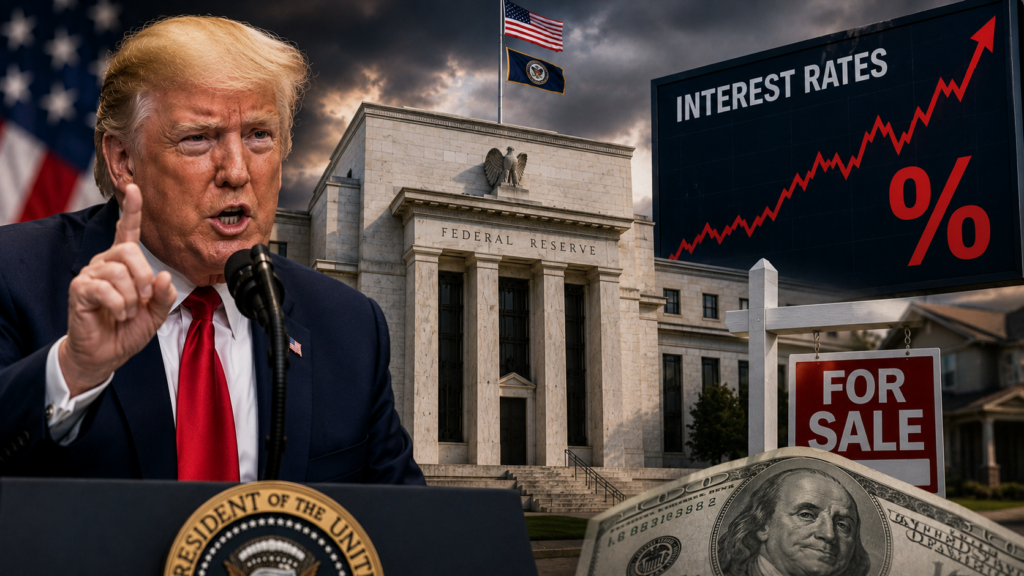
President Donald Trump is continuing his campaign for lower interest rates, arguing that Federal Reserve cuts would provide “rocket fuel” for the U.S. economy. However, despite months of public pressure from the White House, borrowing costs have continued to rise as inflation remains elevated and financial markets demand higher yields on U.S. government debt.
According to a report by ABC News, citing the Associated Press, Trump’s push for lower rates has so far failed to materialize as Treasury yields climb and the Federal Reserve signals continued concern over inflation.
What Happened?
For months, President Trump has urged the Federal Reserve to reduce its benchmark interest rate, arguing that lower borrowing costs would accelerate economic growth, boost investment, and improve housing affordability.
Trump has repeatedly described rate cuts as “rocket fuel” for the U.S. economy and has criticized high borrowing costs as inconsistent with America’s economic strength.
However, financial markets have moved in the opposite direction.
Since the conflict involving Iran intensified earlier this year, long-term borrowing costs have increased significantly. Mortgage rates, auto loan rates, and Treasury yields have all remained elevated despite Trump’s calls for monetary easing.
Key Details
Treasury Yields Continue to Rise
Recent market data shows long-term U.S. Treasury yields reaching some of their highest levels in years.
Among the developments highlighted in the report:
- The 30-year Treasury bond yield reached its highest level in nearly two decades.
- The 10-year Treasury yield rose above 4.7%.
- Thirty-year mortgage rates remain around 6.66%, according to Freddie Mac.
Higher yields translate into more expensive borrowing for households, businesses, and the federal government.
Federal debt servicing costs have also increased substantially, with the government spending approximately $827 billion on interest payments during the current fiscal year—more than total national defense spending over the same period.
Federal Reserve Maintains Cautious Approach
Inflation Remains a Concern
Federal Reserve Chair Kevin Warsh said inflation continues to run above the central bank’s preferred target.
Although the Fed has kept its benchmark interest rate unchanged this year, Warsh indicated that financial markets—not policymakers alone—are determining long-term borrowing costs.
He emphasized that market participants are responding to inflation expectations and broader economic uncertainty rather than presidential preferences.
Current market expectations tracked by CME FedWatch suggest investors increasingly anticipate another interest rate increase at the Federal Reserve’s September meeting if inflationary pressures persist.
Why Interest Rates Remain High
Several factors have contributed to rising borrowing costs.
According to the report, analysts point to:
- Persistent inflation.
- Policy uncertainty.
- Higher oil prices during the Iran conflict.
- Increased government borrowing.
- Strong demand for financing major infrastructure and technology projects.
The administration has argued that resolving tensions in the Middle East could lower energy prices and reduce inflation, potentially allowing the Federal Reserve to begin cutting interest rates.
The debate comes alongside broader economic initiatives, including Trump’s clean energy grants policy changes and infrastructure investments intended to support long-term economic growth.
Political and Economic Impact
Interest rates are expected to remain a major political issue ahead of the November midterm elections.
Although unemployment remains relatively low and consumer spending has remained resilient, affordability continues to concern many voters.
Economists cited in the report note that households are paying close attention to whether wage growth outpaces inflation and borrowing costs.
Higher mortgage rates have also complicated Republican efforts to promote improved housing affordability despite previous proposals to expand home construction and encourage lower financing costs.
Earlier this year, the administration directed Fannie Mae and Freddie Mac to purchase additional mortgage loans in an effort to reduce borrowing costs, though mortgage rates have remained largely unchanged.
Trump has continued promoting broader investment initiatives, including his administration’s support for AI data center expansion, as part of his long-term economic strategy.
What Happens Next?
Attention now shifts to the Federal Reserve’s next policy meeting, scheduled to conclude on Sept. 16.
Federal Reserve officials are expected to continue monitoring inflation, labor market conditions, and broader financial trends before making any decisions on interest rates.
While President Trump continues advocating for lower borrowing costs to stimulate economic growth, the direction of future interest rates will likely depend on inflation data and financial market conditions rather than political pressure. The outcome could influence housing affordability, consumer borrowing, and the broader economic outlook heading into the remainder of 2026.
Trump argues that lower Federal Reserve interest rates would boost economic growth, reduce borrowing costs, and improve housing affordability.
The Fed says inflation remains elevated, while financial markets continue demanding higher yields because of inflation and economic uncertainty.