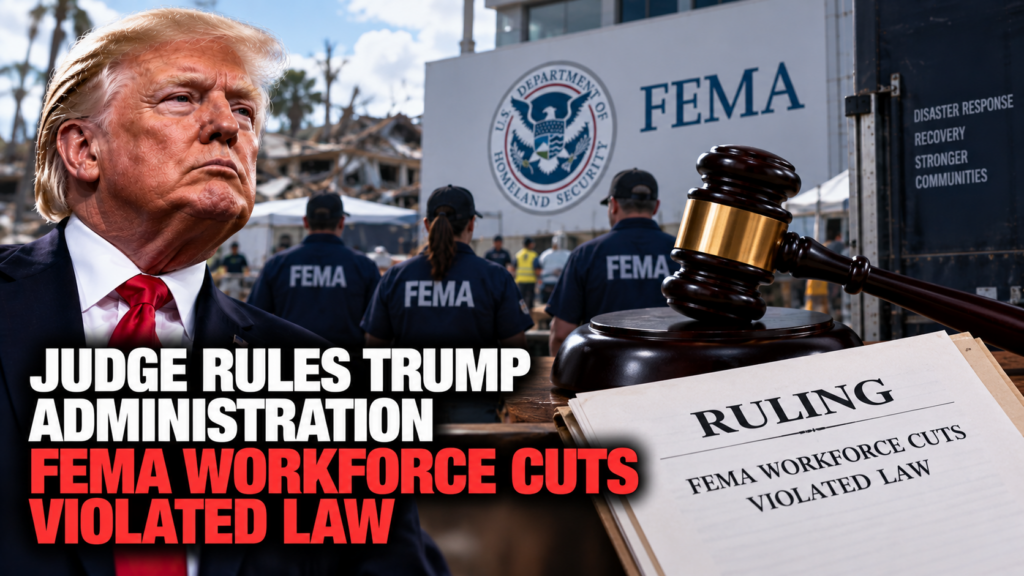
A federal judge has ruled that the Trump administration violated federal law by directing the Federal Emergency Management Agency (FEMA) to cut its workforce roughly in half, finding that the Department of Homeland Security unlawfully interfered with FEMA’s authority over its personnel and disaster-response operations.
According to a report by Reuters, U.S. District Judge Susan Illston in San Francisco said DHS acted unlawfully when it moved to prevent FEMA from renewing temporary contracts for thousands of on-call reservists who respond to disasters.
What Happened
The ruling centers on a federal law enacted after Hurricane Katrina in 2005. The law states that the Department of Homeland Security may not substantially or significantly reduce FEMA’s authorities, responsibilities or functions.
Judge Illston agreed with unions that the administration violated that requirement when DHS directed FEMA to reduce staffing and restricted the agency’s ability to renew contracts for disaster-response reservists.
The judge said the record did not show a reasoned basis for the decision to restrict FEMA’s renewal authority.
Key Details of the FEMA Workforce Cuts
FEMA is part of the Department of Homeland Security, but the agency has its own statutory responsibilities for coordinating federal disaster response.
The administration’s plan targeted thousands of positions, including temporary reservists who can be deployed during emergencies.
FEMA projected staffing for the upcoming fiscal year at 11,383 employees, approximately half of its previous workforce. Illston said the record did not establish a clear basis for selecting that staffing level.
The unions argued that the reductions would undermine FEMA’s core disaster-response mission and were ordered by former Homeland Security Secretary Kristi Noem rather than initiated independently by FEMA.
Trump Administration’s Position
The Trump administration has argued that FEMA has considerable flexibility to determine its appropriate staffing levels.
President Donald Trump has previously questioned FEMA’s role and suggested that the agency should be abolished, with states taking greater responsibility for emergency preparedness and disaster response.
Trump also established a council to review FEMA’s operations.
The administration’s position contrasts with the unions’ argument that significant changes to FEMA’s structure and functions require congressional authorization under federal law.
Judge Raises Concerns Over Signal Messages
The ruling also addressed communications between FEMA and DHS officials concerning the staffing reductions.
In a separate decision, Illston criticized officials for using the Signal messaging application on personal cellphones to communicate about the staffing cuts and then deleting those messages.
The judge said the deleted communications were relevant to the lawsuit. She indicated that the court would presume the missing messages would have been unfavorable to the defendants because they could have provided further evidence concerning the legality of the staffing decisions.
No Penalties Yet
The September 12 ruling determined that the administration’s actions violated federal law but did not immediately impose penalties or other remedies.
Judge Illston said the remedies would be addressed in a separate ruling next month. The parties may submit additional arguments concerning what relief should be provided to the unions that brought the case.
The American Federation of Government Employees, the largest U.S. federal employee union and a plaintiff in the lawsuit, along with FEMA and DHS, had not immediately responded to requests for comment cited in the Reuters report.
Broader Implications for FEMA
The FEMA workforce dispute comes as the Trump administration continues to reconsider the size and structure of federal agencies.
For FEMA, staffing levels have direct implications for its ability to maintain personnel who can respond to hurricanes, floods, wildfires and other emergencies.
The ruling also addresses a broader question about the authority of executive agencies to make major organizational changes when Congress has established specific statutory responsibilities.
The court’s decision does not by itself resolve every dispute surrounding FEMA’s future structure or staffing. The forthcoming ruling on remedies will determine the next legal steps for the agency and the unions involved.
What Happens Next
The immediate focus will be on the court’s forthcoming decision concerning remedies. The administration could also pursue additional legal avenues depending on the scope of the final order.
The case leaves unresolved how far DHS and FEMA can go in restructuring the agency while remaining within the limits established by Congress after Hurricane Katrina.
The outcome could therefore affect not only FEMA’s workforce but also the administration’s broader efforts to reorganize federal agencies and reduce staffing levels.
Related Reading
Trump Administration Backs New Rancher-Focused Executive Orders
Kushner Says Trump Seeks Long-Term Peace in Ukraine
Judge Susan Illston ruled that DHS unlawfully interfered with FEMA’s personnel authority and violated a post-Katrina federal law protecting the agency’s functions.
FEMA projected a workforce of 11,383 employees for the upcoming fiscal year, roughly half its previous staffing level.