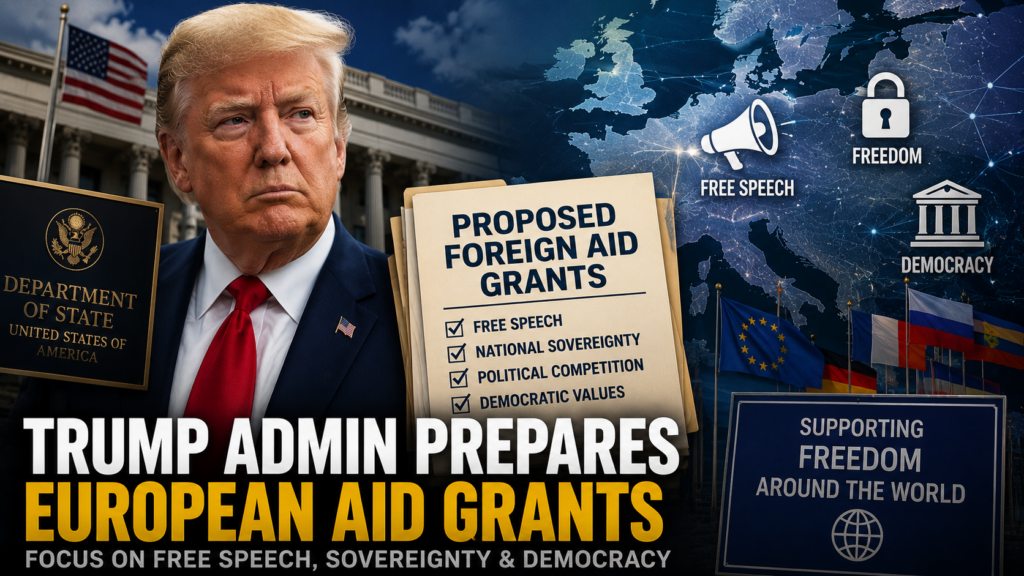
The Trump administration is preparing a new package of foreign aid grants aimed at supporting free speech, national sovereignty, and other policy priorities across Europe and beyond. The proposed funding reflects a broader restructuring of U.S. foreign assistance, with several grants targeting organizations aligned with the administration’s vision for freedom of expression and democratic governance.
According to a report by Financial Times, the State Department has notified lawmakers of multiple proposed grant programs that would support initiatives addressing censorship, political competition, and civil liberties in Europe.
What Happened?
The State Department is considering several new foreign aid grants as part of the Trump administration’s effort to reshape U.S. international assistance.
One proposal would allocate $2 million to initiatives designed to counter what the administration describes as censorship resulting from European Union regulations, including the Digital Services Act (DSA) and the Digital Markets Act (DMA).
Another proposed $5 million grant would support efforts to develop what officials describe as a “civilizational alliance” across Europe by promoting freedom of expression, political competition, and national sovereignty.
The proposals remain under review, and the State Department said no grant recipient is guaranteed funding unless all federal requirements are satisfied.
Key Grant Proposals
The draft funding package includes several initiatives beyond Europe.
Among the proposals are:
- $5 million for Free Speech Union International, an umbrella organization connected to the United Kingdom’s Free Speech Union.
- $2 million for organizations in Eastern Europe and the Balkans supporting Western democratic and cultural institutions.
- Funding to support efforts opposing judicial overreach and censorship in Brazil.
- $1 million to document alleged human rights abuses against ethnic minorities in South Africa.
- $40 million for the Victims of Communism Memorial Foundation, the largest grant outlined in the proposal.
The administration also explored funding for the British-American think tank 878, although later reports indicated that proposal may have been included in error and is not expected to move forward.
Administration’s Foreign Aid Strategy
The proposed grants illustrate a significant shift in how the Trump administration intends to allocate foreign assistance.
Rather than emphasizing traditional development programs alone, several initiatives focus on protecting freedom of speech, defending national sovereignty, and supporting organizations that promote democratic values as defined by the administration.
Officials argue these efforts respond to increasing restrictions on political expression in several countries while strengthening alliances among democratic nations.
The broader policy direction aligns with other Trump administration initiatives emphasizing institutional reform and executive priorities, including new federal employee discipline rules affecting government operations.
Political Reactions and Debate
Some of the proposed recipients have generated political debate.
Critics argue that organizations such as Free Speech Union International have become associated with conservative and anti-woke causes despite describing themselves as nonpartisan.
Supporters, however, contend the grants would reinforce freedom of expression and strengthen democratic institutions facing increasing regulatory pressure.
The proposed funding also comes as President Trump continues criticizing Democratic opponents ahead of the upcoming midterm elections while emphasizing ideological differences over governance and international policy.
The administration’s broader agenda also includes initiatives such as Trump’s election security measures that highlight protecting democratic systems and national institutions.
What Happens Next?
The proposed grants remain under active review within the State Department and must complete the federal approval process before any funding is awarded.
Potential recipients will still be required to meet all applicable grant standards and eligibility requirements.
If approved, the funding package would represent one of the most significant reorganizations of U.S. foreign aid priorities under President Trump’s second administration, placing greater emphasis on free speech initiatives, national sovereignty, and ideological partnerships across Europe and other regions.
The proposals include funding for free speech initiatives, civil society organizations, and projects supporting national sovereignty and democratic values.
No. The State Department says the programs remain under review, and organizations must still meet federal grant requirements before receiving funding.