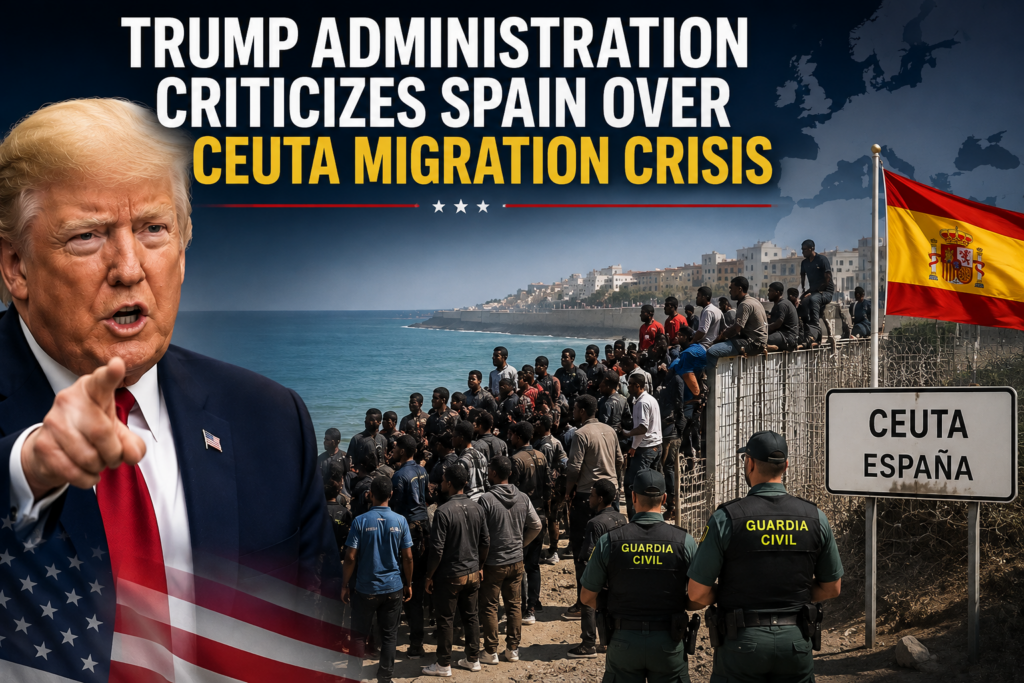
The Trump administration has sharply criticized Spain’s handling of the recent migration surge in Ceuta, using the situation to defend its own immigration policies and warn against what it describes as permissive border enforcement. President Donald Trump and senior White House officials pointed to images from the Spanish enclave as they argued for maintaining strict U.S. immigration measures ahead of the 2026 midterm elections.
According to a report by EL PAÍS, Trump cited the influx of migrants into Ceuta during a television interview, framing it as a warning of what he believes could happen in the United States under different immigration policies.
What Happened?
President Trump commented on the migration crisis affecting Ceuta, the Spanish enclave on the northern coast of Africa, during an interview with Fox News.
Referring to images showing large numbers of migrants entering the territory, Trump said the situation illustrated the consequences of weak border enforcement and warned American voters ahead of the November midterm elections.
The remarks came as the administration continues emphasizing border security as one of its central policy priorities during Trump’s second term.
Key Details
White House Officials Echo Trump’s Message
Several senior administration officials reinforced the president’s criticism of Spain’s migration response.
Vice President JD Vance wrote on social media that the images from Ceuta demonstrated what he described as the consequences of large-scale migration policies.
White House Deputy Chief of Staff for Policy Stephen Miller also linked the events in Spain to the U.S. immigration debate, arguing that similar policies could produce comparable outcomes in the United States.
White House Deputy Press Secretary Anna Kelly said Spain and other countries should reconsider migration policies that, in the administration’s view, encourage irregular migration.
Immigration Remains a Central Political Issue
The administration’s comments come just months before the 2026 congressional midterm elections, where immigration is expected to remain a major campaign issue.
President Trump has consistently promoted stricter border enforcement since returning to office, including expanded immigration enforcement operations and increased deportation efforts.
The White House has repeatedly argued that stronger immigration controls are necessary to improve border security and public safety.
The administration’s broader immigration agenda has also intersected with other legal and policy initiatives, including Trump’s mail-in voting executive order, which has generated significant legal debate over federal authority.
Spain’s Ceuta Migration Crisis
Ceuta is one of Spain’s two autonomous territories in North Africa and has long served as a key entry point for migrants seeking to reach Europe.
The recent influx of migrants has renewed debate across Europe over border management, migration policy, and cooperation between Spain and Morocco.
The Trump administration has used the developments to argue that stronger immigration enforcement remains necessary in both Europe and the United States.
Political and International Implications
The administration’s public criticism adds an international dimension to the U.S. immigration debate while drawing attention to European migration challenges.
Supporters of the administration argue the events reinforce the need for stronger border controls, while critics have questioned whether comparisons between Ceuta and the U.S.-Mexico border accurately reflect the different legal and geopolitical circumstances.
The comments also come as the administration continues advancing broader national security priorities, including Trump’s strategy during the Iran conflict and Strait of Hormuz tensions, which have influenced discussions about global security and border management.
What Happens Next?
Spain continues responding to the migration surge in Ceuta while the Trump administration is expected to keep highlighting border security as a central campaign issue ahead of the November elections.
The developments are likely to remain part of broader debates over immigration policy, international cooperation, and border enforcement in both Europe and the United States.
The administration argued that the migration surge in Ceuta illustrates the consequences of weak border enforcement and used it to defend its own immigration policies.
The crisis refers to a recent influx of migrants into Ceuta, a Spanish autonomous territory in North Africa, prompting renewed debate over migration and border security.