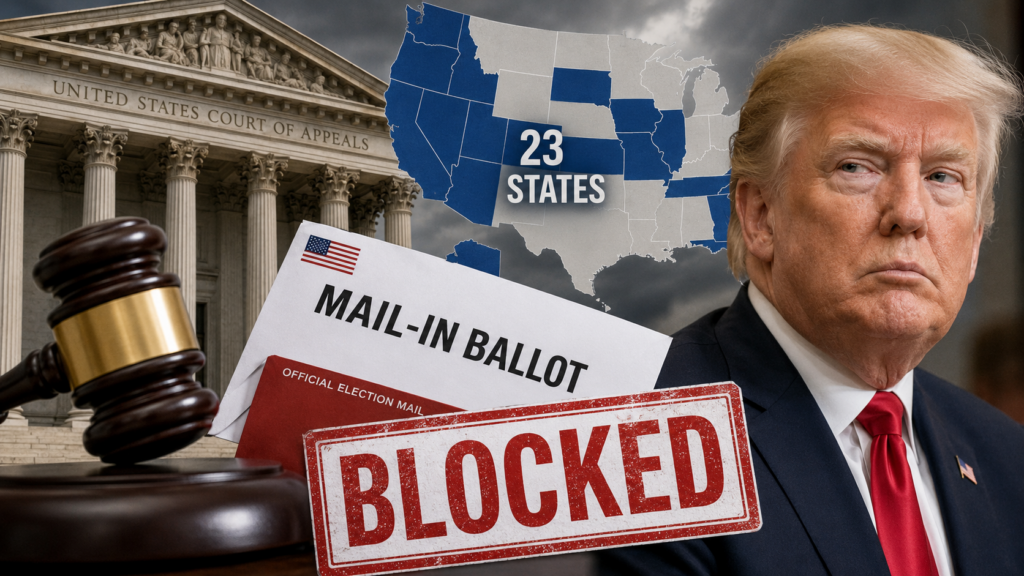
A federal appeals court has ruled that the Trump administration cannot enforce key parts of President Donald Trump’s executive order tightening mail-in voting rules in 23 states, leaving a lower court injunction in place ahead of the 2026 midterm elections. The decision marks another legal setback for the administration’s efforts to reshape federal election procedures.
According to a report by Reuters, the Boston-based 1st U.S. Circuit Court of Appeals rejected the administration’s request to suspend an injunction that had blocked several provisions of the executive order while litigation continues.
What Happened
The Trump mail-in voting order was challenged by a coalition of 23 Democratic-led states and the District of Columbia after President Trump signed the executive order earlier this year.
On July 25, the appeals court ruled that the administration could not implement the order in those states while the lawsuit proceeds.
The administration had argued that the legal challenge was premature because federal agencies had not yet finalized policies needed to carry out the order. However, the appeals court concluded that the states had already been affected by implementation deadlines and that judicial intervention was appropriate.
What the Executive Order Would Have Done
The executive order sought to introduce several changes to federal election administration related to mail-in voting.
Among its key provisions, the order directed:
- The Department of Homeland Security to help compile voter eligibility lists based on citizenship data.
- The U.S. Postal Service to establish new rules affecting the delivery of mail-in ballots.
- The Department of Justice to prioritize investigations involving election officials suspected of issuing ballots to individuals deemed ineligible to vote.
A federal district judge previously concluded that several of these provisions exceeded presidential authority and temporarily blocked their enforcement in the states that filed suit. The appeals court has now allowed that injunction to remain in effect.
Why the Court Ruled Against the Administration
The appeals court agreed that the administration had not demonstrated sufficient grounds to overturn the lower court’s injunction while the case moves through the judicial system.
The earlier ruling found that the president lacked statutory authority to direct federal agencies to create state voter eligibility lists or impose binding mail-in voting requirements without congressional authorization.
The court also found concerns that portions of the executive order could interfere with the constitutional role states play in administering federal elections.
Political and Legal Implications
The ruling represents another significant legal challenge to the administration’s election policy agenda ahead of November’s congressional elections.
The Justice Department may still appeal the decision to the U.S. Supreme Court, leaving the broader constitutional questions unresolved.
Election administration has remained a major issue for the Trump administration, alongside other domestic policy initiatives, including changes to ICE traffic stop enforcement and the nomination of a new TSA privatization advocate.
What Happens Next
The underlying lawsuit will continue in federal court while the injunction remains in place.
Unless a higher court intervenes, the administration cannot enforce the challenged provisions of the Trump mail-in voting order in the 23 states participating in the lawsuit before the 2026 midterm elections.
The Justice Department is expected to evaluate whether to seek Supreme Court review, while state officials continue preparing for November’s elections under existing election laws.
The court found that key provisions likely exceeded presidential authority and allowed a lower court injunction to remain in place while the lawsuit proceeds.
No. The decision currently applies to the 23 states and the District of Columbia that challenged the executive order in court.