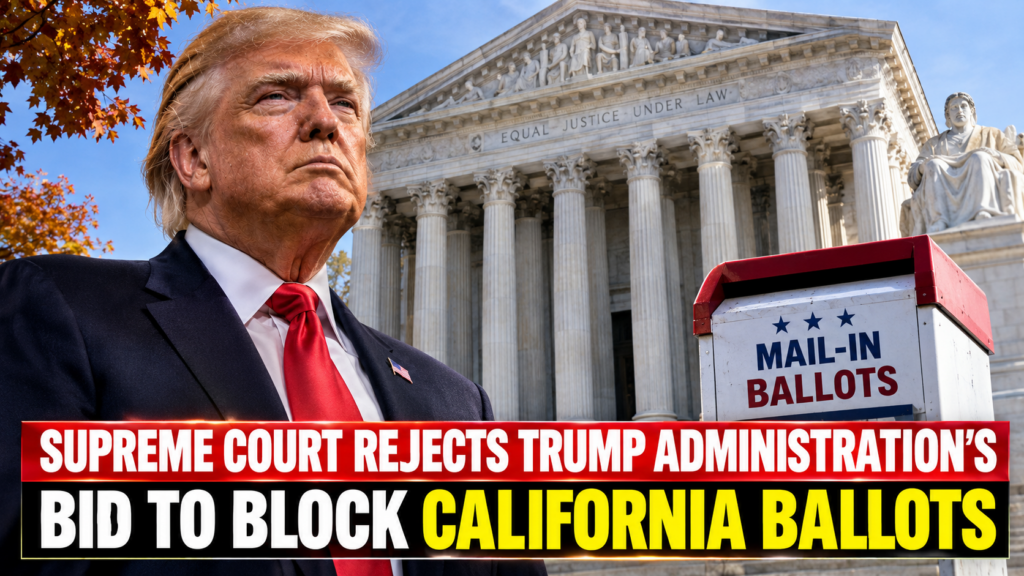
The U.S. Supreme Court has rejected the Trump administration’s attempt to prevent California from counting mail-in ballots from more than 20,000 registered voters suspected by federal officials of being noncitizens. The November 3, 2026, decision marks a significant setback for President Donald Trump’s efforts to challenge state election procedures ahead of the midterm elections.
The court issued a brief, one-sentence order refusing the administration’s emergency request. The decision allows California to continue counting the affected ballots while highlighting the legal limits on federal intervention in state election administration.
What Happened in the Supreme Court Election Case?
The Trump administration asked the Supreme Court to temporarily block California from counting ballots submitted by more than 20,000 registered voters. Federal officials alleged that these individuals were likely not U.S. citizens.
The voter list was compiled by the Department of Homeland Security. However, California challenged its reliability, arguing that it contained numerous errors.
The Supreme Court rejected the administration’s request without providing a detailed explanation. The justices also recorded no publicly noted dissents.
According to a report by Reuters, the decision came approximately six hours and 24 minutes after the administration’s request, an unusually quick response for the nation’s highest court.
Why the Ruling Matters for Trump’s Election Policies
The decision represents another legal setback for Trump’s efforts to influence election procedures through federal action.
The administration has increased its focus on alleged noncitizen voting ahead of the 2026 midterm elections. Trump has repeatedly raised concerns about voting eligibility and election integrity, although voting by ineligible individuals, including noncitizens, has been found to be rare.
The California case also reflects broader tensions between federal authorities and state governments over election administration.
Under the U.S. system, states have significant responsibilities for conducting elections. Federal officials can enforce applicable federal election laws, but attempts to intervene in state ballot-counting procedures may face legal challenges.
A Series of Election-Related Legal Setbacks
The California ruling follows several other Supreme Court decisions that have not gone in the administration’s favor.
In September 2026, the court declined to allow the Trump administration to enforce a U.S. Postal Service rule restricting voting by mail.
The Supreme Court also rejected efforts to reinstate a Republican-friendly congressional district map in Missouri. The state’s highest court had ruled that the map could not be used in the midterm elections without first receiving approval through a voter referendum.
These decisions contrast with earlier rulings during the 2026 election cycle that benefited Republican political interests.
In April, the Supreme Court weakened a key provision of the Voting Rights Act, making it more difficult for minority voters to challenge electoral maps on racial discrimination grounds. In June, the court also removed longstanding campaign finance limits in a case involving Vice President JD Vance and others.
Together, these decisions demonstrate that the court’s election-related rulings have not consistently favored either political party.
Justice Department Responds to the Decision
The Justice Department expressed disappointment following the Supreme Court’s rejection of the California request.
A department spokesperson said the administration would continue deploying election monitors in California and other states to observe compliance with federal law. The spokesperson also stated that the government would continue pursuing election fraud cases and explore other legal options to ensure that only eligible citizens vote.
California Attorney General Rob Bonta welcomed the Supreme Court’s decision. He argued that the ruling sent a message to the administration about the importance of bringing legally sound cases before the nation’s highest court.
Legal experts also questioned the strength of the federal government’s arguments.
Justin Levitt, a constitutional and election law professor at Loyola Law School, suggested that the administration’s recent losses reflected weaknesses in its legal cases. Other election law experts noted that the Supreme Court’s decision to reject the request without seeking a response from California indicated that the justices may have viewed the legal arguments as particularly weak.
What Happens Next?
The Supreme Court’s decision allows California to proceed with counting the affected mail-in ballots. However, it does not resolve every legal dispute involving the Trump administration’s election policies.
The Justice Department has indicated that it intends to continue monitoring elections and pursuing other legal avenues. The administration may therefore face additional challenges as it seeks to expand federal involvement in election oversight.
The ruling also comes at a politically important moment. Republicans entered the November midterm elections with narrow majorities in both chambers of Congress. Losing control of either chamber could make it harder for Trump to advance his legislative agenda and expose his administration to greater congressional scrutiny.
The Supreme Court’s decision reinforces the importance of judicial review when presidential actions intersect with state election responsibilities. As election-related litigation continues, the balance between federal authority, state control, and voting rights will remain an important issue in American politics.
Related Reading
- Supreme Court Blocks Trump Restrictions on Transgender Inmates
- Two Former FBI Officials Charged Over Hunter Biden Laptop Probe
The court denied the administration’s emergency request to stop California from counting ballots from more than 20,000 registered voters suspected by federal officials of being noncitizens. It did not provide a detailed explanation.
No. The decision concerns the attempt to block the counting of specific California ballots. The Justice Department says it will continue deploying election monitors and pursuing other legal actions.