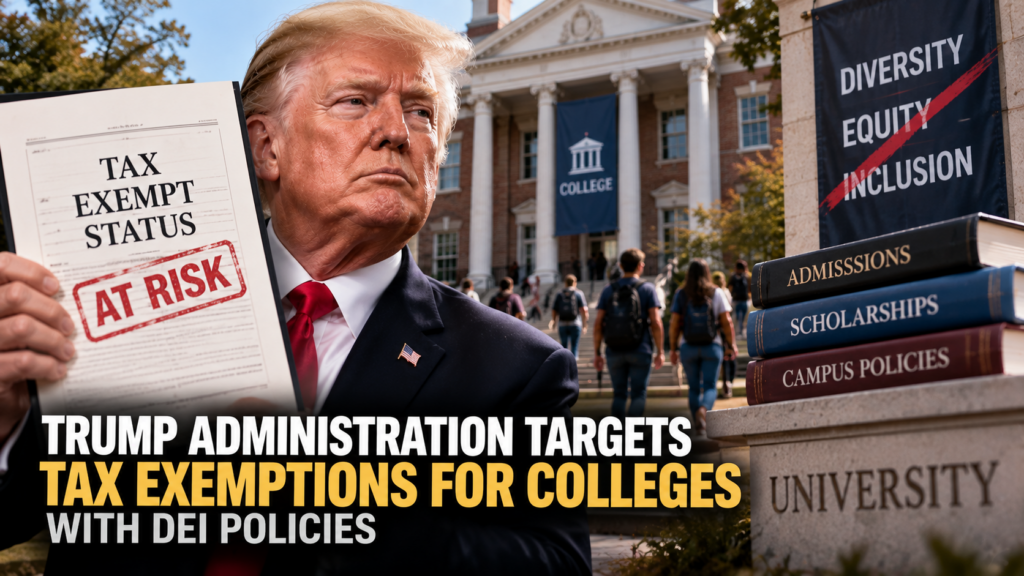
The Trump administration is proposing new tax rules that could strip private colleges and other schools of their tax-exempt status if they use race-based policies, escalating the White House’s campaign against diversity, equity and inclusion programs in American education.
What Happened
The Treasury Department and Internal Revenue Service proposed regulations on September 3 that would make private educational institutions ineligible for federal tax-exempt status if they discriminate based on race, color or national or ethnic origin.
According to a report by NPR, the proposal specifically targets policies that provide benefits based on race, including certain admissions programs, scholarships and other educational programs.
The proposal is part of President Donald Trump’s broader effort to dismantle DEI initiatives that his administration argues violate federal civil rights protections.
Key Details
Up to 18,000 Private Schools Could Be Affected
Treasury and the IRS estimate that the proposed rules could affect as many as 18,000 private elementary, secondary and postsecondary educational institutions.
The agencies also estimate that approximately 750,000 students could be affected because they attend schools offering scholarships allocated using racial, ethnic or national-identity criteria.
The proposal would apply to private schools, colleges, universities, professional schools and trade schools that receive tax-exempt status under Section 501(c)(3).
Race-Based Admissions and Scholarships Targeted
Under the proposed regulations, schools could lose their exemption if they adopt, maintain or enforce policies that discriminate based on race, color or national or ethnic origin.
The restrictions would apply across admissions, scholarships and loans, athletics and other school-administered or school-supported programs.
Treasury Secretary Scott Bessent said schools would not be able to avoid the proposed standard simply by changing the terminology used to describe race-conscious programs.
The administration says race-neutral approaches would remain permissible. Schools could consider factors such as family income, geographic location, first-generation status, individual hardship, military-family status or academic achievement when providing admissions or financial assistance.
Religious Schools Would Retain Certain Protections
The proposal does not prevent private religious schools from maintaining religious missions, curricula or religious observance programs.
Schools could continue selecting students based on genuine religious affiliation or membership when permitted under existing federal law.
The distinction is intended to preserve existing religious protections while establishing a broader federal standard against race-based treatment in private education.
Political and Economic Impact
The proposed tax rules would give the federal government another significant tool for pressuring private colleges to change policies related to race and DEI.
Tax-exempt status provides important financial benefits to private educational institutions. Losing that status could subject schools to federal income taxes while also affecting the tax deductibility of donations made to them.
Higher education officials warned that the uncertainty could also create additional compliance costs and affect scholarship funding.
The proposal builds on Trump’s broader campaign against what his administration describes as discriminatory DEI practices. Federal agencies have already taken steps to challenge race-conscious scholarships, admissions policies and other programs at colleges.
Reactions and Opposition
Higher education groups have criticized the proposal, arguing that it could create significant legal uncertainty for colleges that are attempting to comply with existing civil rights requirements.
Mike Gavin of the Alliance for Higher Education described the move as an attack on efforts to expand access to higher education for working-class Americans and people of color.
The Council of Independent Colleges also raised concerns about the potential impact on donations, particularly contributions earmarked for scholarships.
Officials from the National Association of Independent Colleges and Universities warned that the proposal could create new compliance burdens even for institutions that believe their policies already comply with federal nondiscrimination requirements.
Supporters of the proposal, meanwhile, argue that tax-exempt organizations should not receive federal benefits while using race as a factor in educational decisions.
Historical Context
The federal government has rarely revoked the tax-exempt status of an educational institution.
One of the most significant precedents involves Bob Jones University, which lost its tax exemption after the IRS determined that its policy banning interracial dating and marriage violated fundamental public policy. The Supreme Court upheld the government’s position in 1983.
The university later ended the policy and regained its tax-exempt status in 2017.
The Trump administration’s proposal seeks to apply that broader principle to modern race-conscious educational policies, citing Supreme Court decisions and federal civil rights law as part of its legal foundation.
What Happens Next
The proposed regulations are not immediately effective. If finalized, they would apply to taxable years beginning on or after May 31, 2027.
That gives affected institutions time to review admissions, scholarship, financial-aid and other policies while the federal government considers public comments.
The proposal is likely to face legal and political challenges, particularly over the administration’s interpretation of racial discrimination and its authority to use tax-exempt status as an enforcement mechanism.
The outcome could have significant consequences for private higher education, charitable giving and race-conscious programs nationwide. More broadly, the proposal marks another major escalation in the Trump administration’s effort to reshape how federal civil rights policy applies to American colleges and universities.
Related Reading
- Trump Administration Shuts Down 270 CDL Schools in Fraud Crackdown
- Trump Weighs New Semiconductor Tariffs to Boost U.S. Chips
The administration says private schools using race-based policies should not receive federal tax benefits because those practices violate civil rights protections.
If finalized, the proposed regulations would apply to taxable years beginning on or after May 31, 2027.