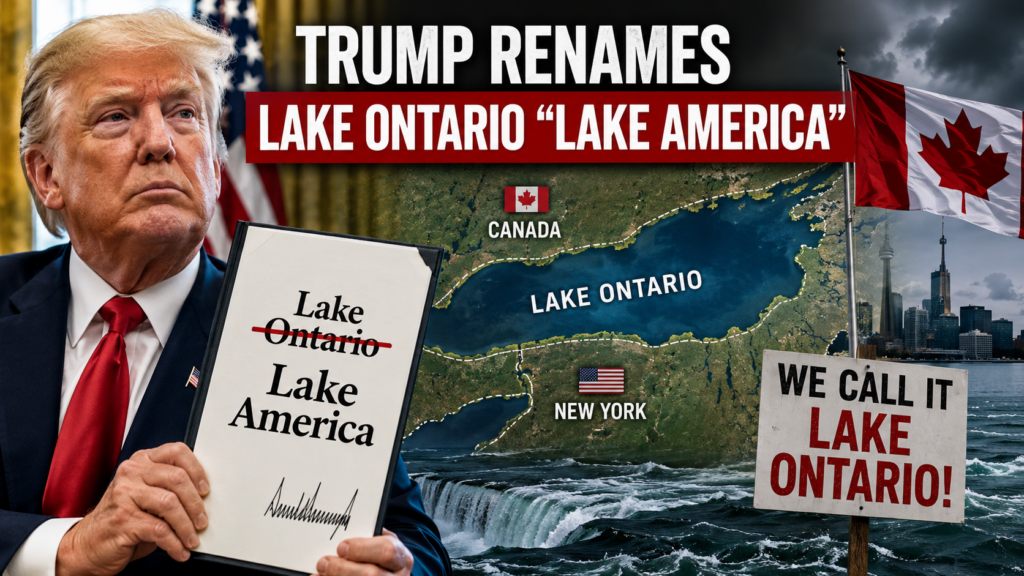
President Donald Trump signed an executive order on August 27, 2026, directing the U.S. government to use Lake America instead of Lake Ontario, escalating tensions with Canada as both countries impose retaliatory tariffs and trade negotiations remain stalled.
According to a report by CNBC report, Trump announced the change in the Oval Office and said it would take effect immediately. The executive order directs the U.S. Interior Department to update the Geographic Names Information System to reflect the new U.S. designation.
What Happened
Trump’s decision came after trade talks between Washington and Ottawa broke down following several days of negotiations. The dispute has already produced new tariffs on billions of dollars in goods moving between the United States and Canada.
The executive order applies to U.S. federal geographic naming. It does not give Trump authority to force Canada, international organizations or other countries to adopt the name Lake America.
Lake Ontario is one of North America’s five Great Lakes and sits along the U.S.-Canada border. About 52% of its surface area is in Canada, while the remainder lies within New York State.
Why Trump Renamed Lake Ontario
Trump had publicly floated the idea of renaming Lake Ontario days before signing the order. The proposal emerged alongside the worsening U.S.-Canada trade dispute.
Trump has repeatedly criticized Canada’s trade policies and argued that the United States has been treated unfairly by its northern neighbor. During his Oval Office remarks, he connected the dispute to his broader complaints about trade with Canada.
The latest action follows Trump’s 2025 decision to rename the Gulf of Mexico as the Gulf of America for U.S. federal purposes. That earlier move also generated international disagreement over whether the new designation would be adopted outside the United States.
Trump suggested that other major bodies of water could potentially receive similar treatment, joking that the United States might eventually rename the Atlantic or Pacific oceans.
Canada Rejects “Lake America”
Canadian Prime Minister Mark Carney quickly rejected the new designation and said Canada would continue calling the body of water Lake Ontario.
Carney emphasized that the lake’s name predates both modern Canada and the United States. He also pointed to its Indigenous origins and described the name as part of Canada’s historical identity.
New York Gov. Kathy Hochul also rejected the change, saying New York would not use Trump’s preferred name. Republican Vermont Gov. Phil Scott called the decision “petty and disappointing.”
Ontario Premier Doug Ford likewise rejected the designation, saying Canadians and the rest of the world would continue to call it Lake Ontario.
Lake Ontario Name Has Indigenous Origins
The name Lake Ontario has deep historical roots. According to reporting cited by AP, the name comes from the Wendat or Huron Indigenous language, with meanings associated with a beautiful, large or shining lake. The name predates European settlement and the establishment of both Canada and the United States.
The lake is also closely tied to the identity of Ontario, the Canadian province that takes its name from the lake.
The dispute therefore goes beyond a change to a government database. Critics in Canada have argued that the move attempts to disregard a name with centuries of historical and Indigenous significance.
U.S.-Canada Trade War Escalates
The renaming came as Washington and Ottawa were already engaged in a rapidly intensifying trade conflict.
The Trump administration recently imposed 50% tariffs on roughly $20 billion worth of Canadian goods. Canada responded with plans for dollar-for-dollar retaliatory tariffs covering hundreds of American products, with rates ranging from 15% to 50%.
Canadian tariffs on targeted U.S. products are scheduled to begin September 8 and include items such as seafood, cheese, household appliances, steel and aluminum products, smartphones and other consumer goods.
The dispute also extends to the automotive industry. Trump’s threatened 50% tariffs on Canadian cars and trucks could further increase pressure on the deeply integrated North American manufacturing sector. Trump’s threatened 50% Canada auto tariffs
The broader tariff strategy has already raised concerns about higher costs for businesses and consumers on both sides of the border.
Political and Economic Impact
The Lake America decision is primarily symbolic, but it arrives at a particularly sensitive moment in U.S.-Canada relations.
Canada remains one of America’s most important trading partners, while supply chains in industries including automobiles, manufacturing and agriculture cross the border extensively.
The escalating tariffs could raise costs for businesses and consumers if companies pass higher import expenses through to customers. AP reported that businesses and households on both sides of the border could face additional price pressure as the new measures take effect.
The latest dispute also follows other Trump administration tariff actions affecting American consumers. The administration has, for example, temporarily waived certain higher beef import tariffs in an effort to address elevated food prices, highlighting the competing pressures between trade policy and affordability. Trump’s beef tariff policy and consumer prices
Reactions and Opposition
The decision has prompted criticism from political leaders, Indigenous representatives and commentators in both countries.
New York officials have rejected the new name, while Canadian leaders have emphasized that the United States cannot determine what Canada calls a geographic feature shared by both nations.
Grand Chief Pierre Picard of the Wendat Nation in Quebec also condemned the change, arguing that it attempted to erase the history associated with the lake’s Indigenous name.
The controversy also illustrates the limits of executive authority over international geographic naming. While the U.S. government can determine how federal agencies identify geographic features, it cannot compel Canada or international organizations to use the same terminology.
What Happens Next
The immediate effect of the executive order will be on U.S. federal geographic naming. Whether private companies, mapping services and other organizations adopt Lake America is a separate question.
The larger issue remains the deteriorating U.S.-Canada relationship. With additional Canadian tariffs scheduled to take effect September 8 and further U.S. tariff threats under consideration, the naming dispute could become another symbol of the broader breakdown between Washington and Ottawa.
For now, the United States and Canada are using different names for the same Great Lake. Trump’s executive order changes the official U.S. federal designation, but it does not erase the centuries-old name used by Canada and much of the international community. The dispute over Lake America therefore reflects a much larger conflict over trade, sovereignty and the future of U.S.-Canada relations.
Trump signed the order amid escalating trade tensions with Canada, directing the U.S. government to use “Lake America” for federal purposes.
No. Canadian Prime Minister Mark Carney and other Canadian officials said they will continue calling it Lake Ontario.