Independent voters had an outsized effect on the 2026 midterms: they make up the largest share of the American electorate, and in November they broke sharply toward Democratic House candidates after favoring Donald Trump in 2024. The independent voters 2026 midterm election impact is best measured in that swing, in the enthusiasm gap that preceded it, and in the questions it raises for 2028. This article reviews the available data, explains who independents actually are, and outlines what local organizers can take from the results.
How Big Is the Independent Bloc in 2026?
Independents are now the largest political identity group in at least one recent national survey. A September 2026 UMass Amherst poll found that 45% of U.S. adults identified as independents, compared with 27% each who identified as Democrats and Republicans. Put differently, the two parties together account for 54% of adults, which is more than the share identifying as independents.
That figure requires context. Party identification is self-reported, and many people who say "independent" still vote consistently for one party. Others move between parties from one cycle to the next. Both groups matter to campaigns, but they behave differently. A voter who rejects a party label out of distaste for politics generally can still be a dependable vote for one side, while a voter who weighs each cycle fresh can swing by double digits, as the 2024 to 2026 results demonstrate. Registration data can also mislead, since in some states voters must declare a party to vote in primaries, which pushes people toward labels they would not choose in a survey.
The practical consequence is straightforward. Neither party can win a national election by mobilizing its base alone, because each base represents roughly a quarter of adults. Margins are decided by the people who do not carry a party label, which is why independent voters so often decide elections in competitive districts and states.
Who Counts as an Independent Voter?
An independent voter is anyone who declines to register or identify with a major party, but the category contains several distinct types of voters. Treating it as a single bloc is the most common analytical error in midterm coverage.
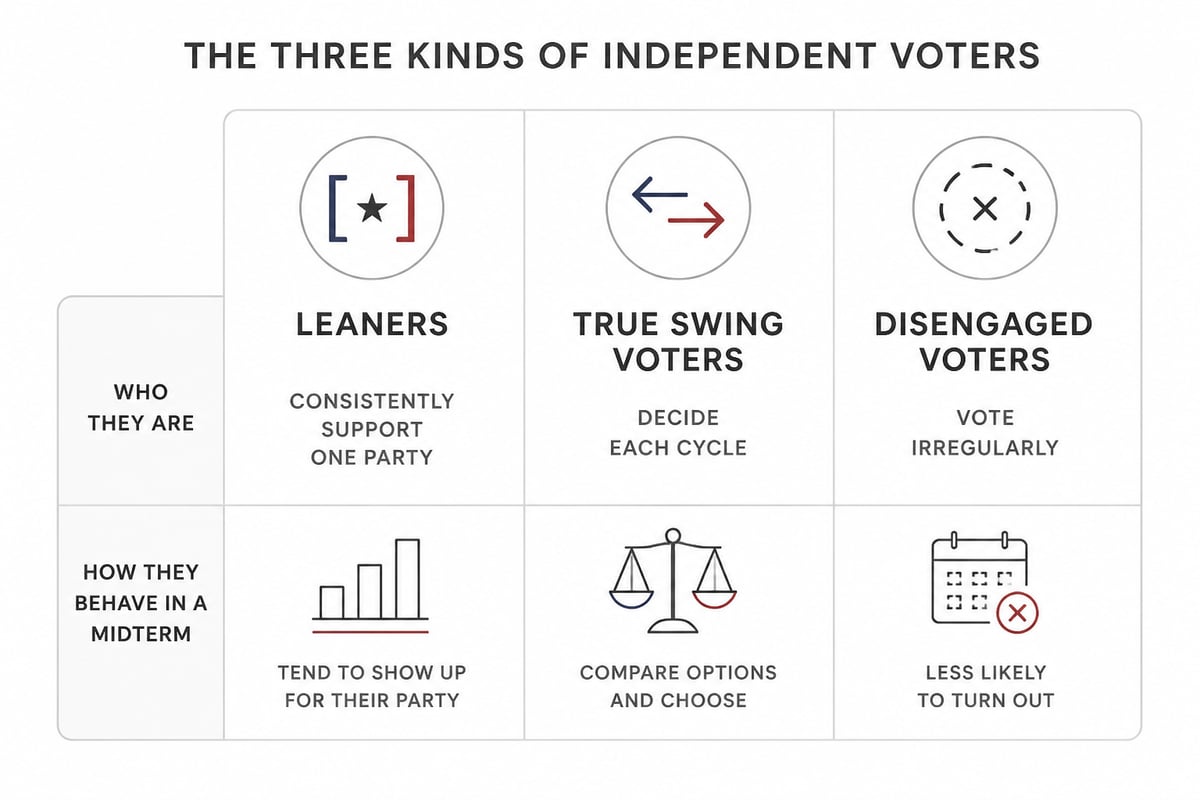
Three groups account for most self-described independents:
- Leaners: Voters who say they are independent but consistently support one party. Public radio station KSFR has published an explainer on how many independents lean Republican or Democratic that separates leaners from voters who are truly independent.
- True swing voters: Voters who evaluate each cycle on its own terms, often weighing the economy, the president's record and candidate quality.
- Disengaged or disaffected voters: Voters who reject both parties and may vote irregularly or skip down-ballot races.
The distinction determines how to interpret topline numbers. A large swing among independents may reflect leaners returning to a party they had drifted from, genuine persuasion of swing voters, or differential turnout among the disengaged. Each explanation carries different lessons for a campaign.
The Enthusiasm Gap Before Election Day
Independents entered the fall with low motivation to vote, and that makes the final result more notable. In the same UMass Amherst survey, a majority of independent respondents said they were not too enthusiastic or not at all enthusiastic about voting in the 2026 midterms, and nearly half said they were not at all enthusiastic.
Low enthusiasm does not always translate into low turnout, but it creates volatility. Voters who feel little connection to either party tend to decide late, respond to the dominant news of the final weeks, and are more likely to treat the midterm as a verdict on the sitting president.
Midterm elections have long worked this way. The party holding the White House typically loses ground, and independents are the group most willing to register that judgment. Readers following the broader pattern can review the 2026 congressional election voter priorities for the issues that moved voters late.
The 26-Point Swing Toward Democrats
The clearest measure of the independent voters 2026 midterm election impact is the post-election swing. An Economist/YouGov poll conducted after the 2026 congressional elections found that independent voters chose Democratic candidates by 26 points. In 2024, the same pollster found independents favored Donald Trump by 8 points.
That comparison implies a movement of roughly 34 points in the independent vote across two years, although the two figures come from different electorates and different contests, so the arithmetic should be read as directional rather than exact.
The same poll surveyed 3,166 registered voters. Among those who voted in the November elections, Democratic House candidates led Republicans 52% to 41%. Independents were therefore a meaningful part of the Democratic advantage, and their shift helped move the overall result.
| Measure | Finding | Source |
|---|---|---|
| Independent vote, 2024 | Favored Trump by 8 points | Economist/YouGov |
| Independent vote, 2026 House | Favored Democrats by 26 points | Economist/YouGov |
| Overall House vote, 2026 | Democrats 52%, Republicans 41% | Economist/YouGov |
| Independent share of adults | 45% | UMass Amherst |
For a full account of the outcome in Congress, see the 2026 midterm election results and what they mean for Trump and Congress.
What Drove Independents Away From the President's Party
Economic conditions and the president's standing are the most consistent explanations for the independent shift, though no single factor accounts for all of it. Surveys of independents repeatedly show that cost of living ranks ahead of ideological issues.
Several factors are worth tracking:
- Prices and affordability. Independents are less likely than partisans to excuse economic frustration. Coverage of Trump, inflation and the midterms examines how price concerns shaped the campaign environment.
- Presidential approval. Midterm independents weigh the incumbent's performance heavily. The Trump approval rating analysis for 2026 tracks how that number moved.
- Executive actions. Independents are often wary of policy made without Congress, a theme explored in the review of Trump executive orders affecting America in 2026.
- Candidate quality. Endorsement-driven primaries can produce nominees who appeal to the base but not to the middle. The MAGA endorsement impact on the 2026 midterms analysis addresses that tension.
Attributing the swing to any one cause requires caution. Post-election surveys capture who voted for whom, not why, and motives vary by region and by voter type.
Independents Versus Party Loyalists
Independents often differ from loyalists: they tend to decide later, split tickets more often, and respond more to national mood than to party messaging. These differences explain why a campaign built for the base can underperform with the largest bloc of voters.
Party loyalists vote reliably and are persuaded rarely. A campaign's task with them is turnout: confirming polling locations, reminding them of early voting windows and making sure the base shows up. Independents require the reverse: persuasion first, then turnout. That sequence changes the tools a campaign should use. Persuasion of unaffiliated voters tends to come from issue-specific mail, local media and conversations that do not open with a party name, while loyalist turnout can rely on party lists and familiar slogans. Ticket splitting adds a further complication, because an independent who supports one party's candidate for president may back the other party's candidate for Congress or a local office, so down-ballot campaigns cannot assume coattails will carry them. The comparison is developed further in the analysis of independent voters versus party loyalists in 2026 and in the report on the independent voter shift.
Demographics add another layer. Independents are not evenly distributed by age or race, and Pew Research Center's breakdown of 2026 midterm vote preferences by race and ethnicity, age and other demographics helps place independent voters within wider patterns. Younger independents, for example, tend to differ from older ones in both issue priorities and likelihood of voting.
Reading the Result Without Overreading It
A single midterm swing is not a permanent realignment, and the 2024 to 2026 reversal is itself evidence of that. Independents moved eight points toward Trump in one cycle and twenty-six points toward Democrats in the next. A bloc that moves that far that quickly is better described as responsive than as loyal.
Three cautions apply to any analysis of the result:
- Leaner effects. If many independents are leaners, part of the swing reflects party-aligned voters returning home rather than neutral voters being persuaded.
- Turnout composition. Midterm electorates are smaller and older than presidential electorates. The independents who voted in 2026 may not resemble those who vote in 2028.
- Poll limits. A survey of 3,166 registered voters carries a margin of error, and subgroup results such as independents carry a larger one.
Regional dynamics matter as well. Swing-state patterns can diverge from the national picture, as shown in the swing state polling analysis for 2026 and the Wisconsin election forecast.
Implications for the 2028 Cycle
The independent voters 2026 midterm election impact will carry into 2028 mainly through candidate selection and message discipline. Both parties now have evidence that the largest group of voters can move decisively against the party in power.
For Republicans, the lesson concerns breadth. Strategists weighing Republican approaches to the 2028 election must decide whether to prioritize base intensity or appeal to the voters who shifted away. Primary contests are where that decision is made in practice, because a nominee chosen for base enthusiasm can struggle in a general electorate in which each party's base is only about a quarter of adults. For Democrats, the risk is assuming the 26-point margin is earned loyalty. Independents who broke Democratic in a midterm may have been registering a verdict on the president rather than endorsing the opposition, and a verdict of that kind can reverse in a presidential year, as the 2024 result shows. Internal debates over direction, covered in the report on Democratic Party internal divisions in 2026, will determine whether the party can hold those voters.
The legislative picture also matters. The 2026 results alter what the president can pass in the final two years of the term, a question examined in the analysis of the 2026 midterms and the Trump legislative agenda heading toward 2028.
What Organizers Can Take From the Independent Vote
Local organizers should treat independents as a persuasion audience rather than a mobilization audience, and plan outreach accordingly. The 2026 data supports several practical conclusions.
- Lead with local, concrete issues. Cost of living, healthcare and services resonate with voters who distrust party labels.
- Avoid partisan shorthand. Messaging that signals a team identity can lose the voters a campaign most needs.
- Plan for late deciders. Independents with low enthusiasm often commit in the final weeks, so a campaign calendar should not front-load all contact.
- Use trusted, non-partisan information. Voters who are skeptical of both parties respond to sources that present facts without an obvious agenda.
- Know the rules. Organizers should confirm registration deadlines, open versus closed primaries and reporting obligations, starting with the Federal Election Commission rules for 2026.
Independents are also less likely to be reached by traditional party infrastructure, which can give community-based groups an advantage. A political club that welcomes unaffiliated voters may reach people neither party's operation contacts.
Your next step is to pick one competitive race in your area and track how independents there are polling, then build your outreach around the issues they name. U.S. Presidential Report publishes non-partisan coverage of presidential elections, Congress and federal policy that can inform that research, and the site is a practical starting point if you want to Start Your Own Political Club grounded in reliable reporting.