Florida's transformation from America's quintessential swing state to a Republican stronghold represents one of the most consequential political realignments in modern electoral politics. For decades, presidential campaigns invested heavily in the Sunshine State, knowing its large electoral vote count could tip national elections. Today, that calculus has changed dramatically, and understanding the forces behind this shift provides crucial insights into broader national trends reshaping American politics.
Understanding Florida's Historical Swing State Status
Florida earned its reputation as the ultimate battleground through a series of razor-thin presidential contests. The 2000 election between George W. Bush and Al Gore famously came down to just 537 votes in Florida, triggering a recount that reached the Supreme Court. This pattern continued through subsequent cycles, with Barack Obama winning the state by narrow margins in 2008 and 2012, and Donald Trump securing it by 1.2 percentage points in 2016.
The state's competitive nature stemmed from its diverse coalition of voters:
- Retirees from traditionally Democratic northeastern states
- Growing Hispanic populations with varied national origins and political preferences
- A substantial African American electorate concentrated in urban areas
- Conservative white voters in rural counties and suburban communities
- Moderate swing voters in the critical I-4 corridor connecting Tampa and Orlando
This delicate balance made Florida unpredictable and essential. Campaigns poured billions into television advertising, field operations, and voter registration drives. U.S. Presidential Report chronicled these intense battle cycles throughout the 2000s and 2010s, documenting how each party developed increasingly sophisticated strategies to win Florida's crucial electoral votes.
The Demographics Behind the Florida Political Shift Explained
The florida political shift explained begins with dramatic demographic changes that accelerated after 2020. The COVID-19 pandemic triggered unprecedented domestic migration patterns, with Florida gaining approximately 740,000 net new residents between 2020 and 2024, according to U.S. Census Bureau migration data. These newcomers arrived predominantly from states with different political cultures, fundamentally altering the state's electoral composition.
In-Migration Patterns and Political Consequences
Analysis of migration sources reveals that Florida attracted disproportionate numbers of residents from conservative-leaning states and Republican-leaning suburbs in blue states. Texas, Georgia, North Carolina, and Tennessee contributed significant population flows, while many transplants from California and New York came from more conservative counties within those states. These migration patterns created a self-reinforcing political dynamic.
The new arrivals brought distinct characteristics:
- Higher rates of remote work enabling relocation from expensive metropolitan areas
- Older median age among retirees seeking tax advantages and warm weather
- Business owners and entrepreneurs attracted by Florida's regulatory environment
- Families seeking alternatives to perceived liberal policies in their origin states
This influx coincided with slower growth among traditionally Democratic constituencies. Younger voters, who lean more progressive nationally, represented a smaller share of Florida's population growth compared to other Sun Belt states like Georgia and Arizona.
The Hispanic Vote Transformation
Perhaps no demographic shift proved more consequential than the transformation of Florida's Hispanic electorate. While Hispanic voters nationally continued supporting Democratic candidates by substantial margins, Florida's unique Hispanic composition produced divergent results.
| Hispanic Subgroup | 2012 Dem Margin | 2024 Dem Margin | Shift |
|---|---|---|---|
| Cuban Americans | -20% | -45% | R+25 |
| Venezuelan Americans | -5% | -30% | R+25 |
| Puerto Ricans | +35% | +15% | R+20 |
| Colombian Americans | +10% | -15% | R+25 |
The Republican Party's focused messaging around socialism, particularly targeting voters with direct experience of authoritarian leftist regimes in Latin America, resonated powerfully. Democratic candidates struggled to counter these narratives effectively, especially after Florida Republicans invested heavily in Spanish-language media and grassroots outreach.
The Pew Research Center analysis of 2024 voting patterns documented this historic shift, showing Republicans winning Florida's Hispanic vote overall for the first time in modern polling history. Miami-Dade County, once a Democratic stronghold powered by Hispanic voters, swung Republican in 2024, symbolizing the broader realignment.
Republican Strategic Advantages and Organizational Superiority
The florida political shift explained cannot be understood without examining the Republican Party's methodical construction of institutional advantages. Since Ron DeSantis became governor in 2019, Florida Republicans implemented a comprehensive strategy that extended far beyond traditional campaigning.
Voter Registration and Mobilization
Republicans achieved a decisive advantage in voter registration, overtaking Democrats for the first time in state history in 2021. By 2024, Republicans enjoyed a registration edge exceeding 900,000 voters. This advantage reflected both conversion of existing voters and superior recruitment of new registrants.
The GOP's approach combined:
- Targeted digital advertising identifying likely Republican voters for registration drives
- Issue-based mobilization around education, COVID-19 policies, and economic freedom
- Integration with state policy where legislative actions reinforced partisan messaging
- Year-round field operations rather than election-cycle-only engagement
Democratic efforts, while substantial, faced organizational challenges and resource constraints. The party struggled to match Republican registration gains, particularly in growing suburban and exurban areas where new construction attracted GOP-leaning transplants.
Legislative and Electoral Rule Changes
Voting law changes documented by the Brennan Center reshaped Florida's electoral landscape. Republicans in the state legislature passed measures that critics argued created barriers to voting while supporters defended as election security enhancements. These changes included restrictions on mail ballot drop boxes, limitations on third-party voter registration organizations, and new identification requirements.
The cumulative effect of these changes remains debated, but their political consequences proved clear. Republicans designed and implemented rules that advantaged their coalition's voting patterns while creating friction for Democratic-leaning constituencies. Whether through intent or effect, these policies contributed to the broader partisan realignment.

Issue Alignment and Cultural Messaging
The florida political shift explained also reflects changing issue salience and cultural positioning. Florida Republicans successfully defined political competition around issues where they held advantages, while Democrats struggled to find messages that resonated across their diverse coalition.
Education and Parental Rights
Education policy became a defining cleavage. Governor DeSantis and Republican legislators passed measures limiting certain classroom discussions about race and gender identity, framed as "parental rights" legislation. These policies generated intense national controversy but proved popular with key voter segments in Florida, particularly suburban parents and conservative Hispanic voters.
Research from the Florida Policy Institute showed that while these policies divided voters, they mobilized Republican constituencies more effectively than they energized Democratic opposition. The Republican framing emphasized parental control and transparency, while Democratic criticisms about censorship and discrimination gained less traction among persuadable voters.
Economic Positioning and COVID-19 Response
Florida's relatively early reopening from COVID-19 restrictions, controversial at the time, became a political asset for Republicans. The state's economic performance during and after the pandemic compared favorably to more restrictive states, and Republican messaging consistently highlighted this contrast.
The Florida Chamber of Commerce political reports documented business community support for the state's approach. This alignment between Republican governance and business interests created a powerful coalition, particularly among small business owners who resented lockdown policies elsewhere.
Economic growth, low unemployment, and continued population increases provided tangible evidence that Republicans wielded effectively. Democratic attempts to criticize other aspects of state governance found less receptive audiences when economic indicators remained strong.
Media Environment and Information Ecosystems
Analysis from the Reuters Institute at Oxford highlighted how fragmented media environments shaped political perceptions. In Florida, Republicans invested heavily in Spanish-language radio, digital platforms, and alternative media that reached constituencies outside traditional Democratic communication channels.
Spanish-language radio in South Florida, particularly influential among Cuban and Venezuelan voters, featured consistently conservative programming. Democratic efforts to compete in this space came late and remained underresourced. This media asymmetry allowed Republican narratives about Democratic positions to spread largely unchallenged among crucial voter segments.
Geographic Realignment Across Florida Regions
The transformation manifested differently across Florida's diverse regions, creating a new electoral map that favored Republicans even in previously competitive areas.
South Florida's Rightward Shift
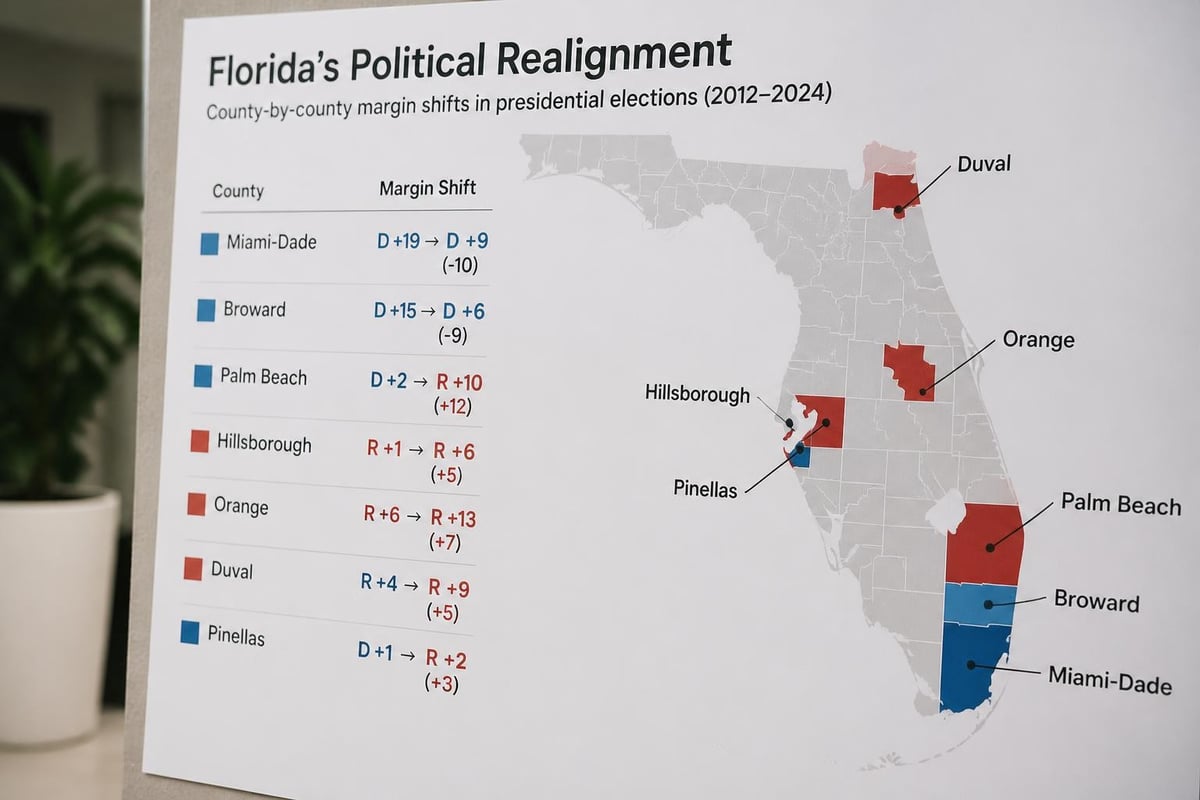
Miami-Dade County's dramatic swing exemplified the broader pattern. A county Barack Obama won by nearly 24 points in 2008 voted Republican in 2024, a stunning reversal. This shift reflected Hispanic voter realignment, Cuban and Venezuelan American mobilization, and erosion of Democratic margins in suburban areas.
Broward and Palm Beach counties, while remaining Democratic, saw substantially reduced margins. The cumulative effect left Democrats without the overwhelming South Florida advantage they historically needed to offset Republican strength elsewhere.
The I-4 Corridor Stabilization
The I-4 corridor connecting Tampa Bay and Orlando traditionally determined statewide outcomes. Republicans made steady gains in this region, particularly in suburban areas around Tampa. Hillsborough County, which Obama won comfortably, became increasingly competitive before trending Republican.
Orange County, home to Orlando, remained Democratic but with diminished margins. The progressive urban core couldn't overcome Republican gains in surrounding suburbs and exurbs, where new development attracted GOP-leaning residents.
Consolidation of Republican Rural and Exurban Dominance
Republicans already dominated Florida's rural counties, but margins expanded further. Counties in the Panhandle, North Florida, and rural Central Florida delivered overwhelming Republican majorities that Democrats couldn't offset elsewhere.
The pattern documented by WLRN’s analysis of Florida’s swing state transformation showed Republicans gaining ground incrementally across multiple regions simultaneously, creating a cumulative effect that tipped the state decisively.
National Implications of Florida's Transformation
The florida political shift explained carries significant implications beyond state borders. Florida's 30 electoral votes, the third-largest prize in presidential contests, have effectively moved from the competitive column to the Republican column in current political calculations.
This transformation affects presidential campaign strategy fundamentally:
- Resource reallocation: Democrats no longer invest heavily in Florida, redirecting resources to Georgia, Arizona, Wisconsin, Michigan, and Pennsylvania
- Coalition strategy: Success without Florida requires Democrats to sweep nearly all remaining swing states
- Republican confidence: Control of Florida provides Republicans a solid foundation in Electoral College math
- Political narrative: Florida's shift reinforces Republican claims of momentum and expanding coalitions
The Brookings Institution’s post-2024 election analysis placed Florida's realignment in context with other Sun Belt trends. While Arizona and Georgia remained competitive or shifted Democratic, Florida's trajectory diverged sharply, creating a new regional political geography.
Gubernatorial Leadership and State Policy Direction
Governor Ron DeSantis's role in the florida political shift explained deserves particular attention. His aggressive pursuit of conservative policies, combined with effective political communication, helped define Florida's political direction. Whether one supports or opposes his agenda, DeSantis demonstrated how state-level leadership can accelerate partisan realignment.
His approach included:
- Consistent conservative positioning on cultural issues that energized the Republican base
- Effective use of state government to demonstrate policy differences with Democratic-led states
- Strong relationships with conservative media ensuring favorable coverage of state actions
- Disciplined political organization that converted policy success into electoral advantage
DeSantis's landslide 2022 reelection, winning by nearly 20 points after a narrow victory in 2018, both reflected and accelerated the broader shift. His success provided a model for Republican governance that other states attempted to replicate, while his national profile made Florida's transformation a subject of intense interest across the political spectrum. The democratic principles that underpin American governance face continual testing through these state-level laboratories of political change.
The Democratic Response and Path Forward
Democrats face difficult strategic questions about Florida's future. Some argue the state remains potentially competitive with improved organization and messaging, while others contend demographic and structural factors have made Florida unwinnable in the near term.
The debate centers on several questions:
Should Democrats continue significant Florida investment? Current consensus suggests limited presidential-level resources, while focusing on specific state legislative districts and local races where demographics remain favorable.
Can Hispanic voter trends be reversed? Some Democrats believe better Spanish-language communication and economic messaging can win back Hispanic voters, while others argue the Republican advantage has become entrenched among key subgroups.
What role should cultural issues play? Disagreement exists about whether Democrats should moderate positions on education and social issues to improve Florida performance, or maintain national stances while focusing on economic populism.
The party's 2026 planning, according to detailed analysis in the ELEX Central Florida State Report, reflects cautious retrenchment. Resources flow toward defending existing Democratic strongholds and building long-term organizational capacity rather than immediate statewide competitiveness.
Comparisons to Other State Realignments
Florida's transformation mirrors and contrasts with partisan shifts in other states. Ohio and Iowa, both former battlegrounds, similarly shifted Republican over the past decade. These states share characteristics with Florida: non-college-educated white voters becoming more Republican, union influence declining, and rural areas consolidating GOP dominance.
However, Florida's trajectory differs from the inverse pattern in Arizona, Georgia, and potentially North Carolina, where growing metropolitan areas and changing demographics favored Democrats. These divergent paths suggest that Sun Belt growth alone doesn't determine political direction; rather, the composition of growth, existing demographic foundations, and state-level political dynamics combine in complex ways.
| State | 2008 Margin | 2024 Margin | Shift |
|---|---|---|---|
| Florida | D+2.8 | R+13.2 | R+16.0 |
| Ohio | D+4.6 | R+11.8 | R+16.4 |
| Georgia | R+5.2 | D+2.3 | D+7.5 |
| Arizona | R+8.5 | D+1.7 | D+10.2 |
These patterns reveal no single formula for Sun Belt politics. Each state's unique demographic composition, migration patterns, and political history produces distinct outcomes. Florida's specific combination of factors created conditions uniquely favorable to Republican realignment.
Potential Reversal Scenarios and Long-Term Outlook
While Republicans currently enjoy substantial advantages, political trends can reverse. Several scenarios could make Florida competitive again:
Generational replacement: Younger voters in Florida, as nationally, lean more progressive. If current age-based voting patterns persist as Generation Z and Millennials comprise larger shares of the electorate, Democratic prospects could improve.
Economic downturn: Republican political success partly rests on Florida's economic performance. A serious recession or state-specific economic crisis could disrupt the political equilibrium and create opportunities for Democratic messaging about economic fairness and government services.
Policy overreach: If Republicans pursue policies that alienate moderate voters or create tangible negative consequences, backlash could emerge. However, Republicans have generally maintained discipline in avoiding positions that threaten their coalition.
Demographic change continuation: If Florida's growth patterns shift to attract more diverse, younger, urban-oriented residents similar to those driving Democratic gains in Georgia and Arizona, the political balance could gradually adjust.
Most analysts, however, expect Florida to remain Republican-leaning through at least the next several election cycles. The structural advantages Republicans have built, combined with demographic momentum, create a durable foundation unlikely to erode quickly without significant disruptions.
The florida political shift explained through demographic change, strategic Republican investment, issue positioning, and geographic realignment represents one of contemporary American politics' most significant transformations. Understanding these dynamics provides essential context for interpreting not only Florida's future but broader national political trends. For comprehensive, non-partisan coverage of how presidential politics intersects with state-level changes and electoral strategies, U.S. Presidential Report offers in-depth analysis of the forces reshaping American governance. Stay informed about the evolving political landscape by exploring our coverage of presidential elections, policy developments, and the demographic trends that determine electoral outcomes.