Understanding how Americans elect their president can seem complex, but getting the electoral college explained simply reveals a system designed over two centuries ago that still shapes modern elections. Rather than a direct popular vote determining the winner, the United States uses a unique mechanism where 538 electors actually cast the deciding votes for president and vice president. This system creates scenarios where candidates focus campaign resources on specific battleground states and where winning the popular vote doesn't always guarantee victory. Whether you're following current presidential elections or studying historical campaigns, grasping how this process works is essential for understanding American politics.
What the Electoral College Actually Is
The Electoral College represents a group of 538 electors who formally elect the President and Vice President of the United States. These individuals aren't permanent officials or government employees. Instead, they're selected every four years specifically to cast votes following the November general election.
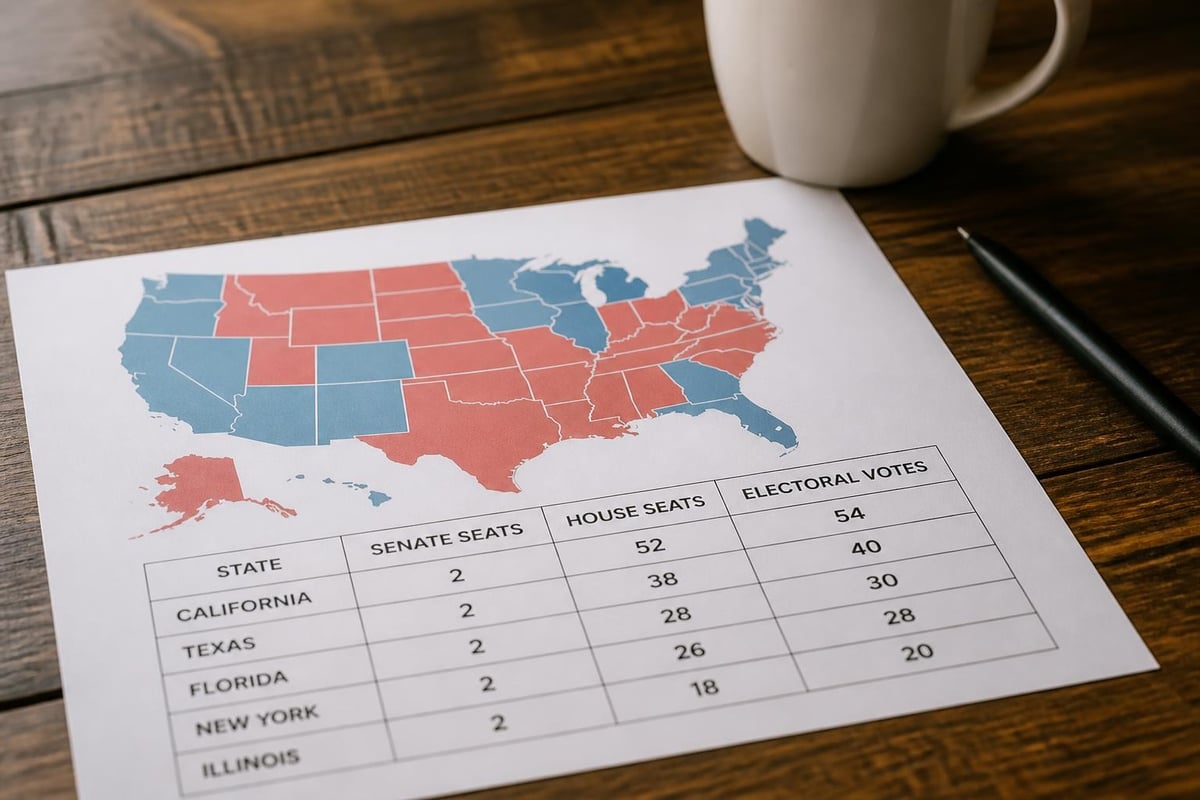
Each state receives electoral votes based on its total congressional representation:
- Number of U.S. Senators (always two per state)
- Number of U.S. Representatives (varies by population)
- The District of Columbia gets three electoral votes through the 23rd Amendment
This allocation means California currently has 54 electoral votes while Wyoming has just three. The distribution changes after each census when House seats are reapportioned based on population shifts. A candidate needs 270 electoral votes to win the presidency, which represents a simple majority of the total 538 votes available.
The Constitutional Foundation
The Founding Fathers established this system during the Constitutional Convention of 1787 as a compromise between those who wanted Congress to select the president and those who preferred a direct popular vote. They worried about several issues: communication limitations across a large nation, the potential for uninformed voters, excessive power concentration, and the influence of more populous states over smaller ones.
Article II, Section 1 of the Constitution originally outlined the electoral process, which the 12th Amendment later modified in 1804 after problems emerged. These constitutional provisions create the framework Americans still use today, though many aspects have evolved through state laws and political party practices.
How Electoral Votes Get Cast
Getting the electoral college explained simply requires understanding the multi-step process from primary elections through the final congressional count. The journey begins months before Election Day and doesn't officially conclude until January.
Step One: Selecting Electors
Political parties in each state nominate their slate of electors before the general election. These individuals are typically:
- Loyal party members or activists
- Current or former state officials
- Community leaders with strong party connections
- People who have performed significant party service
States determine their own methods for choosing electors, but parties generally select them at state conventions or through central committee votes. Federal law prohibits certain individuals from serving as electors, including sitting senators, representatives, and persons holding "an Office of Trust or Profit under the United States."
Step Two: The General Election
When voters cast ballots in November, they're technically voting for their preferred candidate's slate of electors rather than directly for the presidential candidate. This distinction matters legally, even though ballots typically show only the candidates' names.
Winner-take-all versus proportional allocation:
Most states use a winner-take-all system where the candidate receiving the most popular votes claims all that state's electoral votes. Maine and Nebraska differ by using a congressional district method, awarding two electoral votes to the statewide winner and one to the winner of each congressional district. This creates scenarios where these states can split their electoral votes between candidates.
The official U.S. government explanation provides additional details about vote allocation and unusual scenarios that occasionally arise in close elections.
Step Three: Meeting of Electors
Electors meet in their respective state capitals on the first Tuesday after the second Wednesday in December. During these gatherings, they cast separate ballots for president and vice president. While electors usually vote according to their party's candidate, "faithless electors" occasionally vote differently.
| Aspect | Details |
|---|---|
| Meeting Date | First Tuesday after second Wednesday in December |
| Location | Each state's capital building |
| Ballots Cast | Separate votes for president and vice president |
| Faithless Electors | Can face state penalties in some jurisdictions |
States have increasingly enacted laws binding electors to their pledged candidate, with the Supreme Court upholding such requirements in 2020. These certificates of vote are then transmitted to Congress and the National Archives.

Counting and Certifying Results
Congress receives the electoral certificates and counts them during a joint session on January 6th following the election. The sitting Vice President, as President of the Senate, presides over this ceremonial process while tellers from both chambers count the votes aloud.
The counting process includes several formal steps:
- States are called alphabetically
- Each state's certificates are opened and read
- Votes are tallied publicly
- Members may object to specific electoral votes
- The presiding officer announces final results
Objections require signatures from both a senator and representative to trigger debate. Both chambers then separate to discuss the objection for up to two hours before voting whether to sustain it. Both the House and Senate must agree to reject electoral votes, which rarely happens in practice.
When No Candidate Reaches 270
If no candidate secures 270 electoral votes, the election moves to Congress through a contingent election process. The House of Representatives selects the president, with each state delegation receiving one vote regardless of size. A candidate needs 26 state delegations to win. Meanwhile, the Senate chooses the vice president, with each senator voting individually.
This scenario has occurred twice in American history: in 1800 and 1824. The possibility becomes more likely when strong third-party candidates win electoral votes, preventing either major party candidate from reaching the majority threshold. Understanding presidential election dynamics helps contextualize these rare but consequential situations.
Common Misconceptions About the System
Getting the electoral college explained simply means addressing several persistent myths about how the system operates. Many Americans hold incorrect assumptions based on incomplete information or outdated understanding.
Misconception: The popular vote determines the winner
The national popular vote total doesn't decide presidential elections. Candidates can win the presidency while losing the popular vote, which has happened five times throughout American history, most recently in 2016. Each state's popular vote determines which candidate's electors get appointed, but the electoral vote alone determines the final outcome.
Misconception: All states always vote as a bloc
While 48 states use winner-take-all allocation, Maine and Nebraska demonstrate alternative approaches remain constitutionally permissible. States possess significant authority to determine how they award electoral votes, and several states have considered joining the National Popular Vote Interstate Compact, which would effectively create a national popular vote without a constitutional amendment.
Misconception: Electors must vote as pledged
Although increasingly bound by state laws, the Constitution originally allowed electors complete discretion. Faithless electors have cast dissenting votes over 180 times throughout history, though these votes have never changed an election's outcome. Recent Supreme Court decisions have clarified that states can enforce pledge requirements and impose penalties on faithless electors.
Strategic Implications for Campaigns
The electoral college system fundamentally shapes how presidential campaigns allocate resources and develop strategy. Candidates don't campaign equally across all 50 states because electoral math makes certain states more valuable than others.
Battleground States and Campaign Resources
Competitive states where either candidate could reasonably win receive disproportionate attention compared to states considered safely Republican or Democratic. Presidential candidates, their running mates, and surrogates concentrate their time in these battleground locations during the final months before Election Day.
Campaign resource allocation typically focuses on:
- Television and digital advertising in swing states
- Field offices and ground operations in competitive areas
- Candidate appearances in media markets reaching persuadable voters
- Get-out-the-vote efforts in battleground counties
This concentration means voters in states like Ohio, Pennsylvania, Florida, and Wisconsin historically see far more campaign activity than those in California, Texas, or New York. The U.S. Presidential Report tracks these strategic decisions across election cycles, showing how battleground maps evolve with demographic changes.

The Path to 270
Campaigns construct multiple pathways to reach the 270 electoral votes needed for victory. Strategic teams model various scenarios, identifying which state combinations produce winning coalitions. A candidate might pursue a "Rust Belt strategy" focusing on Michigan, Wisconsin, and Pennsylvania, or alternatively seek victories in Sun Belt states like Arizona, Nevada, and Georgia.
| Strategy Type | Key States | Electoral Votes | Risk Level |
|---|---|---|---|
| Midwest Path | MI, WI, PA | 46 combined | Moderate |
| Sun Belt Path | AZ, NV, GA | 37 combined | Higher |
| Traditional Swing | FL, NC, OH | 68 combined | Variable |
These calculations drive polling focus, advertising expenditures, and schedule planning. A campaign winning states totaling 269 electoral votes still loses the presidency, making precise strategic planning essential rather than optional.
Arguments For and Against the System
The electoral college generates ongoing debate among political scientists, elected officials, and citizens. Understanding these arguments requires examining both the system's intended purposes and its practical effects on modern elections.
Defending the Electoral College
Supporters argue the system protects federalism by ensuring states maintain importance in presidential selection. They contend it requires candidates to build geographically diverse coalitions rather than simply maximizing votes in the most populous areas. Small states receive proportionally more influence than their population alone would provide, which defenders see as appropriate in a federal republic.
Additional arguments supporting the current system:
- Encourages political stability by reinforcing the two-party system
- Provides certainty by usually producing clear winners
- Prevents regional candidates from dominating
- Maintains state sovereignty in federal elections
Defenders also note that changing the system would require a constitutional amendment, which demands extraordinary consensus across diverse states with different interests. Historical continuity itself holds value for some supporters who prefer maintaining established institutions.
Criticizing the Electoral College
Critics argue the system violates democratic principles by allowing candidates who receive fewer votes to win the presidency. They point out that voters in safe states effectively have less influence than those in battleground states, creating inequality in political participation. The winner-take-all approach means millions of votes essentially don't matter in non-competitive states.
The electoral college also potentially suppresses turnout in non-competitive states where outcomes seem predetermined. Why should a Republican in California or a Democrat in Wyoming bother voting when their preferred candidate has virtually no chance of winning their state's electoral votes? This dynamic creates disparities in campaign attention and voter engagement across different regions.
Some critics advocate for a national popular vote, while others suggest proportional allocation of electoral votes or the district system used by Maine and Nebraska. The National Popular Vote Interstate Compact represents one approach to effectively implementing popular vote results without amending the Constitution, though it hasn't yet been adopted by enough states to take effect.
Historical Impact on Presidential Elections
Throughout American history, getting the electoral college explained simply helps illuminate how close elections have produced unexpected outcomes and shaped political development. Five presidential elections resulted in electoral college victories for candidates who lost the popular vote: 1824, 1876, 1888, 2000, and 2016.
Notable Electoral College Scenarios
The 2000 election between George W. Bush and Al Gore demonstrated how a single state's contested results could determine the presidency. Florida's 25 electoral votes became decisive after weeks of recounts and legal challenges, ultimately resolved by the Supreme Court. Gore won the national popular vote by approximately 540,000 votes but lost in the electoral college 271-266.
More recently, the 2016 contest saw Hillary Clinton win nearly 2.9 million more votes than Donald Trump nationally while losing the electoral college 306-232. Trump's victories in Michigan, Pennsylvania, and Wisconsin by a combined margin of approximately 77,000 votes proved decisive despite Clinton's substantial popular vote advantage.
These outcomes weren't flukes but rather features of the system's design. The presidential elections coverage examines how these scenarios develop and what they mean for American democracy and governance.
How Close Elections Create Uncertainty
Several elections have been decided by remarkably thin margins in key states. In 2004, John Kerry would have won the presidency by taking Ohio despite still losing the popular vote. In 1976, Jimmy Carter's victory could have reversed with a shift of fewer than 10,000 votes in Ohio and Hawaii.
These close calls reveal the electoral college's potential to magnify the impact of small vote shifts in strategic locations. While supporters argue this encourages attention to diverse regions, critics contend it creates arbitrary results disconnected from overall voter preferences.
State-Level Variations and Innovations
States possess considerable authority over how they implement electoral college procedures, creating diversity in approaches across the nation. This flexibility has produced various innovations and experiments over time, though most states have converged on similar practices.
Different Approaches to Elector Selection
Some states select electors at party conventions while others use central committee processes. Certain states allow presidential candidates to suggest or approve electors, while others leave selection entirely to party leadership. These procedural differences rarely affect outcomes but reflect state-level autonomy within the federal framework.
State variations include differences in:
- Ballot formatting and candidate presentation
- Timing of elector certification processes
- Penalties for faithless electors
- Requirements for third-party ballot access
Maine and Nebraska's district-based allocation represents the most significant variation from winner-take-all systems. Maine has split its electoral votes twice (2016 and 2020), while Nebraska split votes in 2008 and 2020. These states demonstrate alternative approaches remain viable, even if uncommon.
Reform Proposals at State Level
Beyond Maine and Nebraska's approach, various reform proposals emerge periodically at the state level. The National Popular Vote Interstate Compact has been enacted by 15 states plus the District of Columbia, representing 195 electoral votes. The compact would take effect only when states totaling 270 electoral votes join, at which point those states would award their electoral votes to the national popular vote winner.
Proportional allocation represents another reform concept where states would divide electoral votes based on each candidate's vote percentage. This approach would reduce winner-take-all dynamics while preserving the electoral college framework. However, states implementing such changes unilaterally could disadvantage their preferred party, creating collective action problems that prevent adoption.
The Interplay Between Popular and Electoral Votes
Understanding the relationship between popular votes and electoral votes remains crucial for getting the electoral college explained simply. These two metrics measure different things and serve different purposes within the American electoral system.
Key differences between vote types:
- Popular vote: Total individual votes cast nationwide
- Electoral vote: State-based votes cast by electors
- State popular vote: Determines which electors get appointed
- National popular vote: Has no formal role in determining winners
The popular vote reflects individual preferences aggregated nationally, while electoral votes reflect state-by-state outcomes translated through the electoral college mechanism. A candidate can build large margins in certain states while narrowly losing others, producing popular vote victories alongside electoral college defeats.
Vote Efficiency and Electoral Strategy
Campaigns must balance vote efficiency across states. Winning California by five million votes provides the same 54 electoral votes as winning by one vote. This reality encourages candidates to pursue narrow victories in multiple competitive states rather than maximizing margins in favorable territory.
Strategic implications of this dynamic:
- Resources flow toward competitive states
- Safe states receive minimal campaign attention
- Vote margins matter less than state outcomes
- Third-party candidates can play spoiler roles
This efficiency calculation explains why candidates might simultaneously win the popular vote while losing the electoral college. Geographic distribution matters more than raw vote totals, fundamentally shaping how campaigns operate.
Teaching the Electoral College to New Voters
With the electoral college explained simply, civic educators and organizations work to ensure new voters understand how presidential elections actually function. Many young or first-time voters arrive at polling places assuming the popular vote determines the winner, creating confusion when they learn about the electoral system.
Educational approaches typically emphasize:
- The difference between popular and electoral votes
- How each state's electoral votes are calculated
- The winner-take-all system used by most states
- Why campaigns focus on battleground states
- Historical examples of popular vote/electoral vote splits
Understanding the system helps voters make strategic decisions about participation and helps them interpret election coverage more effectively. When news organizations project winners before counting all votes, they're making calls based on electoral college math rather than popular vote totals. Resources like the presidential information available help citizens deepen their understanding beyond basic mechanics.
The electoral college system shapes American presidential elections in fundamental ways that every citizen should understand. From determining campaign strategies to occasionally producing winners who didn't receive the most votes nationally, this constitutional mechanism continues influencing how Americans select their presidents more than two centuries after its creation. For comprehensive, non-partisan coverage of presidential elections and how the electoral process affects current races, U.S. Presidential Report provides detailed analysis and breaking news to keep you informed about every aspect of the presidential selection process.