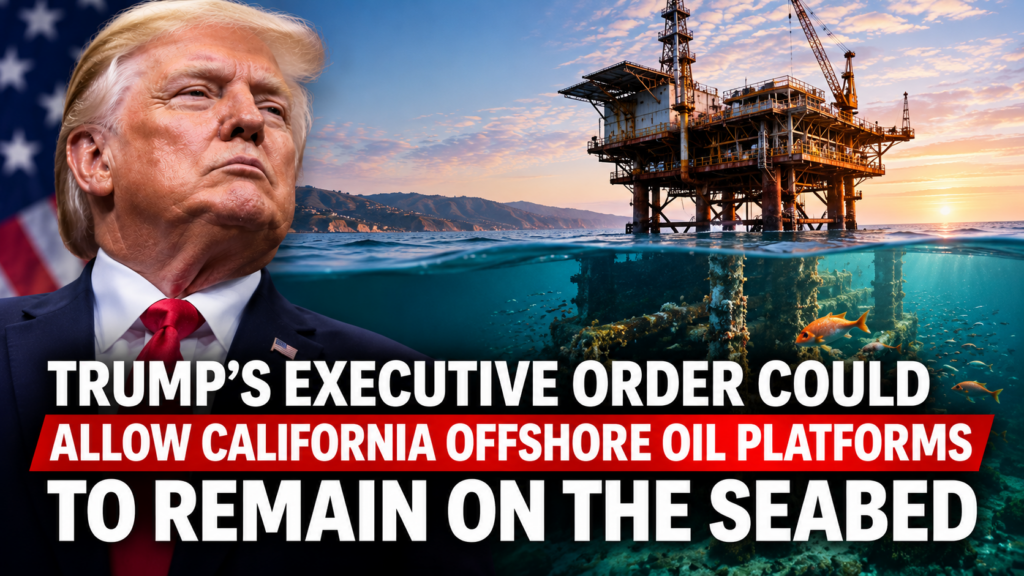
President Donald Trump’s executive order could allow decommissioned offshore oil platforms to remain on the seabed off California instead of requiring their complete removal. The proposed policy would establish a federal “reef-in-place” program, potentially reducing the costs oil companies face when retiring offshore drilling infrastructure.
The plan has raised environmental concerns and questions about corporate responsibility. While supporters argue that abandoned platforms could provide artificial habitats for marine life, critics warn that the policy could benefit oil companies at the expense of California’s coastal environment.
What Happened?
According to a report by The New York Post, Trump’s September 2026 executive order directs the Department of the Interior to establish a federal program allowing decommissioned offshore oil and gas structures to be converted into permanent artificial reefs.
The order, titled “Restoring American Saltwater Angling and Recreation,” includes provisions for leaving platforms in place, partially removing them, or toppling them onto the ocean floor. The policy excludes offshore wind infrastructure. The White House confirms that participating structures must still meet environmental, safety, and navigation requirements.
The proposal could affect 23 offshore oil platforms in federal waters off California, including eight already undergoing decommissioning. Another four platforms are located in state waters, according to the Los Angeles Times.
How Would the New Policy Work?
The proposed program is known as “Rigs-to-Reefs,” an approach that allows decommissioned offshore structures to remain underwater and serve as artificial reefs.
Under the proposed approach, companies could avoid completely removing certain platforms. The Interior Department is also considering making “toppling in place” the default decommissioning method through a regulatory proposal scheduled for 2027.
Toppling involves knocking all or most of an offshore platform onto its side on the seabed. Although the method has been used in the Gulf of Mexico, it has never been implemented in the Pacific waters off California.
Financial Benefits for Oil Companies
Removing offshore oil platforms can be extremely expensive. Federal estimates indicate that removing some of California’s largest platforms could cost more than $200 million.
The proposed policy could significantly reduce decommissioning expenses by allowing companies to leave eligible structures underwater instead of undertaking complete removal. Oil industry consultant Robert Collier described the proposal as a potential financial windfall for operators.
However, critics argue that reducing these costs could encourage companies to pursue additional offshore drilling projects because they would face fewer financial obligations when their infrastructure reaches the end of its useful life.
Environmental Concerns and Marine Life
Supporters of artificial reef programs argue that offshore platforms can provide habitats for marine species. Fish, mussels, anemones, and other organisms have established ecosystems around existing structures.
Marine biologist Milton Love of the University of California, Santa Barbara, has noted that removing platforms can destroy marine life attached to them. Some removal operations also involve underwater explosives that can harm nearby fish.
However, scientists caution that the environmental effects of toppling platforms in California remain uncertain. Differences in ocean conditions, water depths, and marine species mean that findings from the Gulf of Mexico cannot automatically be applied to the Pacific.
California’s Opposition and Regulatory Challenges
California already established its own Rigs-to-Reefs program in 2010. The state allows certain platforms to remain as artificial reefs on a case-by-case basis, provided their upper structures are removed and specific environmental requirements are met.
However, California’s program does not permit the complete toppling of platforms. No offshore platform has yet been converted into an artificial reef under the state’s program.
Environmental organizations also question who would assume long-term responsibility for pollution, structural deterioration, and potential environmental damage. These concerns could become more significant if ownership and liability are transferred from oil companies to public authorities.
What Happens Next?
The Interior Department is expected to pursue further regulatory action in 2027 to establish toppling in place as the default decommissioning method under specified circumstances. The proposal would still require regulatory review and compliance with applicable environmental and safety requirements.
The initiative could face legal challenges from coastal communities, environmental organizations, and California authorities. Disputes over federal and state authority under the Coastal Zone Management Act could further complicate implementation.
Ultimately, the proposal highlights the growing tension between offshore energy development, corporate decommissioning responsibilities, and marine environmental protection. Its outcome could influence how the United States manages aging offshore oil infrastructure for decades to come.
Related Reading
- Data Center Boom Drives US Fossil Fuel Pipeline Expansion as Environmental Rules Weaken
- Trump Signals Harder Line After Midterm Losses as Democrats Take Congress
Trump’s executive order directs the Interior Department to establish a program allowing eligible decommissioned offshore oil platforms to remain underwater as artificial reefs.
Critics argue that the policy could reduce oil companies’ cleanup responsibilities, create long-term environmental risks, and transfer potential liabilities to public authorities.