Wisconsin continues to stand as one of America's most closely watched electoral battlegrounds heading into the 2026 midterm cycle. With razor-thin margins in recent presidential and statewide races, the wisconsin election forecast 2026 has captured the attention of political strategists, polling organizations, and voters nationwide. Understanding the dynamics shaping this year's contests requires examining historical voting patterns, demographic trends, legal changes affecting ballot access, and the unique factors influencing gubernatorial and senate races in the Badger State.
Gubernatorial Race Dynamics in Wisconsin
The 2026 gubernatorial race represents one of the most consequential contests on the ballot this year. Wisconsin's governor wields significant influence over state policy, redistricting processes, and election administration, making this office critical for both parties.
Current Polling Landscape
Recent surveys from the Marquette Law School Poll reveal a competitive environment with substantial undecided voters. The poll's methodology, which distinguishes between registered and likely voters, shows different dynamics depending on turnout assumptions. This distinction becomes particularly important in midterm elections when participation typically drops compared to presidential years.
Key factors influencing the race include:
- Economic sentiment among suburban Milwaukee voters
- Rural turnout in traditionally conservative northern counties
- Madison and Milwaukee voter enthusiasm levels
- Split-ticket voting patterns in swing districts
Additional reporting from Wisconsin Public Radio highlights how candidate messaging on healthcare, education funding, and local economic development resonates differently across the state's diverse regions.
Regional Vote Patterns
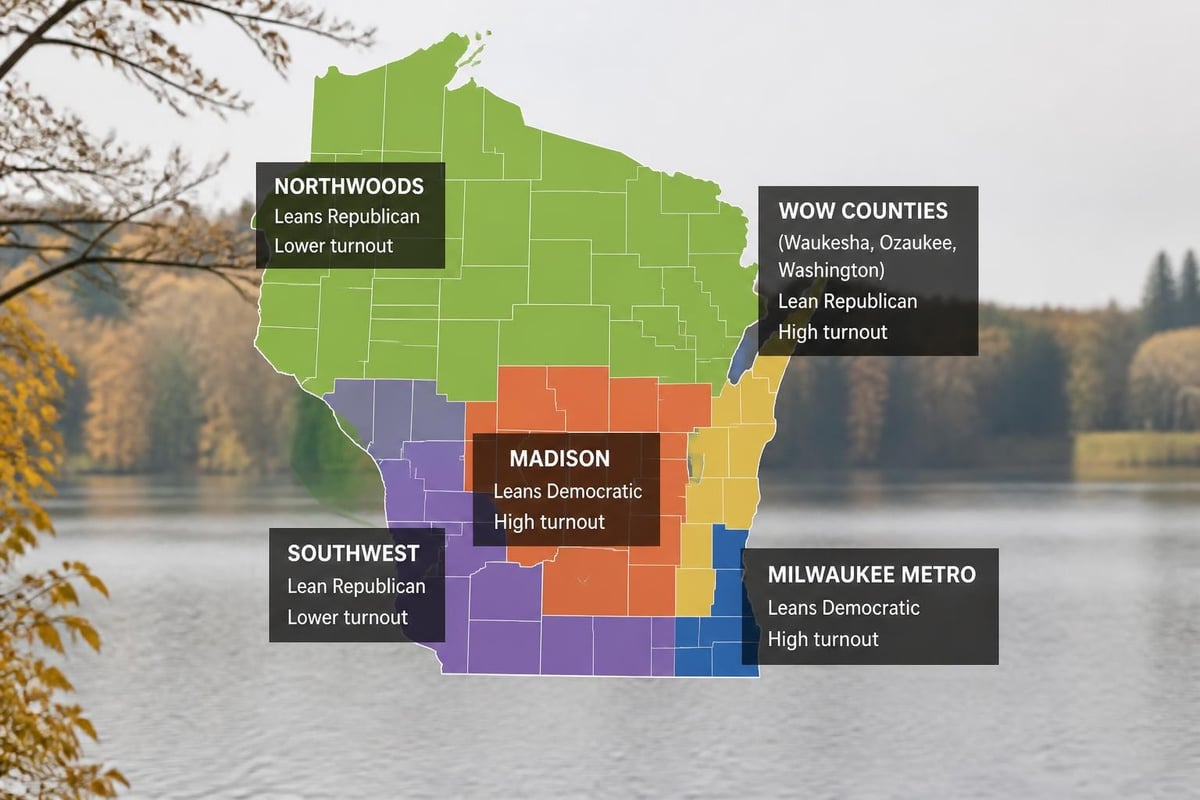
Wisconsin's electoral geography divides into distinct regions with predictable voting behaviors. Understanding these patterns is essential for any wisconsin election forecast 2026.
| Region | Historical Lean | 2026 Key Issues | Turnout Expectation |
|---|---|---|---|
| Milwaukee Metro | Democratic +15 | Crime, infrastructure | High |
| Madison & Dane County | Democratic +30 | Climate, education | Very High |
| WOW Counties | Republican +12 | Taxes, development | High |
| Northwoods | Republican +8 | Economy, healthcare | Moderate |
| Southwest | Competitive | Agriculture, broadband | Moderate |
The WOW counties (Waukesha, Ozaukee, and Washington) historically deliver large Republican margins, but recent shifts among college-educated suburban voters have tightened these areas. Meanwhile, Democratic strength in Madison continues to grow, offsetting some rural losses.
Senate Race Forecast and National Implications
Wisconsin's U.S. Senate seat represents another high-stakes contest with implications extending beyond state borders. Control of the Senate often hinges on a handful of competitive states, and Wisconsin consistently ranks among the most unpredictable.
Demographic Shifts Shaping the Electorate
National research from Pew Research Center demonstrates how demographic changes influence voting patterns across battleground states. In Wisconsin specifically, several trends merit attention:
Age cohort movements show younger voters (18-29) leaning Democratic while maintaining historically lower turnout in midterms. Conversely, voters over 65 participate at higher rates and have trended more Republican in recent cycles, though this varies by education level.
Educational polarization continues to intensify. College-educated voters, particularly women in suburban areas, have shifted toward Democratic candidates since 2016. Meanwhile, non-college-educated voters in rural and exurban areas have moved Republican.
Racial and ethnic composition changes affect electoral math. Wisconsin remains predominantly white (about 81%), but growing Hispanic and Asian populations in Milwaukee and Madison suburbs introduce new dynamics.
The wisconsin election forecast 2026 must account for these overlapping demographic currents, which don't always move in predictable directions.
Historical Turnout Baselines
Data from the MIT Election Data & Science Lab provides granular analysis of Wisconsin's turnout patterns across election cycles. Historical midterm participation typically drops 15-20 percentage points below presidential year turnout, but 2026 may deviate from this pattern.
Factors potentially affecting turnout include:
- Gubernatorial competitiveness driving additional voter interest
- Senate control stakes motivating national party investment
- State Supreme Court elections energizing base voters
- Referendum questions on local ballots increasing engagement
- Early voting accessibility changes under recent legislation
Legal Framework and Voting Access Considerations
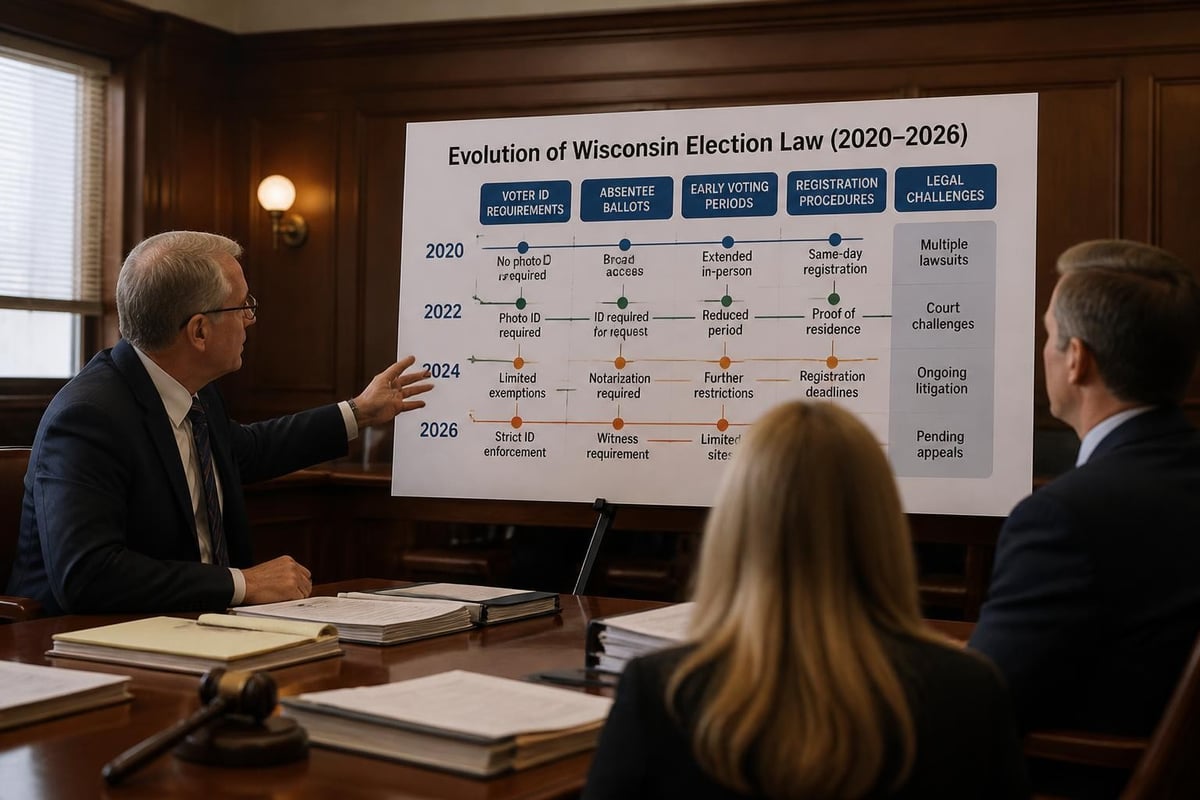
Wisconsin's election laws significantly impact turnout projections and forecasting models. Recent legislative changes and court decisions shape who votes and how easily they can participate.
Ballot Access and Election Law Changes
Research from the Brennan Center for Justice examines legal protections and vulnerabilities in Wisconsin's election system. Key provisions affecting 2026 include:
- Voter ID requirements and acceptable documentation standards
- Absentee ballot request and return procedures
- Early voting windows and location requirements
- Registration deadlines and same-day registration availability
- Drop box usage and monitoring protocols
These legal parameters don't merely affect access; they shape campaign strategy. Candidates must factor compliance costs, voter education needs, and potential litigation into their planning.
Impact on Forecast Models
Election forecasters incorporate legal framework variables when building predictive models. Stricter ID requirements historically correlate with modest turnout decreases among specific demographics, particularly younger voters and those who move frequently. However, robust voter education efforts can mitigate these effects.
The wisconsin election forecast 2026 must weight these legal factors against historical baselines to produce accurate projections.
Campaign Finance and Resource Allocation
Money flows reveal strategic priorities and competitive assessments. Tracking campaign spending patterns helps identify which races parties view as genuinely competitive versus safe.
Spending Patterns in Key Markets
Wisconsin's media markets create unique challenges for campaign advertising. The state splits across multiple media markets, requiring strategic resource allocation:
| Media Market | Population Covered | Cost Efficiency | Strategic Value |
|---|---|---|---|
| Milwaukee | 1.8 million | Moderate | Critical |
| Madison | 650,000 | High | Essential |
| Green Bay | 550,000 | High | Swing region |
| La Crosse | 425,000 | Very High | Persuadable voters |
| Wausau-Rhinelander | 280,000 | High | Rural outreach |
Digital advertising increasingly complements traditional broadcast spending, allowing more precise targeting of persuadable voters in competitive counties. Analysis of ad buys provides real-time indicators of campaign confidence and strategy adjustments.
Polling Methodology and Forecast Accuracy
Understanding polling methodology helps readers interpret wisconsin election forecast 2026 data responsibly. Not all polls carry equal weight, and methodological choices significantly impact results.
Likely Voter Screens and Sample Composition
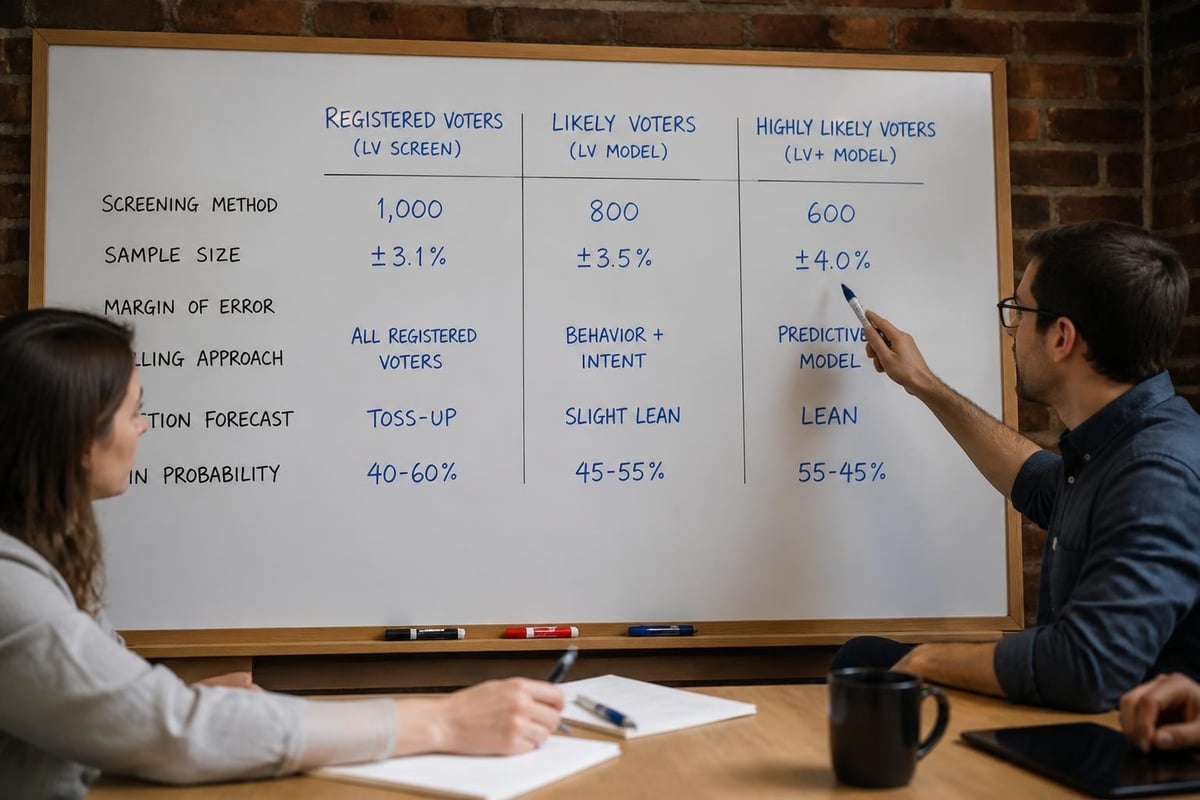
Pollsters employ different techniques to identify "likely voters" among broader registered voter populations. These screens become especially important in midterms when turnout drops.
Common screening methods include:
- Self-reported likelihood of voting on a 1-10 scale
- Voting history from public records (voted in previous midterms)
- Interest level in current campaigns and candidates
- Knowledge measures about registration status and voting location
- Combined models using multiple factors with weighted scoring
Polls using stricter likely voter screens often show different results than registered voter surveys. The wisconsin election forecast 2026 incorporates both to bracket probable outcomes under different turnout scenarios.
Margin of Error and Statistical Significance
Standard polls survey 600-1,200 respondents, yielding margins of error between ±2.5% and ±4%. In a state where elections routinely settle by under 1%, these margins mean many polls cannot definitively declare a leader.
Responsible forecasting acknowledges this uncertainty. Rather than predicting specific vote shares, sophisticated models present probability distributions showing ranges of likely outcomes.
Third-Party and Independent Candidates
Wisconsin's ballot access laws allow third-party candidates who meet signature requirements. While rarely winning, these candidates can influence outcomes in close races.
Historical Impact of Third Parties
The 2016 presidential race in Wisconsin saw third-party candidates receive over 5% combined vote share, potentially affecting the outcome in a race decided by less than 23,000 votes. Similarly, past gubernatorial and senate contests featured libertarian or independent candidates drawing votes from major party nominees.
For the wisconsin election forecast 2026, analysts must consider whether third-party candidates will appear on ballots and estimate their vote-drawing potential. This requires examining:
- Signature petition progress and validation status
- Funding levels and media presence
- Issue positioning relative to major party candidates
- Historical performance of similar candidacies
- Polling inclusion and measured support levels
Forecasting models typically allocate 1-3% vote share to minor candidates in competitive races, with higher shares possible if well-funded campaigns emerge.
Early Vote and Absentee Ballot Trends
Wisconsin's early voting patterns provide real-time indicators of enthusiasm and turnout as election day approaches. While votes aren't counted until polls close, monitoring who requests and returns absentee ballots helps campaigns allocate resources.
Partisan Early Vote Advantage
Historically, Democrats have shown stronger early vote performance in Wisconsin, while Republicans maintain election day advantages. This pattern intensified after 2020 when pandemic conditions drove unprecedented absentee voting.
Current 2026 data shows:
- Absentee ballot requests tracking slightly below 2022 midterm levels
- Urban core early voting locations seeing consistent traffic
- Suburban advance voting remaining competitive between parties
- Rural absentee rates staying modest but growing gradually
These patterns don't predict final outcomes but help campaigns identify whether their get-out-the-vote operations are succeeding. For readers following the wisconsin election forecast 2026, early vote data provides the first concrete evidence replacing polling projections.
Issue Priorities and Voter Motivation
Beyond demographics and mechanics, election outcomes depend on which issues motivate voters most strongly. Wisconsin voters consistently identify several key concerns shaping their decisions.
Top Voter Priorities for 2026
Recent surveys identify economic concerns as the dominant issue category, but specific economic anxieties vary by region and demographic group:
Economic concerns:
- Inflation and cost of living pressures
- Job security in manufacturing sectors
- Agricultural commodity prices and farm economics
- Housing affordability in growing metro areas
Healthcare access:
- Insurance coverage and premium costs
- Rural hospital closures and service availability
- Prescription drug pricing
- Mental health and addiction services
Education and workforce:
- K-12 funding and teacher retention
- Vocational training program expansion
- University system affordability
- Workforce development for skilled trades
Candidates who effectively address these concerns in regionally appropriate ways gain advantages. The wisconsin election forecast 2026 weighs issue salience alongside structural factors when projecting outcomes.
Understanding how these priorities intersect with partisan lean helps explain why seemingly similar voters make different choices. The presidential race coverage available through comprehensive news sources provides additional context on how national issues filter into state-level contests.
Forecast Model Aggregation and Probability
Individual polls provide snapshots, but aggregating multiple surveys produces more reliable forecasts. Statistical models combine polling data with fundamentals like economic conditions, incumbent approval, and historical patterns.
Building Robust Forecast Models
Sophisticated forecasting approaches layer multiple data sources:
- Public polling from reputable firms with disclosed methodology
- Economic indicators including state unemployment and income growth
- Incumbent approval ratings for governor and federal representatives
- National partisan environment measured through generic ballot polling
- Fundraising totals and spending patterns in key races
- Historical baselines from comparable previous elections
These inputs feed statistical models producing probability distributions rather than point predictions. A forecast showing a candidate with 65% win probability acknowledges meaningful uncertainty while indicating an advantage.
Readers seeking comprehensive political analysis can explore additional resources through U.S. Presidential Report’s politics section, which covers state and federal races from a non-partisan perspective.
Wisconsin's Role in National Political Dynamics
While state races matter locally, Wisconsin's electoral performance carries national significance. The state's swing status makes it a bellwether for broader political trends.
Presidential Implications for 2028
Midterm results often preview presidential dynamics two years forward. Strong performance by either party in 2026 Wisconsin races would signal organizational strength, messaging resonance, and demographic coalition stability heading toward 2028.
Factors connecting midterm and presidential performance include:
- Voter file quality built through midterm organizing
- Message testing that reveals effective issue framing
- Coalition strength among key demographic groups
- Turnout infrastructure developed for competitive races
- Candidate recruitment pipelines for future contests
Political observers analyzing the wisconsin election forecast 2026 recognize these downstream implications. Performance in gubernatorial and senate races tests party infrastructure before the higher-stakes presidential contest.
The historical relationship between U.S. presidents and state political dynamics receives detailed coverage through presidential library resources, which document how federal and state politics intersect.
Media Coverage and Information Ecosystem
How voters receive information about candidates and issues significantly affects election outcomes. Wisconsin's media landscape includes traditional journalism, digital platforms, and social media channels with varying levels of accuracy and partisan lean.
Trusted Information Sources
Wisconsin voters rely on multiple information channels:
Traditional media:
- Local television news in major markets
- Regional newspapers and investigative journalism
- Public radio coverage of state politics
- Weekly community newspapers in smaller towns
Digital platforms:
- Candidate websites and email communications
- Social media advertising and organic content
- Political podcasts and YouTube channels
- News aggregators and partisan blogs
The fragmentation of media consumption creates challenges for both campaigns and forecasters. Different voter segments receive substantially different information, complicating efforts to predict how events affect public opinion.
Final Weeks Dynamic Changes
Elections rarely remain static from summer through November. October surprises, debate performances, and late-breaking news can shift races in their final weeks.
Monitoring Late-Breaking Developments
The wisconsin election forecast 2026 continues evolving as new information emerges. Forecasters adjust models based on:
- Candidate debate performances and media coverage
- Opposition research revelations affecting candidate images
- Economic data releases showing improving or deteriorating conditions
- National events that shift the political environment
- Advertising blitzes in final weeks before election day
Readers following Wisconsin races should consult updated forecasts regularly rather than relying on early projections. Statistical models incorporate new data continuously, producing more accurate predictions as election day approaches.
For those interested in how current political developments connect to historical precedents, reviewing information about past administrations through presidential history resources provides valuable perspective on recurring political patterns.
The wisconsin election forecast 2026 reflects a competitive electoral environment shaped by demographic change, legal frameworks, economic conditions, and candidate quality. Wisconsin's status as a perennial battleground ensures intense scrutiny from campaigns, media, and voters through election day. For comprehensive, non-partisan coverage of this race and its implications for national politics, visit U.S. Presidential Report, where you'll find ongoing analysis of Wisconsin's elections alongside coverage of presidential politics, policy developments, and governance issues shaping American democracy.