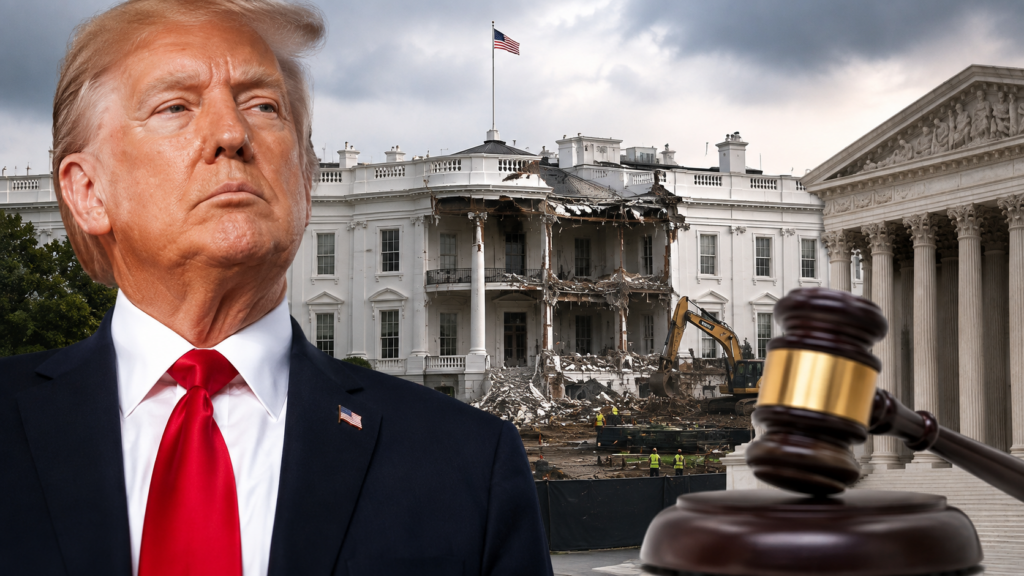
The Trump administration has asked the U.S. Supreme Court to allow White House ballroom construction to continue while it appeals a lower court ruling that halted aboveground work on the $400 million project. The administration argues that stopping construction could create security concerns, while opponents say the project cannot proceed without congressional approval.
According to a report by Spectrum News, Solicitor General D. John Sauer filed the emergency request on Aug. 14, asking the Supreme Court to suspend a recent ruling by a three-judge panel of the U.S. Court of Appeals for the District of Columbia Circuit.
What Happened
The Trump administration wants the Supreme Court to allow construction to resume on a planned 90,000-square-foot ballroom at the White House.
The project is estimated to cost $400 million and is being built where the East Wing previously stood after Trump ordered its demolition last fall. The administration says construction has been underway for about 10 months and is approximately 65% complete.
The request follows a 2-1 decision by the D.C. Circuit ordering the administration to stop aboveground construction because Congress had not approved the project.
The appeals court temporarily delayed the effect of its ruling, giving the Trump administration time to seek Supreme Court intervention. Sauer asked the justices to act before the lower court’s decision takes effect on Aug. 21.
Trump Administration Cites Security Concerns
The administration argues that the construction site itself creates security concerns around the White House.
Sauer described the planned ballroom as part of an integrated complex that includes a secure space important to national security. The Justice Department argues that leaving the East Wing area as an open construction site makes it more difficult to protect the White House.
The administration also maintains that the president has broad authority to renovate and modify the White House without obtaining congressional approval.
The dispute over presidential authority comes as the administration continues to make significant changes to the White House and federal government, including changes involving White House Counsel Will Scharf.
Appeals Court Says Congress Must Decide
The D.C. Circuit majority rejected the administration’s argument that Trump can proceed without congressional authorization.
The two judges in the majority concluded that constructing a massive ballroom at the White House is a decision for Congress rather than an action the president can undertake unilaterally.
The third judge, Trump-appointed Judge Neomi Rao, disagreed. She argued that the National Trust for Historic Preservation did not have the legal standing necessary to challenge the project.
The disagreement therefore involves both presidential authority and whether the preservation group has the legal right to bring the lawsuit.
Historic Preservationists Oppose Construction
The National Trust for Historic Preservation has challenged the ballroom project and is opposing the administration’s request to the Supreme Court.
The group has accused the administration of attempting to accelerate construction before the courts can fully review the case.
The preservationists pointed to plans to install about 1 million pounds of rebar and pour another 3,000 cubic yards of concrete in the week following the administration’s Supreme Court filing.
The group argues that accelerating construction could make it more difficult for the courts to provide an effective remedy if the project is ultimately found unlawful.
The administration disputes that argument and says stopping construction would create unnecessary disruption while leaving the White House surrounded by an active construction site.
Lower Court Previously Allowed Underground Work
The legal battle began before the latest appeals court ruling.
In April, U.S. District Judge Richard Leon ordered aboveground construction to stop. However, he allowed underground work to continue, including construction related to bunkers, military installations and medical facilities.
Leon concluded that pausing aboveground work would not jeopardize national security as long as construction necessary to protect the White House could continue.
The D.C. Circuit later upheld that decision in its 2-1 ruling.
Dispute Raises Broader Executive Power Questions
The ballroom case has developed into a broader dispute over presidential authority over historic federal property.
During an appeals court hearing in June, Justice Department lawyer Yaakov Roth defended a broad interpretation of presidential control over major public facilities. A hypothetical discussion during the hearing involved whether the government could demolish major federal landmarks and whether individuals with historical connections to those properties would have standing to sue.
The exchange highlighted the constitutional and legal questions surrounding the administration’s position.
The case also comes as the Trump administration pursues other major policy and personnel changes across the federal government, including the confirmation of Todd Blanche to a major administration position.
What Happens Next
Chief Justice John Roberts has set a deadline of Tuesday for the plaintiffs to respond to the Trump administration’s Supreme Court request.
The immediate issue before the justices is whether construction should be allowed to continue while the broader legal appeal moves forward.
The Supreme Court’s decision could determine whether workers can resume aboveground construction before the litigation is resolved. The administration argues that stopping the project at its current stage would create unnecessary disruption, while the preservationists maintain that construction should remain paused until the courts determine whether the project is legally authorized.
With the project already reported to be about 65% complete, the Supreme Court’s decision could have significant consequences for both the future of the ballroom and the broader question of how much authority a president has to make major changes to the White House without Congress.
For now, White House ballroom construction remains at the center of a legal fight over executive power, congressional authority, historic preservation and national security.
The Trump administration argues that stopping construction could create security risks and says the project includes facilities important to White House security.
A federal appeals court ruled that Trump cannot unilaterally build the 90,000-square-foot ballroom without congressional approval.