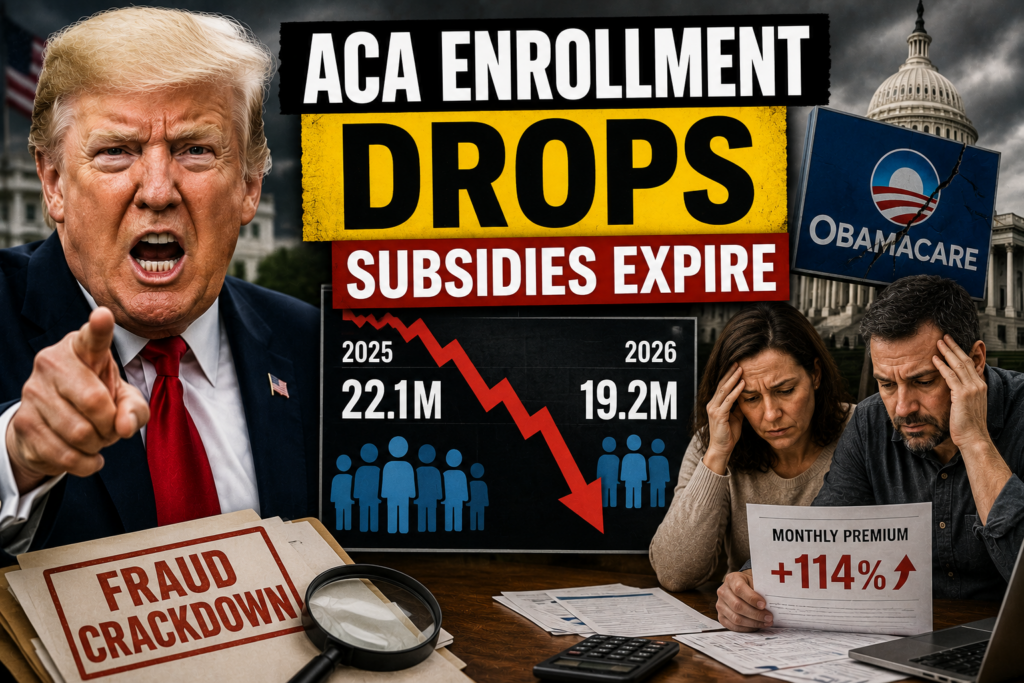
Affordable Care Act (ACA) enrollment has fallen by roughly 3 million people in 2026, marking the first significant decline in years. While the Trump administration says stronger anti-fraud enforcement is responsible for much of the decrease, many health policy experts argue the expiration of enhanced federal premium subsidies is the primary reason millions of Americans have left the ACA marketplace.
According to a report by CNBC, ACA marketplace enrollment declined from 22.1 million people at the end of 2025 to approximately 19.2 million in February 2026, a drop of about 13%.
What Happened
The Department of Health and Human Services (HHS) released new enrollment data showing the largest reduction in ACA marketplace participation since the exchanges were established in 2014.
The figures represent the first “effectuated enrollment” data since enhanced Affordable Care Act premium subsidies expired at the end of 2025. Effectuated enrollment measures individuals who not only selected a health plan but also paid their monthly premiums.
The Trump administration has characterized the decline as evidence that new fraud prevention measures are successfully removing improper enrollments from the federal health insurance system.
Trump Administration Says Fraud Controls Reduced Enrollment
Federal officials say stronger oversight has eliminated fraudulent, phantom, and improper ACA enrollments that expanded during the Biden administration.
Among the administration’s actions:
- Canceling approximately 250,000 ACA policies that officials said were opened without consumers’ consent.
- Eliminating certain special enrollment periods.
- Tightening verification procedures for federal premium subsidies.
- Increasing oversight of insurance brokers participating in the ACA marketplace.
HHS estimates that fraudulent or improper enrollments reached approximately 5.6 million in 2025 before the administration implemented new program integrity measures.
The administration maintains that reducing fraud protects taxpayers while ensuring subsidies are directed only to eligible Americans.
The broader effort aligns with other policy initiatives launched during President Trump’s second term, including new federal programs such as Trump Accounts for children’s savings, which emphasize long-term fiscal policy and government spending priorities.
Health Policy Experts Point to Expiring Subsidies
Many healthcare economists dispute the administration’s explanation.
Instead, they argue the sharp enrollment decline largely reflects the expiration of enhanced premium tax credits that had significantly lowered insurance costs for millions of households.
Those subsidies, first introduced in 2021, allowed many lower-income Americans to obtain ACA coverage with little or no monthly premium.
After the subsidies expired at the end of 2025, average annual premiums increased dramatically.
According to estimates from KFF cited by CNBC, average annual premiums rose from approximately $888 in 2025 to about $1,904 in 2026—an increase of roughly 114%.
Some households faced annual premium increases exceeding $20,000.
Health policy researchers say such increases naturally reduced enrollment.
As Brookings Institution senior fellow Matthew Fiedler noted, higher prices typically reduce demand, particularly among lower-income consumers served by the ACA marketplaces.
Debate Over Fraud Estimates
While experts acknowledge some fraudulent enrollment occurred, many dispute the administration’s characterization of its scale.
Some enrollment records lacking Social Security numbers may involve lawfully present immigrants who qualify for ACA coverage but do not yet possess Social Security numbers.
Others may reflect administrative or data-entry errors rather than intentional fraud.
Policy experts also note that individuals estimating future income during ACA enrollment sometimes unintentionally report inaccurate earnings because of changing employment or seasonal income, requiring adjustments later through federal tax filings.
Several researchers argue these situations should not automatically be classified as fraudulent enrollment.
Additional ACA Changes May Further Reduce Enrollment
Healthcare analysts also point to additional administrative changes approved by Republicans that are expected to further reduce ACA enrollment over the coming years.
The Congressional Budget Office projects ACA marketplace enrollment could decline to approximately 12.5 million people by 2028.
Meanwhile, the uninsured rate is projected to increase from 7.6% in 2025 to roughly 10.4% by the end of the decade.
The administration argues these reforms improve efficiency and reduce government waste while preserving affordable healthcare options.
The healthcare debate also comes as the administration continues broader domestic policy reforms affecting federal programs and constitutional issues. Readers may also be interested in the Supreme Court ruling involving Trump’s immigration policy, another significant policy development during the administration.
Political Debate Intensifies
The enrollment decline has become a major point of disagreement between Republicans and health policy advocates.
Republican officials emphasize program integrity, arguing taxpayer-funded subsidies should be protected from abuse.
Many healthcare experts, however, contend that affordability—not fraud—is driving Americans out of the insurance marketplace.
With the 2026 midterm elections approaching, healthcare affordability is expected to remain one of the administration’s most closely watched domestic policy issues.
What Happens Next
Enrollment trends throughout the remainder of 2026 will help determine whether the recent decline represents a temporary correction following fraud enforcement or the beginning of a longer-term reduction in ACA participation.
As premium costs remain elevated and federal policy continues evolving, lawmakers, insurers, and consumers will be closely monitoring the future of the Affordable Care Act marketplace.
The Trump administration says fraud prevention reduced improper enrollments, while health policy experts argue the expiration of enhanced premium subsidies made coverage less affordable.
According to HHS data, ACA marketplace enrollment fell by about 3 million people, declining from 22.1 million at the end of 2025 to 19.2 million in early 2026.