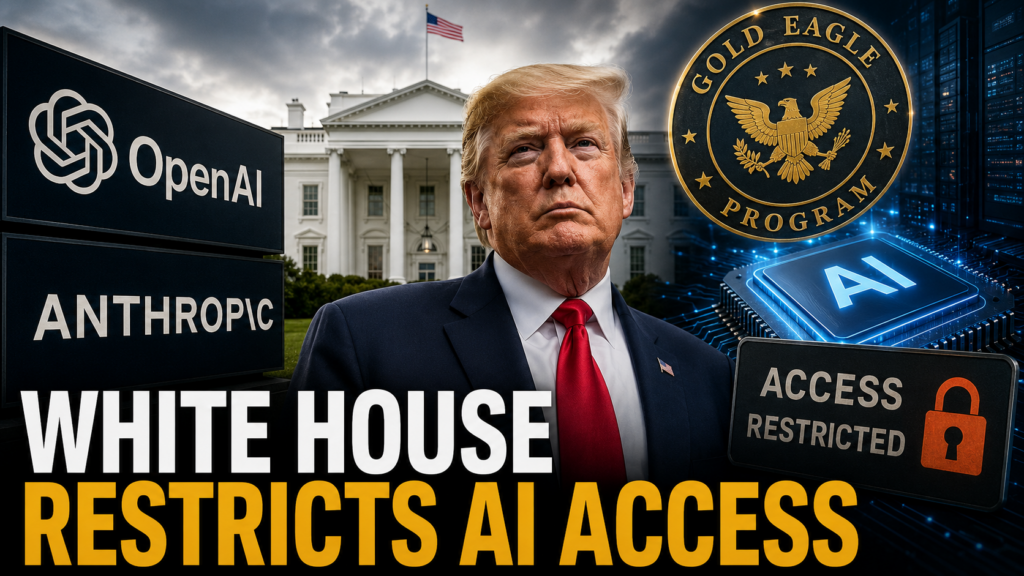
The Trump administration is taking a more active role in overseeing access to the world’s most advanced artificial intelligence systems, introducing a framework that could reshape how frontier AI models are distributed. The proposed approach would give the White House greater influence over which organizations can access cutting-edge models developed by OpenAI and Anthropic, raising new questions about AI governance, national security, and innovation.
According to a report by Quartz, citing CNBC, the administration is preparing a new system known as the “Gold Eagle” program that would centralize oversight of access to frontier AI technologies.
What Happened?
The Trump administration is reportedly establishing a government clearinghouse through the Gold Eagle initiative to oversee which companies and organizations can gain access to newly released frontier AI models.
If implemented as described, AI developers such as OpenAI and Anthropic would no longer independently determine every organization eligible to receive early access to their most capable models. Instead, companies could be required to obtain federal approval before expanding access to selected partners.
However, the White House has disputed reports suggesting it directly approves AI model releases. Administration officials maintain that participation remains voluntary and that companies ultimately decide when and how to release their AI systems.
Key Details of the Gold Eagle Program
According to people familiar with the matter cited by CNBC, the Gold Eagle initiative would establish a centralized review process for frontier AI deployments.
Previously, both OpenAI and Anthropic managed limited-access programs independently:
- Anthropic used Project Glasswing to provide selected cybersecurity partners with access to its Mythos models.
- OpenAI created the Daybreak consortium to distribute advanced cybersecurity-focused AI models to approved organizations.
The reported changes could significantly alter these programs by introducing government oversight into partner selection.
The White House has emphasized that Gold Eagle was officially launched as a cybersecurity coordination initiative designed to help government agencies and private companies identify and respond to software vulnerabilities more quickly. Its published documentation does not explicitly state that it serves as an approval authority for AI model releases.
Growing Federal Oversight of Frontier AI Models
The latest developments continue a broader trend of increased federal involvement in advanced AI technologies.
Earlier this year, the administration asked AI developers to submit powerful new models for government review before public release. OpenAI’s GPT-5.6 rollout was also limited to government-vetted partners during its initial deployment following discussions with federal officials.
Meanwhile, Anthropic previously faced export restrictions that temporarily suspended worldwide access to its Fable 5 and Mythos 5 models before access was partially restored after negotiations with the U.S. government.
The administration argues these measures are intended to reduce cybersecurity risks associated with increasingly capable AI systems while protecting critical national infrastructure.
As AI regulation expands, the administration’s broader domestic policy agenda has also drawn attention, including new federal employee discipline rules that increase executive oversight across government agencies.
Competition with China Adds Pressure
National security concerns are playing a growing role in U.S. AI policy.
The emergence of China’s Moonshot AI and its Kimi K3 model has intensified competition between the United States and China in advanced artificial intelligence. Reports indicate Kimi K3 is approaching the performance of leading American frontier AI models on several benchmarks.
Former White House AI adviser David Sacks warned that excessive regulation could weaken America’s competitive position, arguing that slowing AI deployment risks allowing international rivals to close the technological gap.
The administration is also reportedly considering additional restrictions on certain Chinese AI technologies as Washington seeks to maintain U.S. leadership in the global AI race.
Political and Industry Implications
The reported expansion of government oversight reflects an evolving balance between encouraging AI innovation and addressing national security risks.
Supporters argue stronger oversight can prevent advanced AI systems from being exploited by malicious actors while safeguarding critical infrastructure.
Critics, however, warn that greater government involvement could slow innovation, create uncertainty for AI developers, and complicate collaboration between private companies and research organizations.
The debate also aligns with broader Trump administration efforts to increase federal oversight in several policy areas, including election security measures that emphasize protecting critical national systems.
What Happens Next?
Although the White House disputes claims that it formally approves AI model releases, questions remain about how the Gold Eagle initiative will influence future deployments of frontier AI models.
As competition with China accelerates and AI capabilities continue advancing rapidly, policymakers, technology companies, and enterprise customers will closely watch how the administration balances innovation with national security priorities.
The outcome could shape not only the future of OpenAI and Anthropic’s model rollout strategies but also establish a lasting framework for how advanced artificial intelligence is governed in the United States.
Gold Eagle is a Trump administration initiative focused on coordinating AI-related cybersecurity efforts and is reportedly being expanded to influence access to frontier AI models.
Officials say stronger oversight is intended to address national security and cybersecurity risks while maintaining U.S. leadership in artificial intelligence.