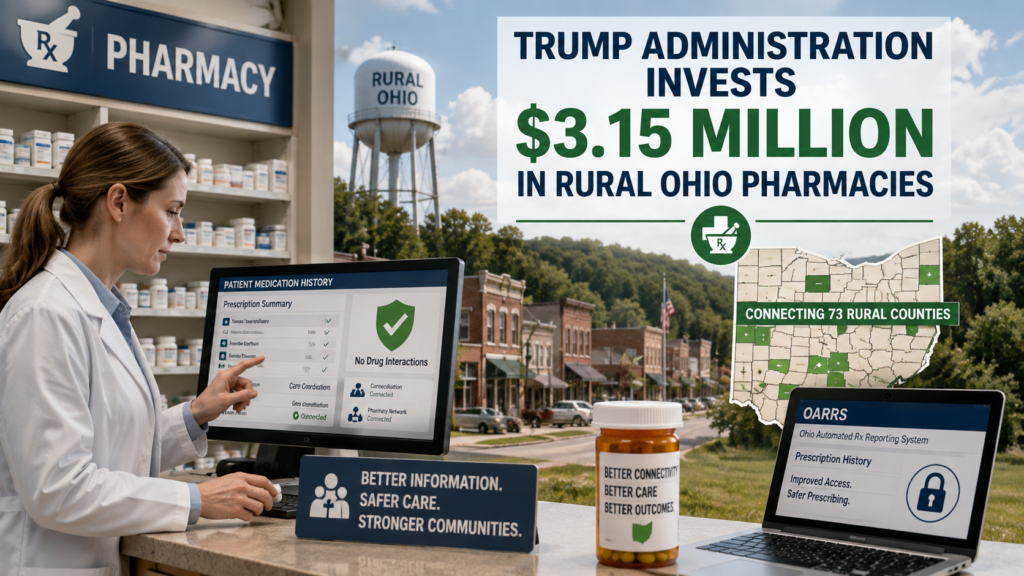
The Trump administration is investing $3.15 million in rural Ohio pharmacies to improve healthcare connectivity, prescription drug information sharing and medication coordination across the state’s 73 rural counties.
According to a report by Ideastream Public Media, the funding will connect independent and retail pharmacies, federally qualified health centers and outpatient hospital pharmacies with healthcare providers to improve access to critical prescription information. The Centers for Medicare & Medicaid Services confirmed the investment through its Rural Health Transformation Program.
What Happened
The administration announced the $3.15 million investment on August 26 as part of the federal Rural Health Transformation Program, a $50 billion initiative created under the Working Families Tax Cuts Act.
The funding will support pharmacy connectivity throughout Ohio’s 73 rural counties, with the goal of giving prescribers and pharmacists better access to patient and prescription information.
Federal officials said improved connectivity could help healthcare professionals identify potentially dangerous drug interactions and combat situations in which individuals obtain controlled substances from multiple providers.
The investment builds on an earlier $10 million allocation focused on strengthening Ohio’s rural healthcare workforce.
Key Details of the Rural Ohio Pharmacy Investment
$2 Million for Pharmacy Connectivity
Of the $3.15 million total, $2 million will support expanded pharmacy connectivity and care coordination.
The funding is intended to improve pharmacists’ access to patient medical records, strengthen medication management and help healthcare providers coordinate treatment more effectively.
The Centers for Medicare & Medicaid Services said the investment could also help reduce drug-related adverse events by giving pharmacists more complete information about patients’ medications.
$1.15 Million for Prescription Drug Information
The remaining $1.15 million will improve rural providers’ integrated access to the Ohio Automated Rx Reporting System, known as OARRS.
The funding will support needs assessments, outreach and onboarding assistance to increase integration between OARRS, electronic health records and pharmacy dispensing systems.
The objective is to give prescribers and pharmacists better information when reviewing prescription histories and managing medications.
Why Pharmacy Connectivity Matters
Healthcare providers in rural areas can face difficulties obtaining a complete picture of a patient’s medical history when information is spread across different pharmacies, physicians and healthcare facilities.
Tom Campanella, a Northeast Ohio healthcare consultant and president of Campanella Counseling Inc., said connectivity problems can prevent providers from evaluating patients from a more comprehensive perspective.
Better information sharing could allow pharmacists and prescribers to coordinate medication decisions more effectively, particularly when patients receive care from multiple providers.
The initiative is part of a wider effort to modernize rural healthcare infrastructure. It also follows the administration’s broader rural health investments aimed at strengthening healthcare services in underserved communities.
Broader Rural Health Funding in Ohio
The $3.15 million pharmacy initiative is only one part of Ohio’s Rural Health Transformation funding for fiscal year 2026.
Projects supported by the program include:
- $2 million for pharmacy connectivity and care coordination.
- $1.15 million to improve access to prescription drug information through OARRS.
- $10 million previously announced for Ohio University to strengthen the rural healthcare workforce.
- $61.7 million for a funding opportunity to develop and expand rural Clinically Integrated Networks and Rural Health Innovation Hubs across 73 non-urban counties.
Ohio’s rural health strategy also includes connecting employers, schools and community organizations to recruit, train and retain healthcare professionals in rural communities. These workforce efforts complement federal support for rural healthcare workforce development.
Ohio received more than $200 million from CMS in 2026 as part of the broader rural healthcare investment.
Political and Healthcare Impact
The investment has drawn support from Ohio officials and members of Congress.
Gov. Mike DeWine welcomed the funding, saying the administration had recognized the need to improve healthcare in rural Ohio.
CMS Administrator Dr. Mehmet Oz said the federal investment is intended to expand healthcare access and improve care for rural communities, while Health and Human Services Secretary Robert F. Kennedy Jr. said the administration is directing resources toward workforce development, infrastructure modernization and expanded access to care.
Several Ohio Republican lawmakers also praised the funding and emphasized the importance of ensuring that a person’s ZIP code does not determine their access to healthcare.
Remaining Challenges
Healthcare consultant Tom Campanella described the investment as a positive starting point but said additional work is needed to address healthcare and quality-of-life challenges throughout rural Ohio.
The connectivity initiative addresses one specific problem: fragmented healthcare and prescription information. Other challenges, including workforce shortages, pharmacy closures and access to healthcare facilities, remain broader issues for rural communities.
The administration’s approach is therefore combining technology investments with workforce development and expanded rural healthcare networks.
What Happens Next
The next phase will focus on implementing pharmacy connectivity improvements, conducting needs assessments and helping rural healthcare providers integrate prescription monitoring information with electronic health records and pharmacy systems.
The success of the rural Ohio pharmacy investment will depend on how effectively pharmacies and healthcare providers adopt the technology and whether improved information sharing leads to safer medication management and better patient outcomes.
The $3.15 million investment represents a targeted component of the Trump administration’s broader rural healthcare strategy. By connecting pharmacies and providers across Ohio’s rural counties, the program aims to modernize healthcare coordination while giving rural patients access to more integrated and informed care.
The administration announced $3.15 million to strengthen pharmacy connectivity across Ohio’s 73 rural counties.
The funding includes $2 million for pharmacy connectivity and care coordination and $1.15 million to improve access to prescription drug information.