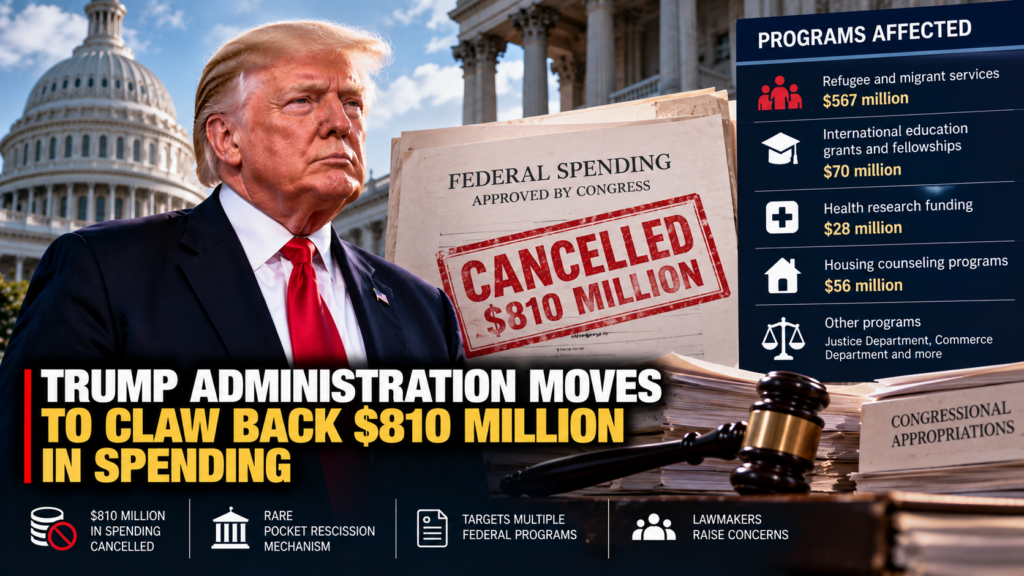
The Trump administration is moving to cancel $810 million in spending approved by Congress, using a rarely used mechanism known as a “pocket rescission” just days before the end of the federal fiscal year.
According to a report by PBS NewsHour, the rescissions target programs across several federal agencies, including services for refugees and migrants, education, housing and minority business development. The administration argues that some of the funding is no longer necessary or does not align with its priorities.
What Happened
The White House announced the spending cancellations on September 25, only days before the end of the federal fiscal year.
The largest portion, $567 million, comes from funding for programs operated through the Department of Health and Human Services’ Office of Refugee Resettlement. The administration said reduced migration across the southern border meant some of the funding was no longer needed.
Other programs affected include initiatives at the Education Department, Housing and Urban Development, Justice Department and Commerce Department.
What Is a Pocket Rescission?
A pocket rescission occurs when the president proposes canceling appropriated funds late enough in the fiscal year that Congress has little practical time to act before the funds expire.
Under the normal rescission process, Congress has 45 legislative days to consider a presidential proposal to cancel previously approved funding. The administration’s timing left lawmakers with only a few days before the fiscal year ended.
The Government Accountability Office has previously questioned the legality of using this mechanism to effectively prevent Congress from exercising its authority over appropriated funds.
Programs Targeted by the Cuts
The $810 million package covers several categories of federal spending.
The largest reduction affects refugee and migrant services. The package also includes approximately $70 million for international education grants and fellowships, $28 million in health research funding, and $56 million in housing counseling programs, according to congressional reporting.
The White House has characterized some of the targeted programs as wasteful, duplicative or inconsistent with its policy priorities.
Lawmakers Challenge the Spending Cuts
The move has drawn criticism from lawmakers in both parties, particularly members of the Senate Appropriations Committee.
Sen. Susan Collins, the Republican chair of the committee, said Congress received notice of the $810 million rescissions without warning or consultation. She argued that the administration was interfering with Congress’s constitutional authority over federal spending.
Sen. Patty Murray, the committee’s top Democrat, also criticized the move, arguing that Congress had approved the funds through the appropriations process.
The disagreement centers on whether the executive branch can effectively prevent congressionally approved funds from being spent without obtaining congressional approval.
Previous Use of the Authority
The Trump administration used a similar strategy in 2025 to cancel roughly $4.9 billion in foreign aid approved by Congress.
That earlier action was challenged in court. The Supreme Court allowed the administration’s foreign-aid rescissions to proceed but did not issue a broad ruling resolving the legality of pocket rescissions for domestic spending. The Court’s reasoning included the president’s authority over foreign affairs.
The latest package differs because it primarily targets domestic programs, raising a new set of questions about presidential authority over congressional appropriations.
What Happens Next
The spending dispute could lead to further legal and congressional challenges as lawmakers examine the administration’s use of the rescission process.
The issue also comes as Congress faces additional funding deadlines for the federal government. The outcome could help clarify how much discretion a president has to withhold or cancel funds that Congress has already approved.
For now, the administration maintains that the rescissions are legally permissible, while congressional critics and government oversight officials have raised objections to the process. The dispute places congressional spending authority and presidential control over federal programs at the center of the debate.
Related Reading
- Trump Administration Begins Border Wall Construction in Big Bend, Texas
- US Clears Way for $24.3 Billion F-35 Sale to Saudi Arabia
A pocket rescission is a mechanism used to withhold congressionally approved funds late in a fiscal year, leaving limited time for Congress to respond.
The latest package totals approximately $810 million, with the largest portion targeting programs under the Department of Health and Human Services.