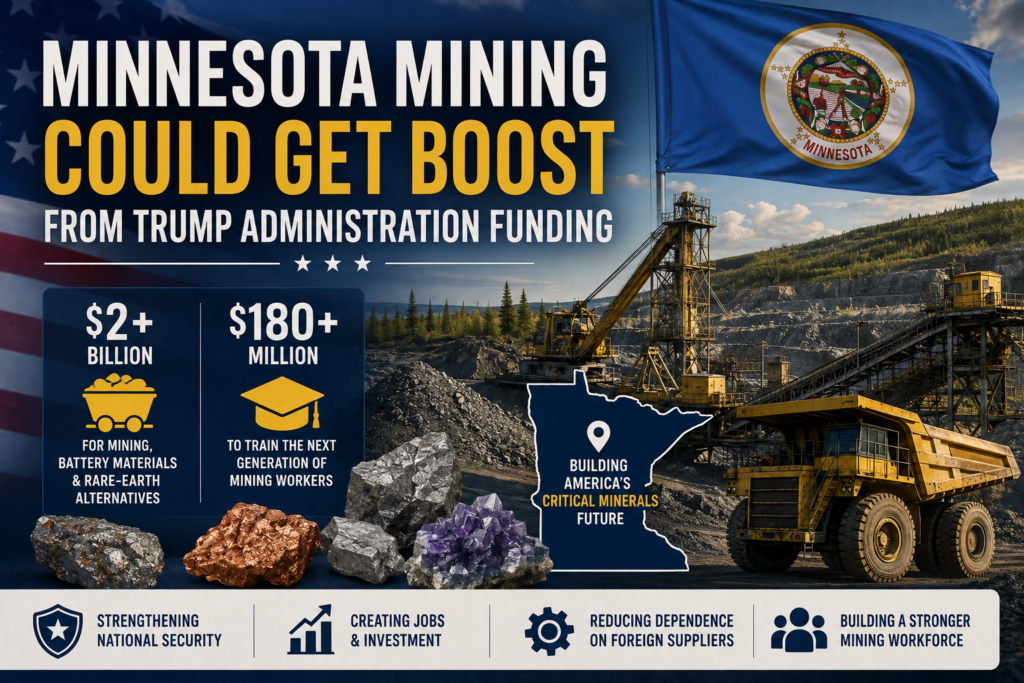
Minnesota mining could receive a significant boost from the Trump administration’s latest critical-minerals initiative, as Washington announced more than $2 billion in funding for mining, battery materials and rare-earth alternatives, alongside more than $180 million aimed at expanding the U.S. mining workforce.
According to a report by KSTP, the new funding could benefit Minnesota’s mining industry as the administration seeks to expand domestic production of critical minerals and address a growing shortage of skilled mining professionals.
What Happened
The Trump administration announced the funding during a push to strengthen U.S. mining and critical-mineral supply chains.
The initiative includes major investments and loans for companies working on battery materials, mining and alternatives to rare-earth materials. It also includes more than $180 million in grants through the Department of Energy and universities to train the next generation of mining professionals.
Reuters reported that the broader package announced by President Donald Trump included a $1.4 billion conditional Defense Department loan for Sila Nanotechnologies, a $400 million loan for Sunrise Energy Metals and a $150 million loan agreement with Minnesota-based Niron Magnetics.
The administration has framed the investments as part of a strategy to increase domestic production and reduce U.S. dependence on foreign suppliers, particularly China.
Why Minnesota Mining Could Benefit
Minnesota already has a long-established mining industry and is home to companies developing technologies connected to the broader critical-minerals supply chain.
One of the most direct Minnesota connections is Niron Magnetics, a Minnesota-based company developing permanent magnets that do not rely on mined rare-earth materials.
The Pentagon has agreed to provide Niron with a $150 million loan. The company plans to use the funding as it works toward developing a manufacturing facility in Minnesota that could cost roughly $600 million.
Niron’s technology is particularly relevant to the administration’s strategy because rare-earth magnets are used in products ranging from electronics to advanced defense systems.
The development also comes as the Trump administration pursues a broader critical-minerals strategy designed to strengthen U.S. control over strategically important resources and reduce exposure to overseas supply chains.
Mining Workforce Becomes a Major Focus
Funding for mining education is another major component of the initiative.
The administration plans to direct more than $180 million toward programs designed to train future mining professionals. The Department of Energy announced $100 million in grants for educational programs, while the Pentagon plans to provide an additional $80 million for projects at three U.S. mining schools.
The administration has set a goal of increasing the number of mining-related graduates at U.S. universities over the next two years.
That effort could be particularly important for Minnesota, where mining companies are facing an aging workforce and a shortage of engineers and other specialized professionals.
Industry Leaders Welcome the Investment
The funding has been welcomed by representatives of Minnesota’s mining industry.
Colin Marsh of Mining Minnesota said the industry is facing what he described as a “silver tsunami” of mine engineers approaching retirement.
He said the retirement of experienced workers is creating a significant gap that will require the industry to attract younger workers.
Mining-related careers can offer high wages, opportunities to travel and specialized professional experience, making workforce development a key part of maintaining the industry’s future.
The administration’s education initiative is intended to address that workforce shortage while expanding the number of Americans entering mining and mineral-related fields.
Critical Minerals and National Security
The funding push extends beyond traditional mining.
Critical minerals are used in advanced weapons, vehicles, batteries, electronics and other technologies that the U.S. considers important to national security and economic competitiveness.
Reuters reported that the administration is seeking to replenish defense stockpiles and reduce dependence on Chinese supply chains. Minerals such as rare earths, tungsten, germanium and scandium are important inputs for precision-guided weapons, aircraft, armored vehicles and sensors.
The strategy therefore links mining policy with defense and industrial policy.
For Minnesota, that could create opportunities not only for traditional mining operations but also for companies involved in processing, materials technology and mineral alternatives.
Trump’s Broader Push for Domestic Mineral Production
The latest funding is part of a larger effort by Trump to expand U.S. mineral production.
The administration has argued that decades of investment by China have given Beijing a dominant position in the mining and processing of numerous strategic minerals.
Trump has responded by using federal financing, government-backed loans and other tools to encourage domestic and allied production.
The administration has also pursued policies intended to accelerate mining development and reduce reliance on foreign sources.
This approach is closely connected to Trump’s efforts to expand domestic critical-mineral production and strengthen U.S. control over strategic supply chains.
What the Funding Could Mean for Minnesota
The immediate impact on Minnesota will depend on how projects develop and how quickly new investments translate into actual production and jobs.
The $150 million Niron Magnetics loan provides one direct connection between the federal initiative and Minnesota’s advanced-materials sector.
Meanwhile, expanded mining education could help address one of the industry’s biggest long-term challenges: finding enough engineers, technicians and other skilled workers to replace retiring employees.
The broader push could also create opportunities for suppliers, engineering firms, educational institutions and companies developing technologies connected to mining and mineral processing.
Challenges Remain
Federal funding does not guarantee that mining projects will succeed.
Reuters noted that some of the announced agreements remain subject to finalization and that major mining and materials projects can take years to complete. Technical difficulties, high costs and other development risks can also prevent projects from reaching commercial production.
That means Minnesota’s potential mining boost will depend on whether federal support can translate into viable projects and a larger skilled workforce.
What Happens Next
The Trump administration is expected to continue using federal financing and policy measures to expand U.S. production of critical minerals and related materials.
For Minnesota, the combination of new financing, workforce development and demand for domestic mineral supply could create new opportunities across the mining sector.
The state’s mining industry is now positioned within a much larger national strategy focused on economic security, defense supply chains and reducing dependence on foreign mineral processing. If the administration’s investments lead to successful projects and a stronger workforce, Minnesota mining could become an important beneficiary of the federal government’s renewed focus on domestic mineral production.
The administration announced more than $2 billion in funding for mining, battery materials and rare-earth alternatives, plus more than $180 million for mining education and training.
Minnesota-based Niron Magnetics is receiving a $150 million Pentagon loan, while expanded mining education could help address the state’s skilled-worker shortage.