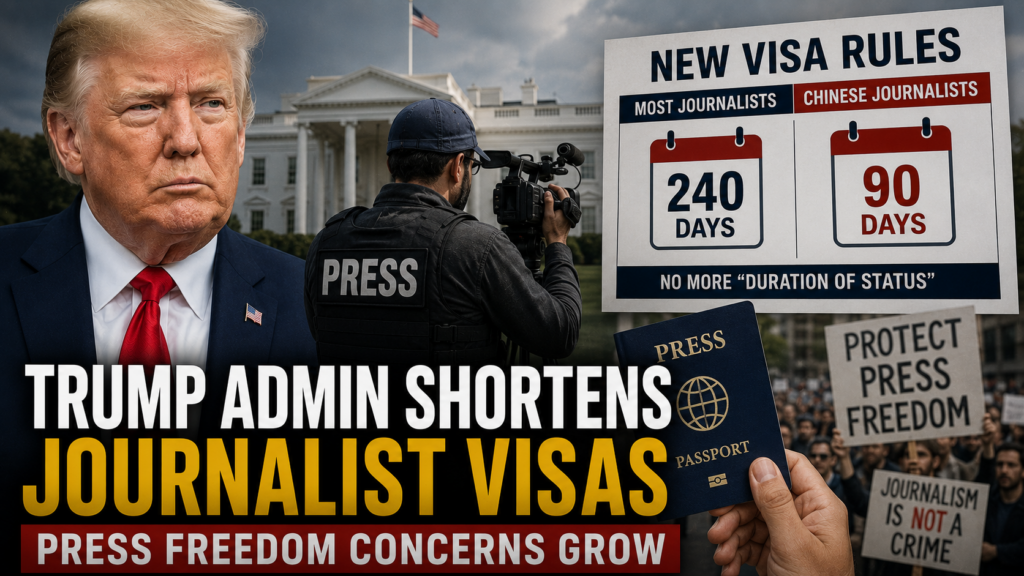
The Trump administration has announced new visa restrictions that significantly reduce the length of stay for foreign journalists working in the United States. Under the new policy, most journalist visas will be limited to 240 days, while Chinese journalists will face a 90-day limit, prompting criticism from press freedom organizations.
According to a report by European Federation of Journalists, the Department of Homeland Security’s new rule also changes visa policies for foreign students and cultural exchange visitors, with implementation scheduled 60 days after publication in the Federal Register.
What Happened?
The Department of Homeland Security announced that foreign journalists holding nonimmigrant I visas will no longer benefit from the long-standing “duration of status” system.
Instead, journalist visas that previously could remain valid for several years will now generally be limited to 240 days, while journalists from China will receive visas valid for only 90 days.
The administration also introduced changes affecting international students and cultural exchange visitors, limiting many of those visas to four years.
Officials said the new policy will take effect 60 days after it is officially published in the Federal Register.
Key Details of the Visa Changes
The revised policy eliminates the “duration of status” framework that previously allowed foreign journalists to remain in the United States as long as they continued to meet visa eligibility requirements.
The change is expected to affect thousands of international journalists and their families currently working in the United States under I visas.
This is not the first time such a policy has been proposed. During President Trump’s first administration, a similar proposal was introduced in 2020 but was later withdrawn after President Joe Biden took office in 2021.
The visa policy follows broader immigration and administrative initiatives undertaken during Trump’s second term, including new federal employee discipline rules that have reshaped several areas of federal policy.
Press Freedom Organizations Voice Opposition
The European Federation of Journalists (EFJ) strongly criticized the new visa restrictions, arguing they could discourage independent reporting.
EFJ President Maja Sever said the shortened visa periods are not based on objective criteria and warned that repeated visa renewal requirements could place additional pressure on foreign correspondents.
The organization argues that journalists may become concerned about future visa approvals, creating conditions that could encourage self-censorship among international media working in the United States.
The EFJ has urged Congress to reject the proposed rule, describing it as harmful to press freedom.
Potential Impact
Media organizations say the policy could create greater administrative burdens for international news outlets that maintain correspondents in the United States.
Frequent visa renewals may increase operational costs while creating uncertainty for journalists covering U.S. politics, government, and international affairs.
The policy also arrives as the administration continues implementing broader national security and government reforms, including Trump’s election security measures affecting federal operations.
What Happens Next?
The new visa rule is scheduled to take effect 60 days after publication in the Federal Register unless modified through the regulatory process.
Press freedom organizations are expected to continue lobbying Congress and federal officials to reconsider the policy, while media organizations assess how the shortened visa periods could affect long-term reporting operations in the United States.
The outcome may influence future debates over immigration policy, international media access, and the balance between national security priorities and press freedom.
Foreign journalist visas will generally be limited to 240 days, while Chinese journalists will receive visas valid for only 90 days.
They argue that frequent visa renewals could create administrative pressure and encourage self-censorship among foreign correspondents.