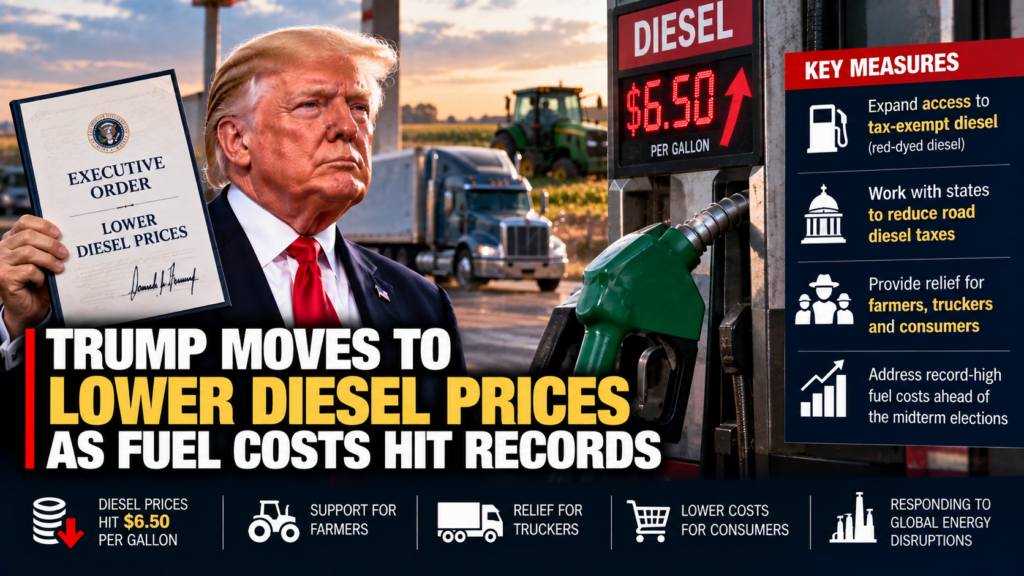
President Donald Trump is preparing an executive order aimed at lowering diesel prices by expanding access to tax-exempt fuel as record-high costs put pressure on American farmers, truckers and consumers ahead of the November midterm elections.
According to a report by Politico, the Trump administration is taking action to address surging diesel prices as the cost of the fuel continues to create economic and political pressure.
Trump Considers Expanding Access to Tax-Exempt Diesel
One of the measures under consideration would expand the use of tax-exempt diesel, commonly known as red-dyed diesel.
Red-dyed diesel is generally exempt from the federal diesel excise tax and is primarily used for off-road purposes, including agricultural equipment and certain industrial operations. The administration is considering ways to make the fuel more accessible while potentially reducing some of the costs associated with diesel use.
The executive order could also direct the Department of Transportation to work with states on measures that could reduce road diesel taxes.
The goal is to provide relief as diesel prices remain significantly higher than they were earlier in the year.
Why Diesel Prices Have Risen
Diesel prices have surged because of disruptions in global energy markets and geopolitical conflicts.
The conflict involving Iran and the continuing war in Ukraine have affected fuel supplies and international energy markets. Attacks on refineries in Russia and the Middle East have also contributed to concerns about refined fuel availability.
Diesel prices reached roughly $6.50 per gallon at their recent peak, placing significant pressure on industries that depend heavily on diesel.
The increase is particularly important because diesel powers much of the country’s freight transportation system. Higher fuel costs can therefore affect not only truck drivers and shipping companies but also the prices consumers pay for food, goods and other products.
Farmers and Truckers Face Growing Pressure
Farmers are among the groups most exposed to higher diesel costs because agricultural machinery depends heavily on diesel fuel.
Truckers and freight companies are also facing higher operating expenses. Since trucks move a large share of goods across the United States, sustained increases in diesel prices can eventually work their way through the broader economy.
The administration’s proposed action is therefore designed to address more than fuel prices alone. Lower diesel costs could potentially reduce operating expenses across several industries.
The White House has also been under pressure to respond to fuel costs as lawmakers and industry groups debate additional measures.
Trump Administration Shifts Focus From Diesel Export Ban
The administration had previously considered restricting U.S. diesel exports as a way to increase domestic supply and lower prices.
However, that approach has become less prominent following an agreement among G7 countries to release up to 100 million barrels of oil and fuel reserves.
Instead, the administration is now considering measures focused more directly on domestic fuel costs.
Agriculture Secretary Brooke Rollins has also indicated that diesel prices have recently declined somewhat, although she said additional action was still needed.
Diesel Prices Become a Political Issue
The sharp increase in diesel prices has created political pressure for the Trump administration.
Republican lawmakers have raised concerns that expensive fuel could hurt farmers, transportation companies and consumers before the November midterm elections.
The administration’s proposed actions could therefore serve both an economic and political purpose. Providing relief at the pump could help reduce pressure on businesses and households while demonstrating that the White House is responding to rising costs.
However, the effectiveness of the measures will depend on how quickly they can affect the price consumers actually pay for diesel.
What Happens Next?
The Trump administration is expected to continue working on measures aimed at lowering diesel prices and reducing the economic impact of high fuel costs.
Any expansion of tax-exempt diesel access would need to be coordinated with federal and state authorities. The administration could also consider additional policies if fuel prices remain elevated.
For now, the focus remains on increasing access to lower-cost fuel while avoiding policies that could further disrupt domestic fuel markets.
Conclusion
Diesel prices have become an increasingly important economic issue as elevated fuel costs affect transportation, agriculture and consumer prices.
The Trump administration’s planned action on tax-exempt diesel represents one of its latest attempts to provide relief. Whether it can produce meaningful savings will depend on implementation, fuel supply conditions and developments in global energy markets.
With fuel costs also becoming a political concern ahead of the midterms, the administration is likely to face continued pressure to demonstrate that its policies can deliver tangible relief.
Related Reading
- White House Weighs Red-Dyed Diesel Tax Relief to Lower Fuel Prices
- Wall Street Falls as Oil Rises After Trump Rejects Iran Proposal
Diesel prices have risen amid global supply disruptions linked to conflicts in Iran and Ukraine and attacks on refineries.
The administration is preparing measures that could expand access to tax-exempt red-dyed diesel and potentially reduce road-diesel taxes.