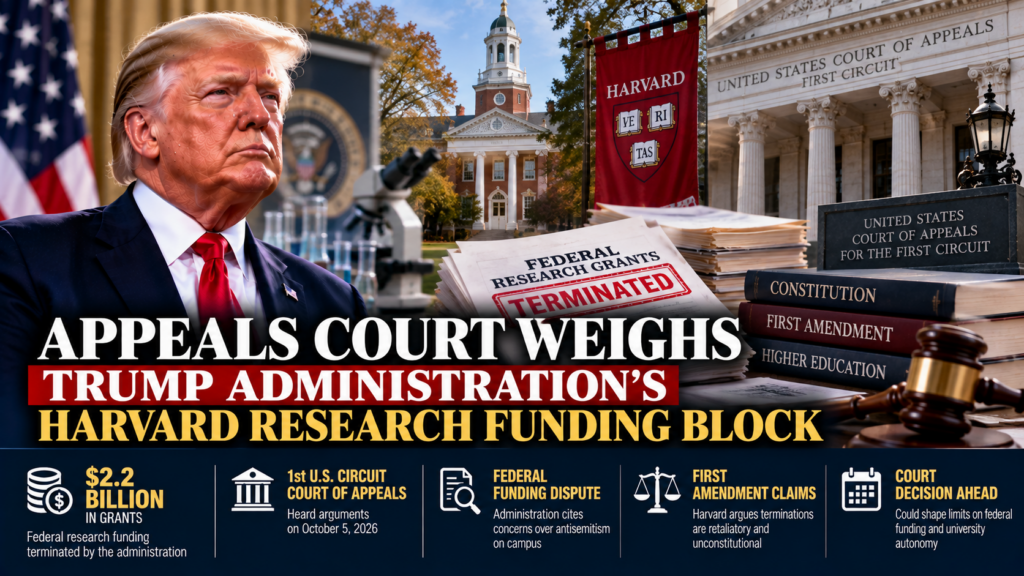
A U.S. appeals court is weighing whether the Trump administration can terminate more than $2 billion in federal research funding awarded to Harvard University. The case could help define how far the federal government can go when using funding to pressure universities.
What Happened
On October 5, the Boston-based 1st U.S. Circuit Court of Appeals heard arguments over the Trump administration’s effort to restore the termination of Harvard’s federal grants.
According to a report by Reuters, Justice Department lawyer Michael Velchik argued that the government has the authority to withhold federal funding if Harvard does not do enough to combat antisemitism on campus.
The administration ultimately terminated about $2.2 billion in Harvard grants after first freezing the funding in 2025.
Why the Trump Administration Blocked Harvard Funding
The dispute began after Trump administration officials sent Harvard a list of 10 demands in April 2025.
The demands included ending diversity, equity and inclusion programs. They also called for third-party auditors to monitor academic departments for viewpoint diversity.
Harvard President Alan Garber rejected the demands. He argued that the government should not dictate what private universities teach, whom they admit or hire, or what areas of research they pursue.
The administration then froze federal grants, citing Harvard’s alleged failure to adequately address harassment of Jewish students during campus protests related to the Israel-Hamas conflict.
Harvard Claims Retaliation
Harvard challenged the funding termination in court. The university argued that the administration’s actions amounted to retaliation for constitutionally protected speech under the First Amendment.
Harvard lawyer Paul Clement told the appeals court that the university has a right to be free from unconstitutional conditions beyond its contractual rights to federal grants.
Judge Sandra Lynch, one of the three judges on the appeals panel, appeared receptive to Harvard’s argument that the grant terminations were retaliatory. She questioned the lack of findings or an investigation before the administration announced the funding cuts.
A lower court previously ruled in Harvard’s favor. U.S. District Judge Allison Burroughs concluded that the administration had used antisemitism as a pretext for what she characterized as an ideologically motivated campaign against elite universities.
Justice Department Defends Funding Authority
The Justice Department has argued that the federal government is not required to continue providing taxpayer funds to universities that it believes have failed to address antisemitic conduct and discrimination.
The department has also challenged the lower court’s jurisdiction. It argues that disputes over the grant terminations should instead be handled by the U.S. Court of Federal Claims in Washington, D.C.
The appeals court’s decision could address both the administration’s authority over federal funding and the proper court for challenging those decisions.
What Happens Next
The appeals court’s ruling could have consequences beyond Harvard. The case could help determine whether a presidential administration can use federal research funding as leverage to push universities to make institutional or policy changes.
Harvard is also facing other legal battles with the Trump administration. A separate lawsuit alleging that the university failed to protect Jewish students from harassment was dismissed by a judge in August.
The broader dispute puts federal research funding, university autonomy and First Amendment protections at the center of a major legal conflict between the Trump administration and higher education institutions.
Related Reading
- Trump Administration Moves to Claw Back $810 Million in Spending
- White House Expands Taxpayer-Paid Ad Campaign Boosting Trump
The administration cited Harvard’s alleged failure to adequately address antisemitism and harassment of Jewish students on campus.
The Trump administration ultimately terminated about $2.2 billion in federal grants awarded to Harvard.