The American media landscape has become increasingly polarized, with audiences gravitating toward outlets that reinforce their existing political beliefs. Understanding the dynamics of conservative media vs liberal media is essential for anyone seeking comprehensive coverage of presidential administrations, policy decisions, and political developments. This divide affects how Americans perceive presidential actions, interpret policy proposals, and ultimately participate in democratic processes. As media fragmentation accelerates in 2026, recognizing these differences has become more critical than ever for informed citizenship.
The Historical Evolution of Political Media Bias
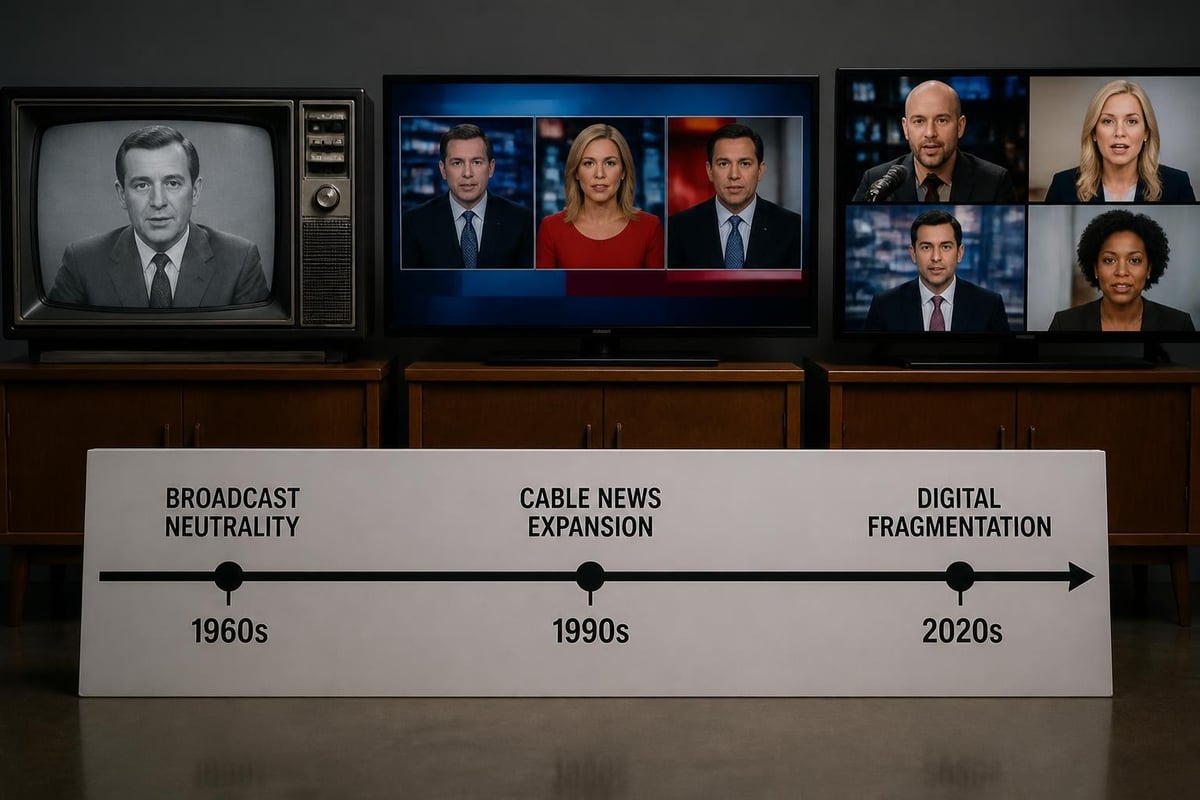
The divide between conservative media vs liberal media did not emerge overnight. Traditional broadcast networks maintained relative neutrality through the mid-20th century, constrained by Federal Communications Commission fairness requirements and limited channel availability. The elimination of the Fairness Doctrine in 1987 opened the door for explicitly partisan programming.
Cable news revolutionized political coverage in the 1980s and 1990s, creating 24-hour news cycles that demanded constant content. This demand led networks to develop distinct editorial perspectives to differentiate themselves in an increasingly crowded marketplace. Research on media bias dynamics shows that bias is not static but evolves based on competitive pressures and audience expectations.
The Rise of Digital Platforms
The internet fundamentally transformed how Americans consume political news. Digital platforms allowed niche outlets to thrive without the overhead costs of traditional broadcasting. Conservative media found early success online, building communities around talk radio personalities and emerging digital-first publications.
Liberal media similarly expanded its digital footprint, with established outlets developing robust online presences and new digital-native publications emerging. This expansion created echo chambers where audiences could exclusively consume content aligned with their worldview.
Identifying Bias in Presidential Coverage
When examining conservative media vs liberal media coverage of presidential administrations, several distinct patterns emerge. These differences manifest in story selection, framing, source citation, and emphasis on particular policy areas.
Story Selection Differences:
- Conservative outlets prioritize immigration enforcement, economic regulation, and religious liberty
- Liberal outlets emphasize climate policy, healthcare access, and social justice initiatives
- Both demonstrate selective coverage of presidential scandals based on party affiliation
- National security stories receive different emphasis depending on administration alignment
Framing and Language Choices
The way outlets frame identical events reveals underlying bias. A presidential executive order might be described as "decisive leadership" by sympathetic outlets or "executive overreach" by critics. These framing choices shape audience perception before presenting factual details.
Studies examining media bias measurement demonstrate that question formulation and presentation significantly affect how audiences assess bias in news coverage. The language choices extend beyond obvious editorializing to subtle word selection in supposedly objective reporting.
| Coverage Element | Conservative Framing | Liberal Framing |
|---|---|---|
| Immigration Policy | Border security, rule of law | Humanitarian crisis, family separation |
| Economic Regulation | Job-killing restrictions | Consumer protections |
| Healthcare Policy | Government overreach | Universal coverage expansion |
| Foreign Policy | Strength, deterrence | Diplomatic engagement |
Audience Segmentation and Media Consumption Patterns
The conservative media vs liberal media divide has created distinct audience segments with minimal overlap. Research on audience fragmentation indicates that cable and network news audiences have become increasingly segregated, impacting shared understanding of political events.
Most Americans now consume news from sources that align with their political preferences. This self-selection creates reinforcing feedback loops where outlets cater to existing audience beliefs to maintain viewership and advertising revenue.
Demographic Differences
Conservative media audiences skew older, with traditional cable news viewership concentrated among Americans over 50. These audiences demonstrate higher trust in established conservative outlets and talk radio personalities. They value commentary that validates concerns about cultural change and government expansion.
Liberal media audiences show more age diversity, with younger demographics favoring digital platforms over traditional broadcast. These audiences prioritize coverage of social justice issues, environmental policy, and systemic inequality. They demonstrate skepticism toward institutions perceived as maintaining status quo power structures.
Trust Metrics Across the Divide:
- Conservatives express highest trust in Fox News, talk radio, and religious broadcasting
- Liberals demonstrate highest trust in NPR, PBS, and major newspapers
- Both groups show declining trust in outlets perceived as centrist
- Crossover consumption has decreased significantly since 2020
Economic Incentives Shaping Coverage
Understanding conservative media vs liberal media requires examining the business models driving content decisions. Analysis of media bias types distinguishes between ideological bias and spin, with both influenced by economic considerations.
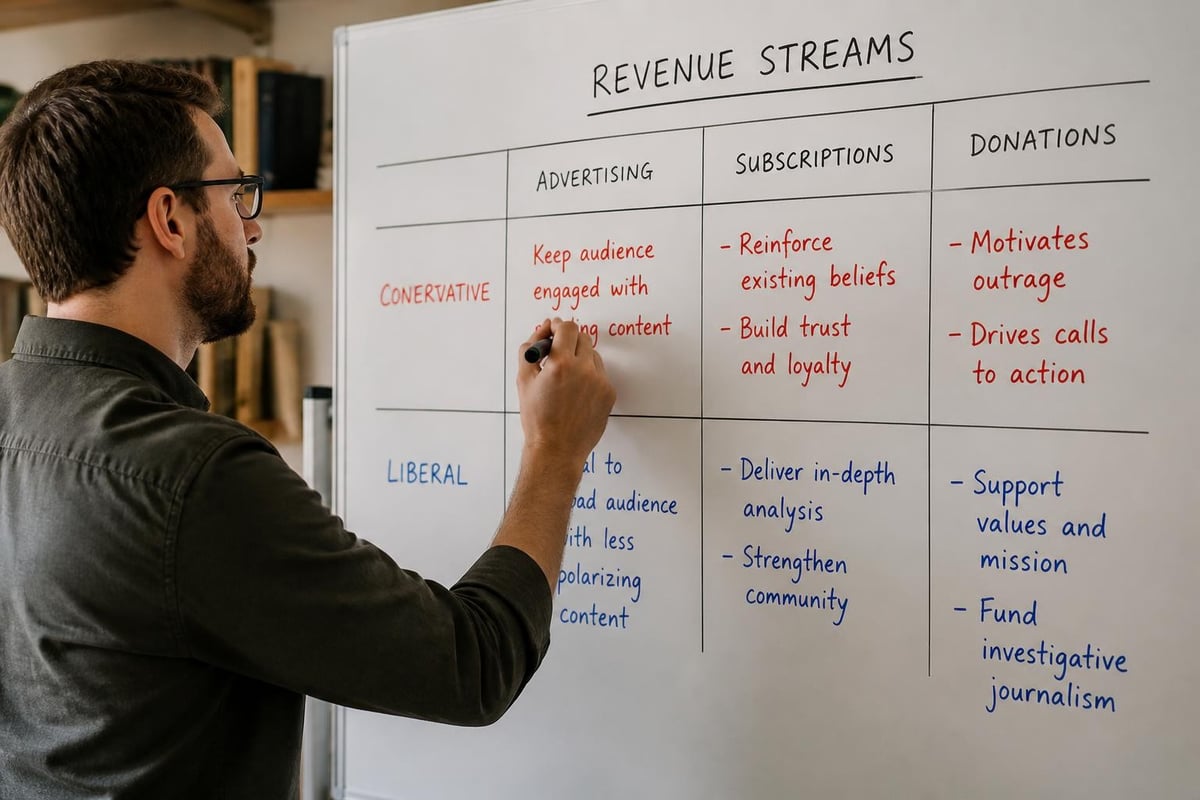
Advertising revenue remains the primary funding mechanism for most outlets, creating incentives to maintain audience loyalty through content that confirms existing beliefs. Research on advertiser influence demonstrates that newspapers provide less critical coverage of their advertisers, illustrating how economic relationships shape editorial decisions.
Subscription Models and Partisan Loyalty
Digital subscriptions have become increasingly important revenue sources, particularly for print publications transitioning online. This shift incentivizes outlets to deepen connections with core audiences rather than broaden appeal. Subscribers expect consistent political perspectives aligned with their values.
Conservative outlets have built successful subscription models around premium commentary and insider political analysis. Liberal outlets similarly monetize in-depth investigative reporting and expert analysis from progressive perspectives. Both approaches reinforce partisan divisions by rewarding outlets for serving narrow audience segments.
Presidential Coverage Through Partisan Lenses
Coverage of presidential administrations represents the starkest contrast in conservative media vs liberal media approaches. The same presidential action receives dramatically different treatment depending on outlet perspective and presidential party affiliation.
During Republican administrations, conservative outlets emphasize economic achievements, judicial appointments, and foreign policy strength. U.S. Presidential Report provides non-partisan coverage that allows readers to compare these different perspectives. Liberal outlets during the same period focus on policy impacts on vulnerable populations, environmental rollbacks, and democratic norms.
The Inverse During Democratic Administrations
The pattern reverses completely under Democratic presidents. Liberal outlets celebrate progressive policy achievements, executive actions addressing climate change, and expanded social programs. Conservative outlets emphasize government spending, regulatory burdens, and concerns about constitutional limits.
This partisan flip demonstrates that bias stems less from consistent ideological principles than from team loyalty. Issues that conservative media treats as critical threats under Democratic leadership receive minimal attention under Republican presidents, and vice versa.
Detection and Classification of Media Bias
Advances in computational analysis have enabled more systematic examination of media bias patterns. The Media Bias Identification Benchmark provides a framework for testing bias detection techniques across different bias types.
Researchers now analyze word choice, source selection, topic emphasis, and framing patterns to quantify bias levels. These tools reveal that most outlets demonstrate measurable bias, though degrees vary significantly. The challenge lies in distinguishing between perspective-based reporting and deliberate misinformation.
Practical Tools for News Consumers
Several organizations provide media bias ratings to help audiences navigate the conservative media vs liberal media landscape. These resources categorize outlets along the political spectrum and assess factual accuracy separately from political lean.
Evaluation Criteria Include:
- Source diversity in reporting
- Distinction between news and opinion content
- Correction policies and transparency
- Use of loaded language
- Story selection patterns
Understanding these evaluation frameworks helps audiences recognize bias in their preferred sources and seek complementary perspectives. No outlet is completely neutral, but awareness of bias patterns enables more critical consumption.
The Impact on Democratic Discourse
The conservative media vs liberal media divide has profound implications for American democracy. When citizens consume entirely different information ecosystems, they develop incompatible understandings of basic facts about presidential actions and policy outcomes.
This fragmentation undermines the shared reality necessary for productive democratic debate. Citizens cannot meaningfully deliberate about policy trade-offs when they disagree about fundamental questions of what occurred and why.
Presidential Accountability Challenges
Media polarization affects presidential accountability mechanisms. Partisan outlets provide cover for aligned presidents while aggressively scrutinizing opposition administrations. This creates asymmetric accountability where presidential missteps receive vastly different coverage depending on party affiliation.
The public relies on media to monitor presidential power and inform electoral decisions. When outlets function primarily as partisan advocates, this watchdog role diminishes. Scandals that should transcend party lines instead become fodder for partisan interpretation.
| Democratic Function | Impact of Media Polarization |
|---|---|
| Information Distribution | Fragmented, contradictory narratives |
| Agenda Setting | Parallel partisan priorities |
| Accountability | Asymmetric based on party |
| Public Deliberation | Reduced common ground |

Navigating Media Bias as an Informed Citizen
Recognizing the conservative media vs liberal media divide is the first step toward more informed news consumption. Citizens committed to understanding presidential governance must actively seek diverse perspectives and cross-check information across sources.
Strategies for Balanced Consumption
Consuming news from across the political spectrum requires intentional effort but yields more complete understanding. Start by identifying your own biases and the outlets that reinforce them, then deliberately seek alternative perspectives on major stories.
Compare how different outlets cover the same presidential speech, policy announcement, or political event. Note which facts appear consistently across sources versus which claims appear only in partisan outlets. This comparative approach reveals areas of genuine disagreement versus disputed facts.
Practical Steps for Media Literacy:
- Follow at least two outlets from different political perspectives
- Distinguish between news reporting and opinion commentary
- Verify major claims through multiple independent sources
- Recognize emotional manipulation techniques in partisan coverage
- Seek primary sources like presidential speeches and official documents
Reading presidential statements directly, rather than through media interpretation, provides unfiltered access to administration messaging. Official White House transcripts and policy documents allow independent assessment before consuming media analysis.
The Role of Non-Partisan Outlets
While the conservative media vs liberal media divide dominates attention, non-partisan outlets serve crucial functions in the information ecosystem. These organizations prioritize factual accuracy over ideological consistency and maintain strict separation between news and opinion content.
Non-partisan coverage of presidential administrations focuses on policy mechanics, implementation details, and measurable outcomes. Rather than emphasizing whether policies are good or bad, these outlets explain what policies actually do and who they affect.
Challenges Facing Neutral Coverage
Maintaining non-partisan status has become increasingly difficult in the current media environment. Audiences accustomed to partisan validation often perceive neutral coverage as biased against their perspective. Outlets face pressure to choose sides to maintain audience engagement and revenue.
Additionally, the concept of objectivity itself has come under scrutiny, with critics arguing that false balance between unequal positions can mislead audiences. The challenge lies in distinguishing between perspectives deserving equal weight and manufactured controversies designed to muddy waters.
Social Media's Amplification Effect
Social media platforms have intensified the conservative media vs liberal media divide by creating algorithm-driven filter bubbles. Users primarily see content shared by like-minded connections, reinforcing existing beliefs and shielding them from contrary perspectives.
Presidential news spreads through partisan networks with minimal cross-pollination. A policy announcement generates completely different social media conversations in conservative versus liberal spaces, with each group consuming content that confirms their preexisting views.
Viral Misinformation Dynamics
The speed of social media sharing enables misinformation to spread before fact-checks can circulate. Partisan outlets sometimes publish misleading headlines or decontextualized clips that generate engagement before corrections emerge. By the time accurate information appears, the false narrative has already shaped audience perceptions.
This dynamic particularly affects presidential coverage, where high stakes and strong emotions accelerate sharing of content that portrays opposition presidents negatively. Users share stories that align with their biases without verifying accuracy, contributing to widespread misconceptions about presidential actions.
Looking Toward the Future of Political Media
The conservative media vs liberal media landscape continues evolving as technology and audience preferences shift. Traditional broadcast continues declining while digital platforms gain prominence, creating opportunities for new entrants and business models.
Some observers hope that economic pressures will eventually push outlets toward broader audiences, moderating partisan extremes. Others predict further fragmentation as niche outlets serve increasingly specific audience segments with precisely tailored content.
Emerging Technologies and Media Consumption
Artificial intelligence and personalization algorithms may deepen existing divides by serving each user perfectly customized content. Alternatively, these technologies could help audiences discover quality information outside their normal consumption patterns.
The rise of podcasting and video content creates new formats for political analysis, some emphasizing partisan advocacy and others prioritizing depth and nuance. These formats allow for longer-form exploration than traditional broadcast constraints permitted.
Visualization research on media bias explores how better communication of bias patterns might enhance consumer awareness and understanding. As audiences become more sophisticated about media literacy, demand for transparent, accountable journalism may grow.
Implications for Presidential Elections
The conservative media vs liberal media divide significantly impacts presidential campaigns and elections. Candidates must navigate parallel media ecosystems with different gatekeepers, norms, and audience expectations. A message that resonates in conservative outlets may fall flat or generate backlash in liberal spaces.
Campaign coverage demonstrates the starkest partisan differences, with outlets emphasizing scandals affecting opposition candidates while minimizing concerns about aligned candidates. This creates information asymmetry where voters exposed only to partisan sources receive incomplete pictures of candidate strengths and weaknesses.
Presidential debates represent rare moments where candidates must simultaneously address both conservative and liberal audiences. However, post-debate coverage immediately fragments along partisan lines, with each ecosystem declaring their preferred candidate victorious regardless of performance.
Election Coverage Disparities:
- Poll coverage emphasizes results favorable to aligned candidates
- Opposition research receives amplification in partisan outlets
- Policy proposals receive different levels of scrutiny
- Candidate gaffes generate asymmetric attention
Media Bias and Policy Understanding
Beyond elections, the conservative media vs liberal media divide affects how Americans understand presidential policy proposals and implementations. Complex policies like healthcare reform, tax legislation, or environmental regulation require detailed explanation to assess trade-offs and likely impacts.
Partisan outlets typically present simplified narratives emphasizing benefits for aligned policies and costs for opposition policies. This oversimplification prevents audiences from developing nuanced understanding necessary for informed participation in democratic processes.
For example, coverage of presidential budget proposals varies dramatically across partisan outlets. Conservative media emphasizes spending levels and deficit impacts, while liberal outlets focus on program funding and beneficiary populations. Both perspectives offer partial truth, but complete understanding requires engaging with both frames.
Understanding the dynamics of conservative media vs liberal media empowers citizens to navigate our polarized information environment more effectively and develop more complete pictures of presidential governance. While partisan outlets will continue serving distinct audiences, informed citizens can actively seek diverse perspectives and primary sources to transcend these divisions. U.S. Presidential Report offers non-partisan coverage of presidential news, policy developments, and political matters, helping readers access balanced information about current and past administrations without partisan filtering.